
Sound familiar?
Many US manufacturers struggle because their most valuable operational data never talks to itself. A machine controller doesn't know what the MES knows. The MES doesn't know what the ERP knows. And by the time someone stitches it all together manually, the insight is already stale.
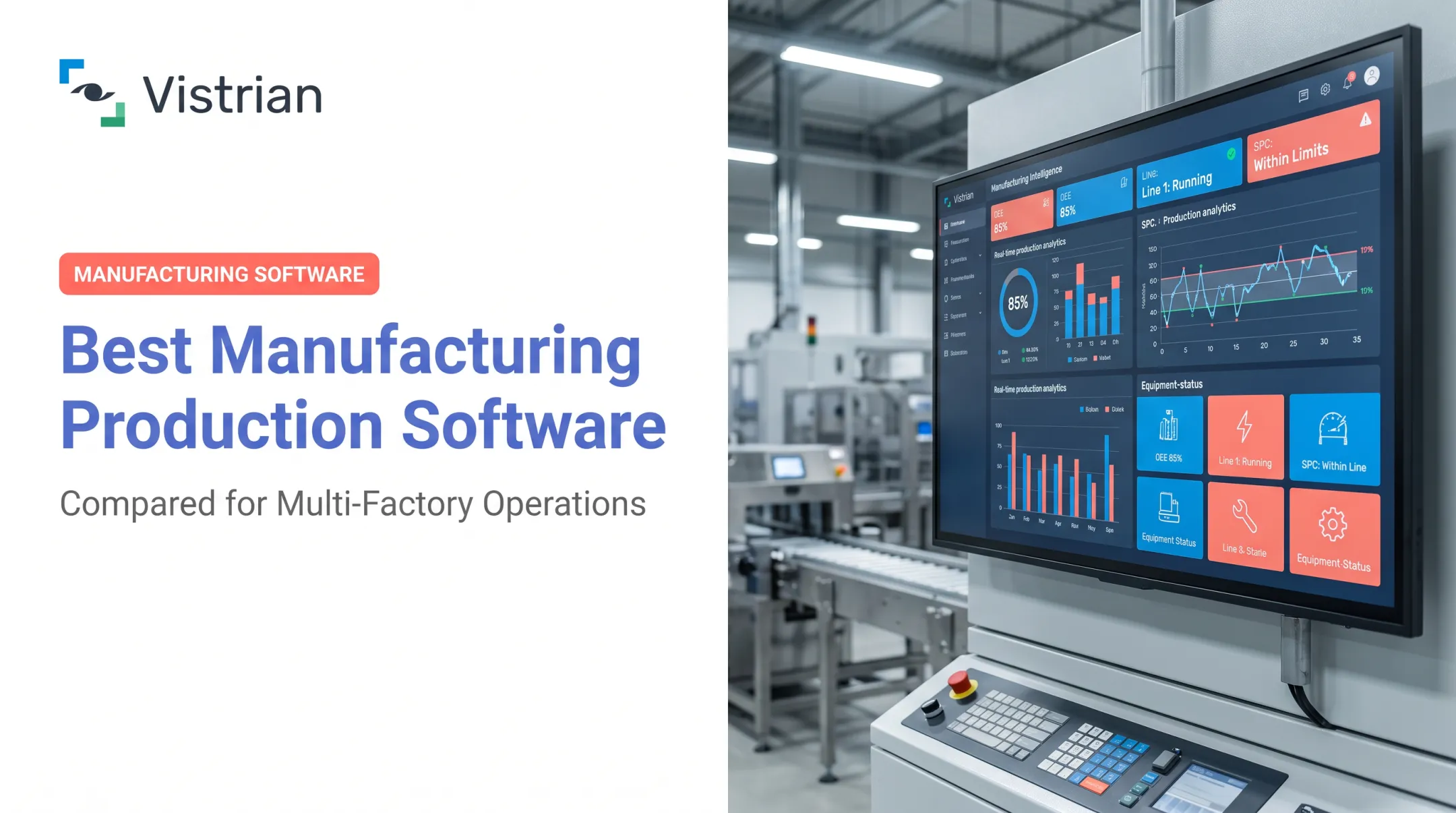
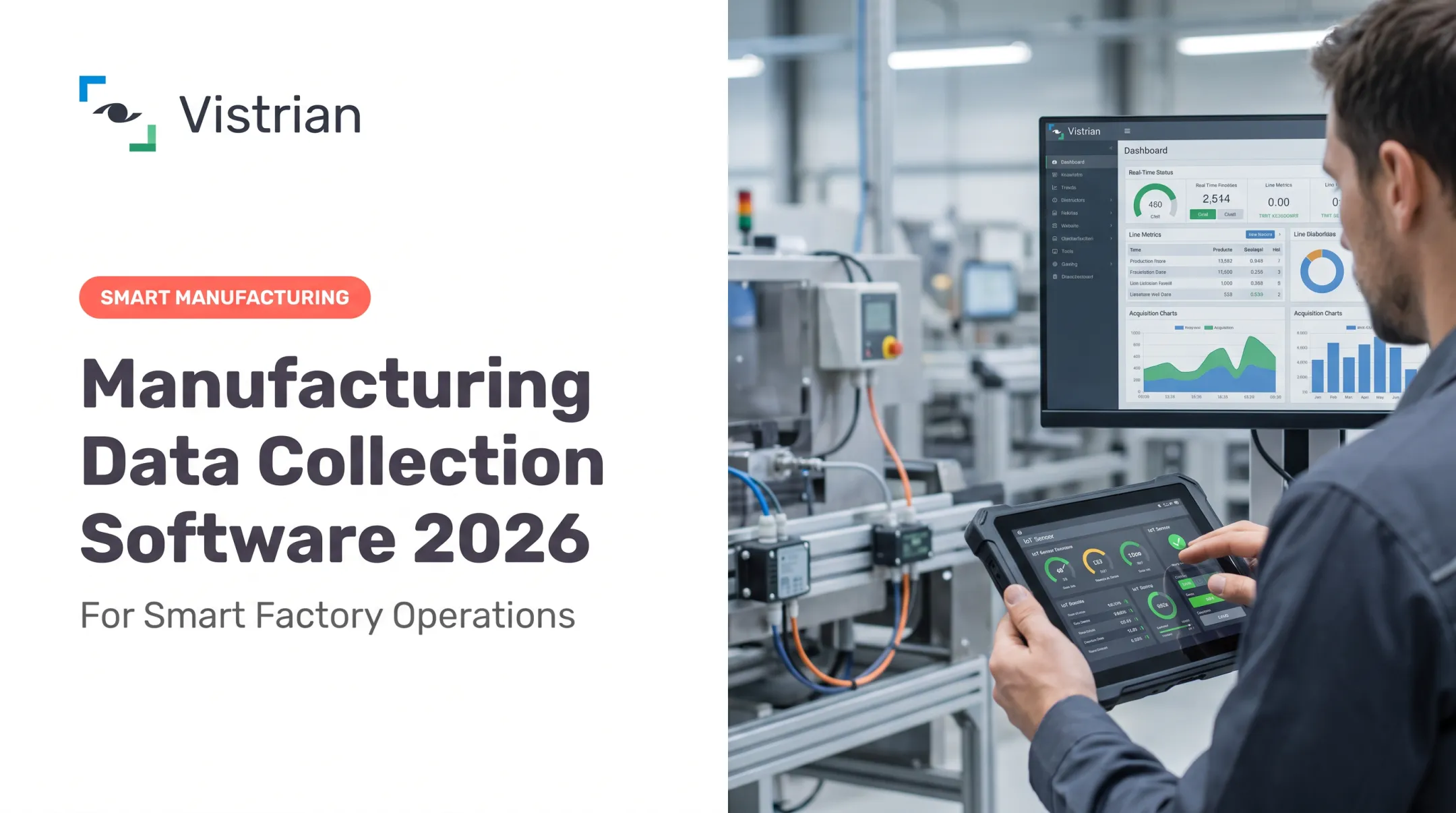
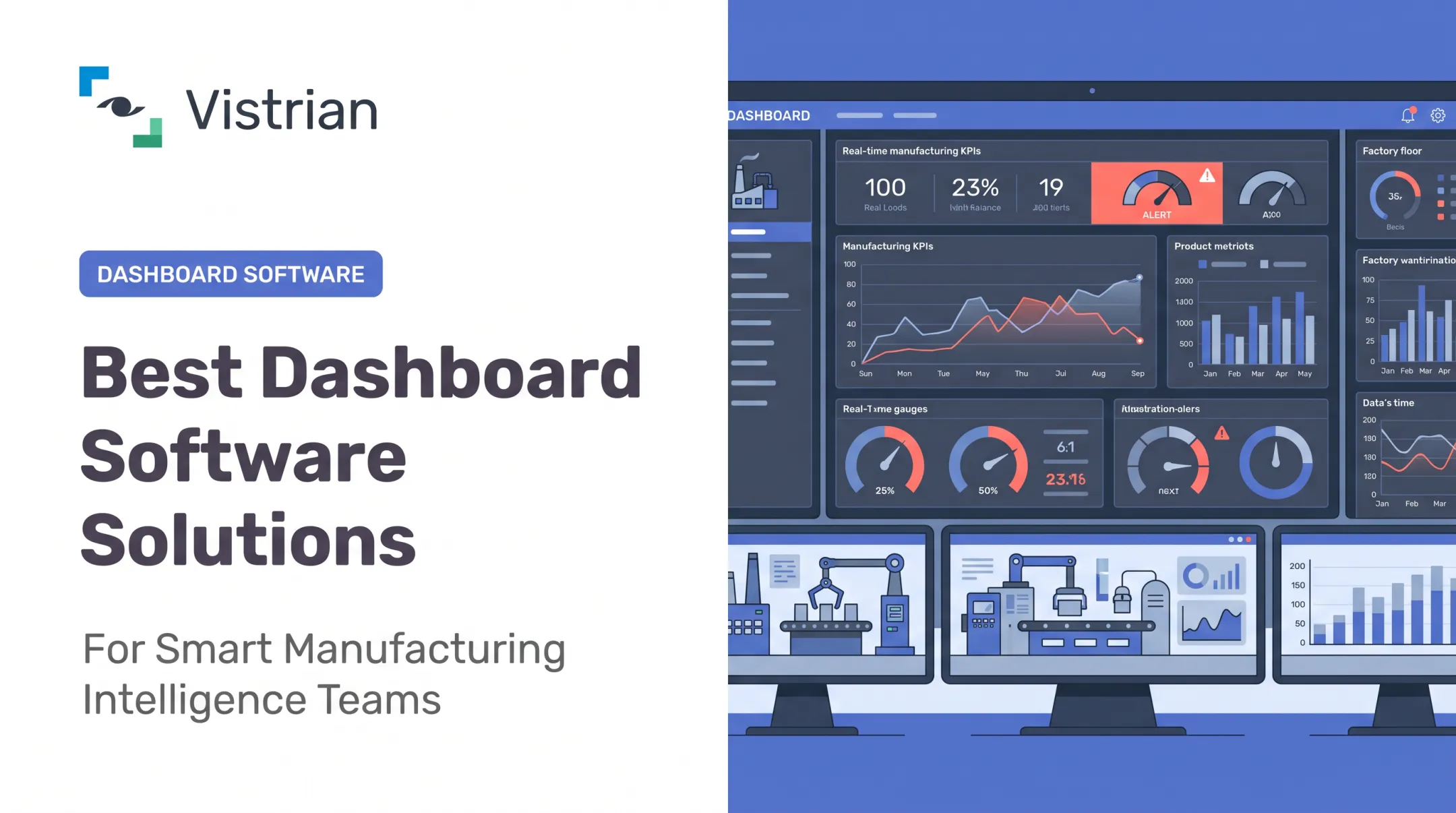
Manufacturing analytics software solves this by turning scattered operational data into something teams can actually act on, improving equipment utilization, throughput, yield, OEE, downtime response, and cost control.
This guide compares five platforms across connectivity, analytics depth, scalability, and deployment fit. Features and pricing change fast, so verify specifics directly with each vendor before you commit.
Key Takeaways
- Unify factory-floor data with operational and business systems—not just historical charts.
- Match the platform to your goal: machine monitoring, OEE, predictive maintenance, quality, or multi-site visibility.
- Prioritize legacy equipment compatibility, data governance, ERP/MES/CMMS integration, and implementation support.
- Vistrian Manufacturing Suite (FactoryLOOK) delivers real-time visibility across equipment, maintenance, and enterprise systems.
Overview of Manufacturing Analytics in the US Market
Manufacturing analytics software collects, contextualizes, and analyzes data from equipment, sensors, production systems, quality processes, maintenance workflows, and supply chains. It turns raw machine signals into decisions a plant manager can act on before a shift ends—not weeks later in a report.
Four Types of Analytics, Four Questions
Every analytics platform falls somewhere on this spectrum:
- Descriptive — What happened? (OEE dashboards, scrap counts, cycle-time trends)
- Diagnostic — Why did it happen? (downtime-by-reason breakdowns, defect correlation)
- Predictive — What might happen next? (failure forecasting, demand prediction)
- Prescriptive — What action should we take? (automated scheduling adjustments, maintenance triggers)
The US Context
American manufacturers face a specific set of pressures: aging equipment mixed with new IIoT-enabled machines, tightening labor markets, and pressure to modernize without ripping out working systems.
Deloitte's 2025 Smart Manufacturing Survey found that 57% of large US manufacturers already use data analytics at the facility or network level, with reported gains of 10-20% in production output and 10-15% in unlocked capacity.
The same survey noted that nearly half of manufacturers struggle to fill production and operations-management roles. Software that cuts manual data-wrangling directly eases that pressure.
No single platform wins every plant. Rank options by fit with your equipment, existing systems, and the decisions you need on the floor this quarter.
Top Manufacturing Analytics Software in 2026
We evaluated each platform on real-time data collection, machine connectivity, analytics/KPI coverage, predictive capabilities, usability, scalability, deployment model, and proven manufacturing use cases.
Vistrian Manufacturing Suite / FactoryLOOK
Vistrian's Manufacturing Suite is a modular, cloud-enabled platform built around FactoryLOOK, its core data-acquisition and connectivity layer, paired with Vistrian Dashboards, Vistrian Analytics, and Vistrian Industrial IoT.
What sets it apart:
- FactoryLOOK connects to machine controllers, logs, databases, standard protocols, and IIoT sensors—including controllers as old as 40 years
- Vistrian Analytics tracks OEE, throughput, utilization, yield, cycle time, and SPC, with a rules engine that flags anomalies and triggers threshold alerts
- Root-cause analysis is built into the platform, so teams can trace losses without a separate tool
In one deployment, a major North American chocolate manufacturer used FactoryLOOK to trace a persistent bottleneck to plumbing between refiners and holding tanks—not the refiners themselves—avoiding over $1 million in unnecessary capital spending.
The suite fits discrete plants, semiconductor and electronics operations, process manufacturers, and multi-plant teams running mixed-vendor equipment. Ian Chizmar, an MTS Systems Architect at Soraa, noted easy integration with legacy fab equipment and existing MES. Western Digital reported a similarly smooth rollout across varied equipment types.
| Attribute | Details |
|---|---|
| Deployment | Cloud-enabled, modular; on-premises supported |
| Primary analytics | OEE, throughput, utilization, yield, cycle time, SPC, root-cause |
| Equipment connectivity | PLCs, controllers, legacy systems, IIoT sensors |
| Integration scope | MES, CMMS, enterprise dashboards |
| Multi-site support | Deployed across 10+ countries in Asia and North America |
| Target plant profile | Small to large discrete, process, and semiconductor plants |
| Pricing | Not publicly listed; request a quote |
Verify current packaging and naming with Vistrian directly, as product bundles evolve.
Where it needs planning: Machines without digital interfaces need Vistrian's IIoT sensor layer first. Data standardization across departments remains an internal task, and multi-plant rollouts work best in phases.
MachineMetrics
MachineMetrics focuses tightly on machine-level data collection and production analytics, built primarily for discrete manufacturing environments running CNC and similar equipment.
Core capabilities include automated machine data collection, real-time production dashboards, downtime analysis, and OEE tracking. Its 2025 Max AI feature detects issues, supports shift handoffs, and unifies machine and ERP data.
It suits CNC shops, contract manufacturers, and precision or medical-device producers that want a focused deployment rather than a full operations suite.
| Attribute | Details |
|---|---|
| Primary use case | Machine monitoring, production tracking, OEE |
| Connectivity | Machine controllers, open APIs, hybrid Edge/Cloud architecture |
| Deployment | True SaaS, volume-based pricing |
| Integrations | ERP (including Epicor, Infor), inventory, maintenance systems |
| Reporting | Real-time dashboards, downtime and root-cause analysis |
| Ideal customer | Mid-to-large discrete manufacturers, CNC/multi-plant operations |
| Pricing | Subscription-based; demo required for quote |
Trade-off to weigh: MachineMetrics excels at machine and production data but does not natively cover broader ERP, quality management, or supply-chain functions. Plants that need those usually pair it with another system.
Siemens Insights Hub
Siemens Insights Hub (the platform formerly known as MindSphere) is built for industrial IoT data collection at scale, with named applications for OEE, Asset Health & Maintenance, Energy Manager, and Quality Prediction.
It fits industrial enterprises with complex assets, engineering-heavy operations, or existing Siemens equipment. Quality Prediction uses process data to flag likely defects and recommend parameter adjustments before rework starts.
| Attribute | Details |
|---|---|
| Core analytics | OEE, asset health, quality prediction, energy optimization |
| Industrial connectivity | Asset/time-series APIs, MindConnect, Integrated Data Lake |
| Deployment architecture | Public or private cloud; edge analytics available |
| Integrations | Siemens Industrial Edge, third-party via APIs |
| Target organization size | Large industrial enterprises |
| Implementation model | Varies by project; specialist configuration often needed |
| Pricing | Not publicly disclosed |
Trade-off to weigh: Insights Hub's depth brings complexity. Smaller manufacturers without dedicated OT or data teams often face steeper configuration and specialist skill needs. Some named applications may require separate Siemens licensing, so confirm scope before budgeting.
Tulip
Tulip approaches analytics from the frontline worker's perspective. It's a no-code platform for building operator-guided apps, paperless work instructions, and quality checks, with analytics layered on top of that workflow data.
Manufacturers that prioritize operator engagement and standardized processes—especially in pharmaceutical, aerospace, and medical-device settings—tend to choose it.
| Attribute | Details |
|---|---|
| Workflow capabilities | No-code apps, digital work instructions, quality checks |
| Analytics depth | Tulip Analytics, Tulip Tables, production tracking |
| Integrations | Hundreds of pre-built connectors for CNC, ERP, WMS |
| Deployment | Cloud, managed by Tulip |
| Target use cases | Frontline digitization, compliance, traceability |
| Scalability | Multi-site administration supported |
| Pricing | Essentials/Professional tiers; custom Enterprise pricing |
Trade-off to weigh: Tulip is strong on connected-worker workflows but lighter on dedicated historian features and enterprise-grade predictive analytics. Plants with heavy MES or ERP needs usually complement it with a broader system.
Plex Smart Manufacturing Platform
Plex bundles MES, quality management, and traceability into one platform for manufacturers who want execution data and analytics together instead of separate point solutions.
Its QMS spans Core, Advanced, Supplier, and Total tiers, with closed-loop quality management and real-time inventory tracking in the MES layer.
| Attribute | Details |
|---|---|
| Platform scope | MES, QMS, traceability, ERP connectivity |
| Analytics/KPI coverage | Real-time inventory, quality, AI-driven insights |
| Manufacturing modules | Quality, genealogy/traceability, production execution |
| Integrations | Full ERP and third-party system connectivity |
| Deployment | Multi-tenant SaaS; cloud and edge configurations |
| Target plant profile | Discrete, hybrid, and regulated industries |
| Pricing | Not publicly disclosed; demo-based |
Trade-off to weigh: Consolidating on one platform is appealing, but larger Plex deployments need real planning. Independent reviews praise usability while flagging implementation timelines and support costs, so budget time for change management.

How We Chose the Best Manufacturing Analytics Software
We combined first-party product documentation, current demos, independent review data, and customer references rather than relying on vendor marketing claims alone.
Our evaluation weighed five criteria:
- Connectivity and data architecture: Support for PLCs, historians, APIs, and standard industrial protocols, plus whether data normalizes into one shared model or stays siloed across systems.
- Analytics and manufacturing depth: OEE, downtime, throughput, yield, SPC, and root-cause capabilities, with AI or predictive claims backed by evidence rather than a feature name on a webpage.
- Usability and actionability: Whether insights trigger a maintenance ticket, scheduling change, or quality hold, not just role-based dashboards. As LNS Research's coverage of manufacturing execution systems notes, analytics should drive real-time fixes, not just historical reporting.
- Scalability, security, and implementation: Cloud vs. on-premises options, multi-plant administration, data ownership, and the realistic effort to clean up legacy data before go-live.
- Commercial fit: Pricing structures, licensing variables, and available ROI evidence.
Our recommendation across every platform reviewed: start with a high-value pilot, define baseline KPIs first, and expand from there rather than deploying everything at once.
Conclusion
The best manufacturing analytics software connects your actual equipment and systems to the decisions your team needs to make today—not the longest feature list on a vendor page.
Before you choose, compare:
- Real-time connectivity
- Analytics depth
- Usability and time-to-value
- Scalability across lines and sites
- Security and access controls
- Implementation effort
- Total cost of ownership
Favor vendors that show measurable outcomes, not only promised ones.
If your plant needs real-time visibility across legacy and modern equipment, OEE tracking, root-cause analysis, or consolidated reporting across multiple sites, Vistrian’s Manufacturing Suite is built for those requirements. Reach out to discuss your setup and see what fits.
Frequently Asked Questions
How is data analytics used in manufacturing?
Manufacturing analytics powers machine and sensor monitoring, OEE and KPI tracking, quality analysis, predictive maintenance, and production planning. It also supports bottleneck detection and root-cause analysis on the plant floor.
Which software is best for manufacturing companies?
It depends on plant size, equipment connectivity, existing ERP/MES systems, and budget. The five platforms reviewed here each fit different priorities, from machine-level monitoring to full MES replacement.
What are the top 5 data analysis tools?
Manufacturing platforms, general BI tools, and industrial IoT systems all get labeled “data analysis tools.” For manufacturing specifically, this article covers Vistrian, MachineMetrics, Siemens Insights Hub, Tulip, and Plex.
What is an analytics solution?
It's the combination of data sources, an integration layer, a data model, dashboards, alerts, and governance that together turn raw operational data into a decision someone can act on.
What are the four main types of analytics?
Descriptive shows what happened (an OEE dashboard). Diagnostic explains why it happened (downtime-reason correlation). Predictive estimates what comes next (failure forecasting). Prescriptive recommends the action (an automated maintenance trigger).
What are some examples of predictive analytics?
Common manufacturing examples include equipment failure prediction, demand forecasting, and downtime-risk estimation. NIST's research on predictive analytics frameworks notes these are probability-based estimates, not guaranteed outcomes.