
That gap between what's happening on the floor and what leadership actually knows about it costs real money. Manufacturing production software closes it by connecting planning to execution, giving teams visibility into uptime, throughput, yield, cycle time, and downtime as it happens, not after the fact.
This guide compares five production software options built for US manufacturers and walks through how to choose based on your manufacturing mode, plant complexity, integration needs, and total cost of ownership.
Key Takeaways
- Manufacturing production software spans ERP, MES, MRP, IIoT, and analytics — identify your operational problem before comparing vendors.
- The right platform balances production planning, shop-floor visibility, machine connectivity, quality tracking, and scalability.
- Vistrian Manufacturing Suite fits manufacturers needing modular, cloud-enabled visibility across equipment, OEE, and multiple facilities.
- Verify current pricing, implementation scope, integration capabilities, and customer references before shortlisting vendors.
Overview of Manufacturing Production Software in the US Market
Manufacturing production software is a broad category. It covers the digital tools used to plan, execute, monitor, and improve production. Production schedules, work orders, materials, equipment, labor, quality data, and reporting all fall under this umbrella.
But "production software" means different things depending on which layer of the plant you're trying to fix.
ERP, MES, MRP, and IIoT Aren't Interchangeable
Here's how the major categories break down:
- ERP coordinates enterprise-wide functions (finance, procurement, inventory, sales, and production planning) in one system.
- MES focuses on real-time execution and traceability at the shop-floor level.
- MRP centers on material requirements, purchasing, and production planning specifically.
- IIoT and analytics platforms connect equipment data to dashboards, alerts, OEE analysis, and root-cause investigation.
The ISA-95 standard places MES and related operations systems at Level 3, with ERP at Level 4. It is built primarily to define how those two levels talk to each other.
NIST's own guidance frames MES as manufacturing-operations-management software that accounts for inputs and outputs across the process. That is a distinct job from ERP's enterprise-wide planning role.
Where the Investment Is Actually Going
US manufacturers aren't treating this as optional anymore. Deloitte's 2025 Smart Manufacturing Survey of 600 large-manufacturer executives found:
- 78% allocated more than 20% of their overall improvement budget to smart manufacturing
- 88% expected that investment to hold steady or grow
- 57% already used cloud computing; 57% used data analytics
- 46% had IIoT deployed at the facility level
Near-term priorities skewed toward data analytics (40%), advanced production scheduling (35%), and execution systems (33%).

Which category fits depends heavily on your operation. A semiconductor fab, a discrete assembly plant, a food processor, and a make-to-order machine shop all have different bottlenecks.
They often need different combinations of these tools rather than one universal platform. The five products below represent distinct strengths: connected factory visibility, enterprise planning, complex manufacturing support, cloud scalability, and shop-floor execution.
Top Manufacturing Production Software for US Manufacturers
Before comparing platforms, define your criteria. Score each option against the factors that affect daily plant performance:
- Production functionality and shop-floor visibility
- Machine and system integration
- Analytics depth and scalability
- Usability and implementation effort
- Documented customer outcomes
Fit for your manufacturing environment matters more than brand recognition.
Vistrian Manufacturing Suite and FactoryLOOK
Vistrian was founded in 2003, with roots in semiconductor and data-storage manufacturing, environments where equipment downtime is expensive and margin for error is thin. That background shaped a modular Manufacturing Suite built around equipment data acquisition, IIoT connectivity, analytics, SPC, dashboards, alerts, and historian storage.
Why It Stands Out
The core strength is FactoryLOOK. It connects to PLCs, PC-based controllers, and equipment over standard industrial protocols, and pulls data from machine logs or databases when a direct connection isn't available.
That matters for plants running mixed legacy and modern equipment. The Manufacturing Suite supports controllers as old as 40 years and adds IoT sensors where machines lack a digital interface.
What you get from that data:
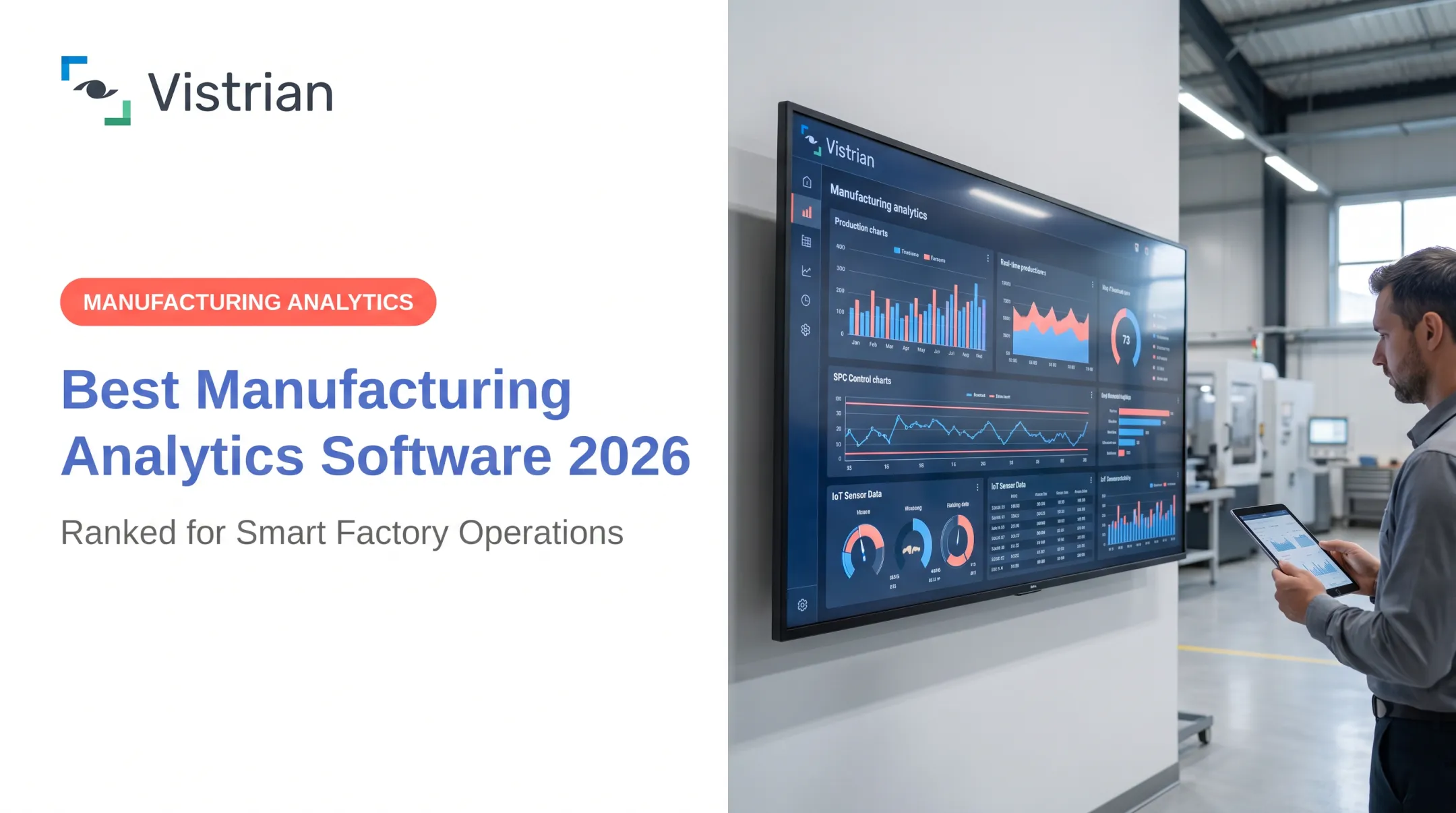
- Real-time equipment utilization and OEE without manual input
- Dashboards showing line performance, quality deviations, and bottleneck locations
- Threshold-based alerts pushed through mobile app and email
- Analytics that flag downtime risk and surface root causes
Best-Fit Use Cases
Vistrian fits discrete plants, semiconductor and electronics fabs, and operations running mixed-vendor or aging equipment. It's also built for multi-plant leaders who need consolidated performance reporting rather than site-by-site guesswork.
One documented example: Blommer Chocolate, one of the largest cocoa processors in North America, used FactoryLOOK to pull roughly 20 parameters per production tool at about one reading per second, combining SCADA and other application data in a single platform. The data showed the real bottleneck was plumbing between refiners and holding tanks, not refiner deterioration as the team had assumed. That finding helped avoid more than $1 million in unnecessary capital spending.
Western Digital and Soraa have also reported that FactoryLOOK integrated smoothly with varied controllers and legacy fab tools.
| Category | Details |
|---|---|
| Best for | Manufacturers needing connected production visibility, equipment data acquisition, and multi-site monitoring |
| Key capabilities | FactoryLOOK connectivity, IIoT integration, OEE/KPI analytics, SPC, dashboards, alerts, historian, reporting |
| Deployment & integration | Cloud and on-premises options; browser and mobile access; connects to legacy controllers, PLCs, and sensors; API-ready for ERP/MES integration |
| Pricing & evaluation | Not publicly listed — request a current quote and evaluate implementation, training, and support costs directly |
NetSuite Manufacturing Edition
NetSuite is a cloud ERP built for manufacturers who want production planning tied directly to financial management, inventory, order management, and procurement in one system.
Best fit when:
- You want one unified system rather than stitching together separate tools
- Your production is discrete manufacturing or make-to-order, driven by sales orders
- You need multi-level BOMs, work orders, and material-availability-based scheduling
On the floor, NetSuite's Manufacturing Mobile module lets operators use scanners for shop-floor reporting without a separate Advanced Manufacturing license. Integration runs through SuiteTalk REST and SOAP web services, with OAuth 2.0 REST preferred for new builds.
NetSuite is strong on planning and enterprise data. Still, confirm whether its execution and machine-connectivity depth covers your shop-floor needs—or whether you still need an MES or IIoT layer.
| Category | Details |
|---|---|
| Best for | Growing manufacturers that want unified ERP plus production planning |
| Key capabilities | Multi-level BOMs, work orders, assembly builds, backflushing, routing tickets, real-time work-order progress |
| Deployment & integration | Cloud-based; SuiteTalk REST/SOAP APIs; mobile scanners; confirm MES/machine connectivity separately |
| Pricing & evaluation | Annual subscription plus one-time implementation fee; no public pricing — request a quote |
Epicor Kinetic
Epicor Kinetic is a manufacturing-focused ERP aimed at complex discrete, mixed-mode, make-to-order, and engineer-to-order operations. Epicor's own materials position Kinetic specifically for manufacturers running multiple production types at once (discrete alongside engineer-to-order, for instance) where a single planning approach doesn't work.
Capabilities worth investigating directly with Epicor:
- Production planning, scheduling, BOM and routing management
- Shop-floor control and quality management
- Multi-site operations support across industries like aerospace, electronics, and industrial machinery
Kinetic supports cloud, on-premises, and hybrid deployment, with an Open REST API for service-based access to ERP data. The trade-off is implementation complexity. Mixed-mode ERPs configured for multiple production types typically require more setup, internal administration, and integration work than a simpler system. Plan for that resourcing before committing.
| Category | Details |
|---|---|
| Best for | Mixed-mode, discrete, or engineer-to-order manufacturers across sizes (confirm current fit with Epicor) |
| Key capabilities | Production planning, scheduling, BOM/routing, shop-floor control, quality, inventory, analytics |
| Deployment & integration | Cloud, on-premises, or hybrid; Open REST API; partner ecosystem for integrations |
| Pricing & evaluation | Quote-based via demo request; no public dollar pricing published |
Plex Smart Manufacturing Platform
Plex, now part of Rockwell Automation, positions itself around automotive, industrial, and high-tech/electronics manufacturing. Its MES module focuses on real-time, paperless production management: finite scheduling, closed-loop quality, inventory traceability, and OEE tracking.
Where Plex tends to fit:
- Manufacturers needing detailed shop-floor execution, not just planning
- Operations wanting quality management (QMS) and asset performance monitoring (APM) in the same platform
- Plants requiring machine-level uptime and health data alongside production data
Plex runs on a multi-tenant SaaS model with edge-to-cloud deployment flexibility, and it holds SOC 1, SOC 2, and ISO/IEC 27001:2013 certifications.
Before committing, confirm it connects cleanly with your existing ERP, quality systems, and maintenance tools. Execution depth only pays off when the platform talks to everything else you already run.
| Category | Details |
|---|---|
| Best for | Automotive, industrial, and electronics manufacturers needing shop-floor execution and connected operations |
| Key capabilities | MES, QMS, APM, production tracking, traceability, finite scheduling, analytics |
| Deployment & integration | Multi-tenant SaaS; edge-to-cloud deployment; developer APIs for inventory, purchase orders, suppliers |
| Pricing & evaluation | Not publicly listed — request current pricing and clarify module, user, and site-based charges |

Acumatica Cloud ERP
Acumatica is a flexible, consumption-based cloud ERP for small and mid-market manufacturers. It brings modular business management—manufacturing, inventory, distribution, financials, and project tracking—under one roof.
Production capabilities Acumatica lists:
- BOMs, routings, and engineering change control
- Finite-capacity scheduling and MRP
- Real-time WIP, material, and labor visibility with mobile/barcode data collection
Those capabilities sit inside a modular, cloud-native architecture that scales with users and transaction volume. Open APIs also support IIoT connections for machine-interface data.
Acumatica's materials describe manufacturing data collection without explicitly claiming a native MES. If deep shop-floor execution is your primary need, confirm whether Acumatica alone covers it or whether you need a connectivity layer on top.
Quick profile:
| Category | Details |
|---|---|
| Best for | Small to mid-market manufacturers needing modular, consumption-based ERP (confirm sizing with Acumatica) |
| Key capabilities | BOMs, routings, production orders, MRP, finite-capacity scheduling, WIP visibility |
| Deployment & integration | Cloud-native; Open APIs for IIoT and third-party connections; deployment choice varies by partner |
| Pricing & evaluation | Consumption-based licensing; no public dollar figure — request pricing directly |
How We Chose the Best Manufacturing Production Software
This list is built on documented product capabilities, current vendor materials, and evidence of fit for distinct manufacturing use cases — not brand familiarity.
Production Planning vs. Real-Time Execution
We scored planning and execution as separate jobs. A system can be strong at one and thin on the other.
Planning capabilities we checked:
- Capacity planning, work orders, BOMs, and routings
- Scheduling that reflects real constraints
Execution signals we checked:
- Real-time downtime, scrap, and machine status
- Shop-floor event capture that operators will actually use
Equipment Connectivity and Data Quality
We looked at support for legacy controllers, PLCs, machine logs, industrial protocols, and IIoT sensors. We also checked how each vendor handles missing data, inconsistent tags, and timestamp accuracy before anything hits a dashboard.
Bad inputs produce bad analytics, no matter how polished the interface looks.
Analytics Tied to Measurable Outcomes
We prioritized platforms with documented, source-attributed case studies over vague claims. Metrics that matter here include OEE, availability, throughput, yield, cycle time, and downtime causes — and whether the vendor names a baseline, timeframe, and scope for any reported result.
Implementation, Security, and Total Cost of Ownership
Gartner's Total Cost of Ownership research makes a useful point: TCO goes well beyond license price. It requires identifying full life-cycle costs — implementation, integration, training, hardware, upgrades, and support — not just the sticker price on a quote.
Those cost and rollout factors shape how buyers should evaluate shortlists.
Common buyer mistakes to avoid:
- Choosing an ERP when the real need is MES-level or IIoT visibility
- Underestimating integration work with existing systems
- Ignoring operator adoption during rollout
- Comparing license prices without calculating full project cost
A practical validation process:
- Document current workflows and pain points
- Define measurable KPIs before shortlisting anything
- Narrow candidates by operational layer (ERP, MES, IIoT, or combination)
- Run a proof of concept with real equipment and production data
- Involve both operators and IT in evaluation
- Confirm the vendor's roadmap and support model before signing

Conclusion
There's no universal "best" manufacturing production software. The right platform matches your manufacturing mode, technical environment, workforce, and reporting needs — not necessarily the biggest ERP name or the longest feature list.
Compare options against your own production scenarios, not vendor marketing pages:
- Production planning
- Shop-floor execution
- Equipment connectivity
- Security
- Total cost of ownership
If you need real-time equipment visibility, legacy-machine connectivity, OEE analytics, or multi-plant monitoring, Vistrian Manufacturing Suite is worth a closer look. Request a product discussion or a demo built around your floor, not a generic script.
Frequently Asked Questions
What is production software?
Production software refers to digital tools that plan, schedule, execute, monitor, and improve manufacturing operations. It spans production management, ERP, MRP, MES, and IIoT capabilities, each covering a different layer of the plant.
What software is used in manufacturing?
Manufacturers typically use combinations of ERP, MES, MRP, WMS, QMS, CMMS, SCM, IIoT platforms, analytics tools, CAD, and PLM software. Most plants integrate several categories rather than relying on one universal application.
What is the best software for manufacturing production planning?
The best fit depends on your manufacturing mode, capacity limits, and how complex your schedules are. Match MRP, ERP, and MES planning features to a real job from your plant, then score each option on constraint handling and schedule accuracy.
What are the four types of ERP?
The four common ERP deployment models are cloud-based, on-premises, two-tier, and hybrid. These labels describe how the system is hosted and rolled out, not which industry it serves.
What are the five ERP modules?
Five core ERP modules are accounting and financial management, human resources, customer relationship management, business intelligence, and supply chain management. Vendors may name or group these modules differently.
What are the four types of WMS?
Four common WMS types are standalone, cloud-based, ERP-integrated modules, and supply-chain execution systems. Choose based on warehouse complexity and how tightly the system must connect to ERP and shipping.