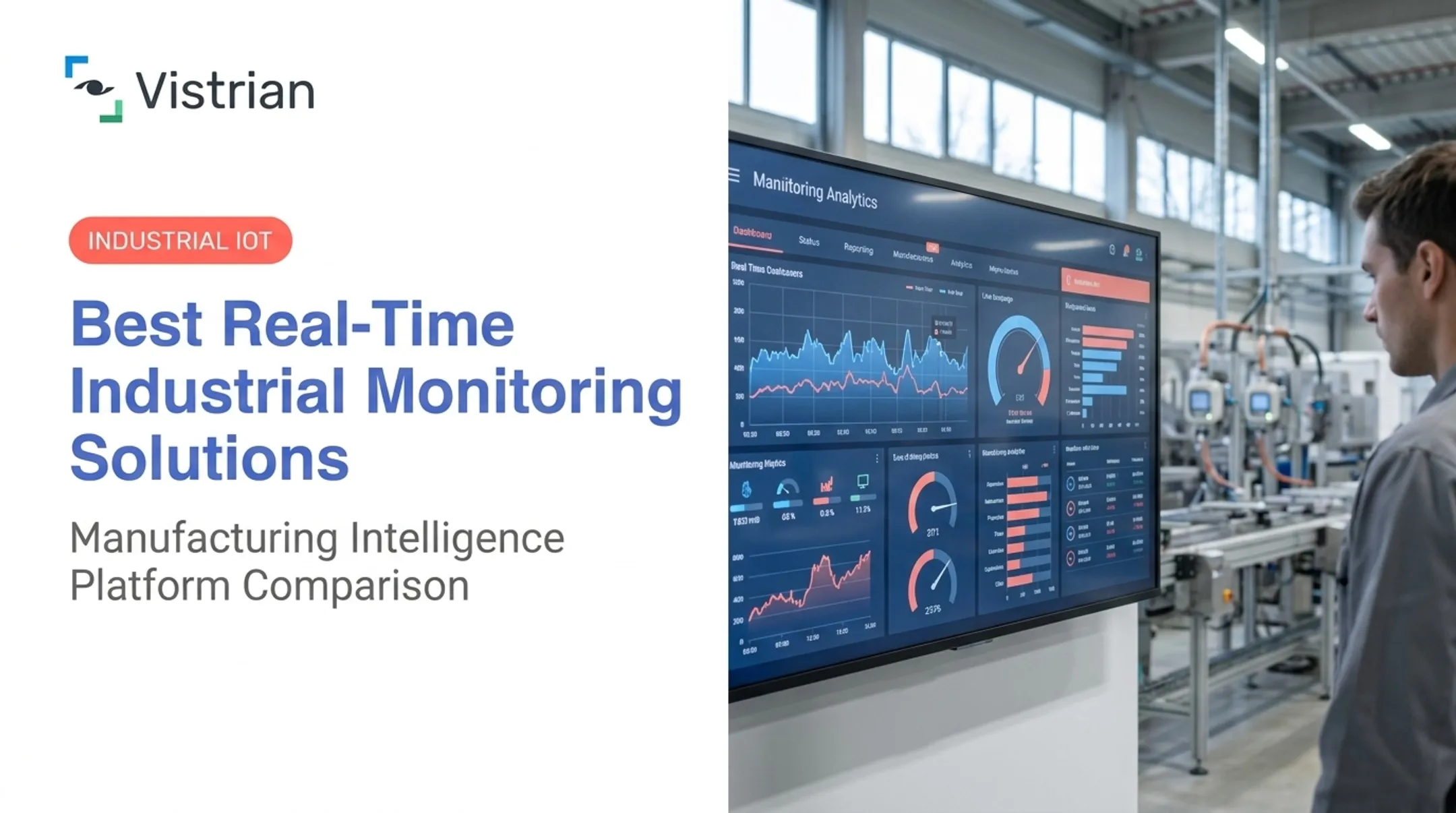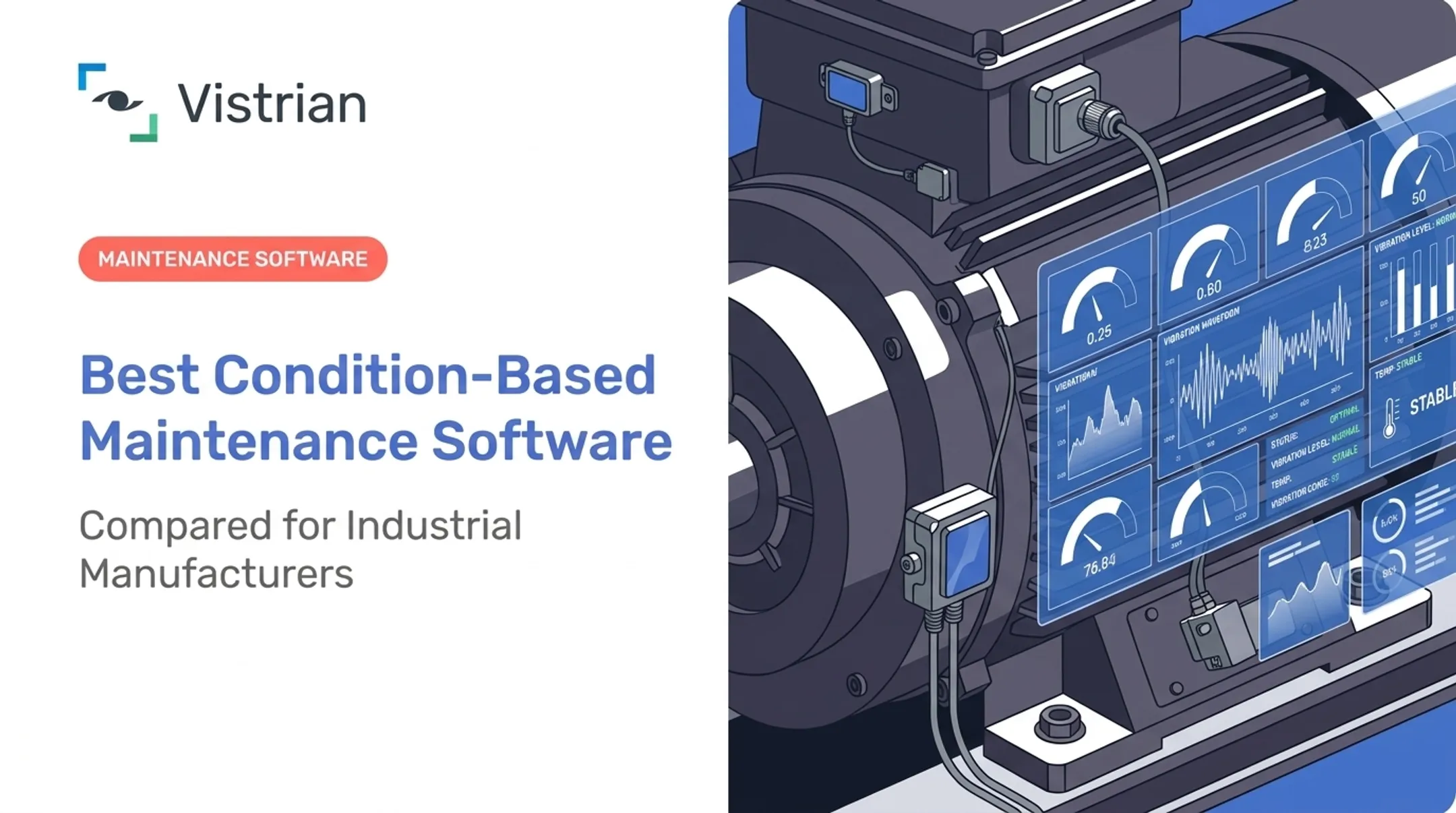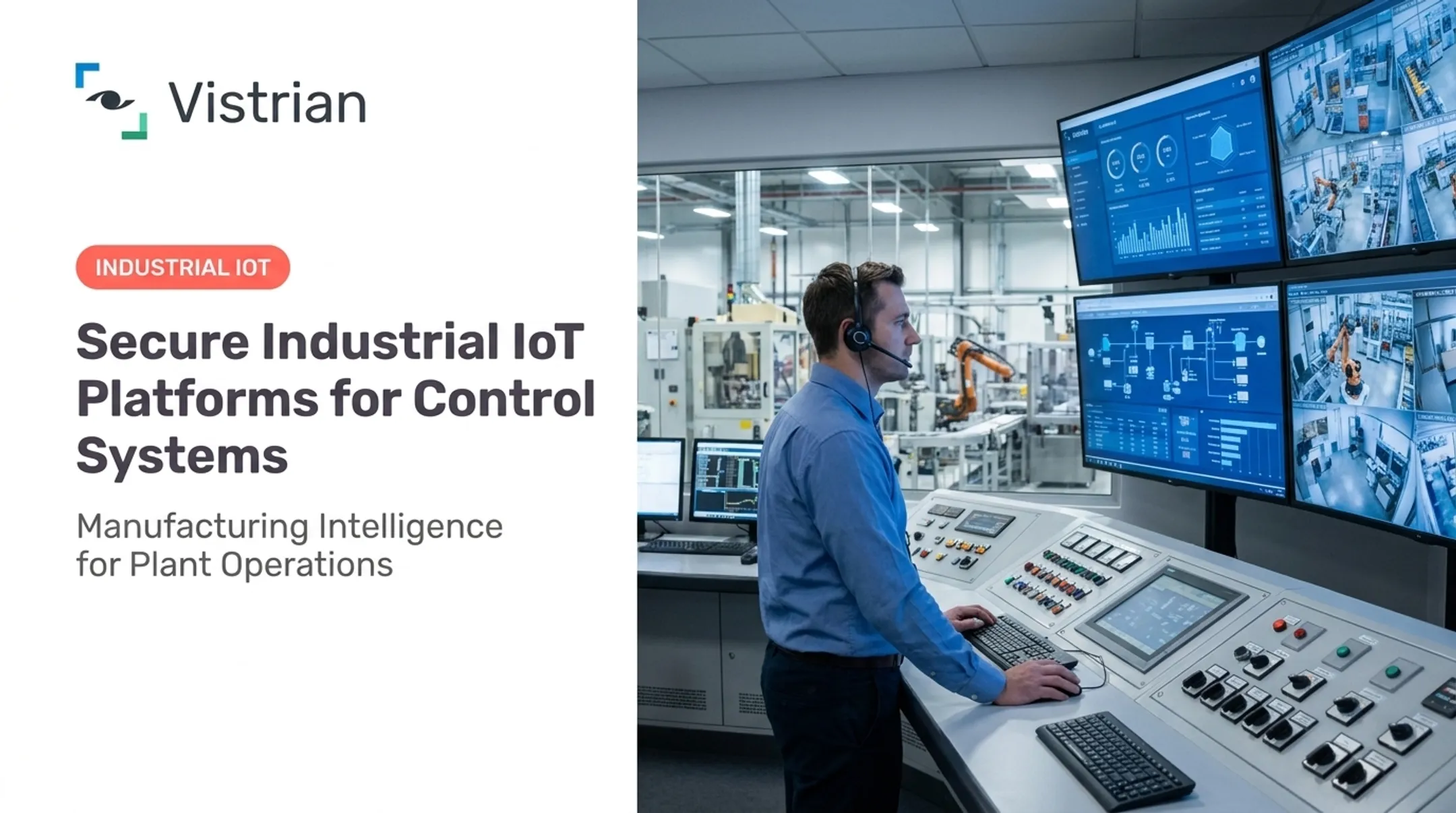

Industrial IoT platforms exist to fix exactly that problem. They connect plant-floor assets, pull operational data into one place, and turn it into visibility you can actually use for decisions on throughput, yield, quality, maintenance, and OEE.
This comparison isn't ranking platforms by brand recognition or cloud market share. We're looking at industrial suitability: connectivity, analytics depth, deployment flexibility, interoperability, security, scalability, implementation effort, and total cost of ownership.
Key Takeaways
- Industrial IoT platforms must handle OT protocols, legacy machines, and production workflows, not just consumer-grade sensors.
- Legacy-machine connectivity, edge/cloud flexibility, and implementation resources matter more than feature-list length.
- Vistrian's Manufacturing Suite fits manufacturers needing modular connectivity, near-real-time visibility, and multi-plant OEE analytics.
- Hyperscaler platforms like AWS and Azure offer scalable infrastructure but typically require extra apps, integration work, and in-house cloud expertise.
Overview of Industrial IoT Platforms in the US Manufacturing Market
An Industrial IoT (IIoT) platform is the software layer that connects machines, controllers, sensors, and production systems, then collects and contextualizes that data to support monitoring, analytics, alerts, and decision-making. On the plant floor, that layer has to work with legacy equipment, strict uptime rules, and systems that already run production.
Why General IoT Tools Fall Short on the Plant Floor
Consumer and general-business IoT platforms weren't built for factories. Industrial environments demand:
- Industrial protocol support: OPC UA, Modbus, SECS/GEM, and similar standards—not just Wi-Fi and Bluetooth
- PLC and legacy machine compatibility, including equipment installed decades ago
- Edge processing for low-latency decisions when a network hiccup can't halt a line
- Deterministic, high-availability operation rather than best-effort cloud messaging
- Integration with MES, ERP, CMMS, SCADA, and historians already running the plant

The Industrial Internet Consortium draws this line clearly: IIoT applies connected devices, data, and advanced analytics specifically to industrial operations like manufacturing and energy, where safety and reliability requirements go well beyond typical consumer IoT.
Common Use Cases US Manufacturers Are Solving For
Real-world deployments tend to cluster around a handful of goals:
- Real-time equipment monitoring, downtime analysis, and OEE tracking
- Predictive or condition-based maintenance
- SPC and quality monitoring
- Energy management and bottleneck identification
- Multi-site performance comparison
In Deloitte's 2025 Smart Manufacturing Survey, which surveyed 600 executives at large US manufacturers in August–September 2024, 92% said smart manufacturing will be their main competitiveness driver over the next three years.
Near-term investment priorities included factory-automation hardware (41%), active sensors (34%), and vision systems (28%). That survey evidence puts shop-floor data visibility at the board level, not only inside IT.
The platforms below serve different roles. Judge them against your equipment mix, data architecture, operational goals, and internal technical bandwidth, not against a generic feature checklist.
Best Industrial IoT Platforms for US Manufacturers
We evaluated each platform on manufacturing fit, machine and protocol connectivity, real-time data handling, analytics, edge/cloud deployment, interoperability, security, scalability, implementation effort, and documented customer results.
Vistrian Manufacturing Suite / FactoryLOOK
Vistrian's Manufacturing Suite is a modular, cloud-enabled smart manufacturing platform built around FactoryLOOK, its equipment-connectivity and data-acquisition engine. The suite combines IIoT connectivity, dashboards, a data historian, e-Recording, SPC, analytics, and alerts in one package.
What sets it apart for plants with mixed or older equipment is how it handles legacy machines:
- Connects to controllers as old as 40 years, according to Vistrian's own product documentation
- Pulls data from machine logs, databases, and standard protocols already in use
- Adds IIoT sensors to capture data from equipment with no digital interface at all
That mix fits several US manufacturing profiles:
- Discrete plants running CNC and assembly lines
- Semiconductor and electronics fabs protecting tool uptime
- Process manufacturers tracking yield
- Multi-plant operators benchmarking sites against each other
Key specs:
| Attribute | Vistrian Manufacturing Suite |
|---|---|
| Deployment | Cloud or on-premises, browser and mobile access |
| Data storage | Within customer firewall (on-prem option) |
| Setup time | Described as fast, minimal configuration overhead |
| Multi-site monitoring | Native, with centralized benchmarking |
| Pricing | Deployment-based, not publicly listed |
In one deployment for North America's largest cocoa processor and ingredient chocolate manufacturer, FactoryLOOK connected every production tool at a single plant. It pulled roughly 20 parameters per tool at about one reading per second. The company reported over $1 million in avoided capital expenditure and projected a 20%+ OEE gain, with a plan to extend to three more plants within six months. Western Digital also reported smooth integration across mixed equipment types and controllers.
Limitation: Vistrian's public documentation does not itemize OPC UA or Modbus certifications the way Siemens does. Manufacturers with strict protocol standards should confirm compatibility in a pilot.
Siemens Insights Hub
Siemens' current industrial IoT offering is Insights Hub. Siemens' own documentation states that "MindSphere has evolved into Insights Hub," so older MindSphere references point to the same product line under a new name.
Insights Hub offers advanced asset connectivity, cloud data upload, streaming analytics at the edge or in the cloud, and the ability to combine IoT data with PLM, CRM, ERP, SCM, and MES systems. It also supports digital-twin comparisons between asset-performance data and product or production models.
Connectivity is a genuine strength. Official documentation lists support for OPC UA, S7, Modbus TCP/RTU, Rockwell, Fanuc Focas, Sinumerik, IEC 61850, MTConnect, BACnet, and custom sources . That coverage favors plants already running Siemens automation gear.
That breadth comes with tradeoffs:
- Implementation complexity for teams outside the Siemens ecosystem
- Licensing isn't published; the product page directs buyers to "contact us for sales and pricing information"
- Independent reviews on G2 cite a learning curve, limited customization, and navigation difficulties as recurring complaints
Insights Hub fits large enterprises already invested in Siemens PLM, MES, or automation hardware. It is a weaker starting point for plants standing up a mixed-vendor floor from scratch.
PTC ThingWorx
ThingWorx, now positioned under PTC's Velotic branding, is an industrial application enablement platform rather than a turnkey manufacturing dashboard. It is a toolkit for building connected-operations apps, not a finished product out of the box.
PTC's manufacturing connectivity guidance recommends pairing ThingWorx with Kepware for edge connectivity. Some PLCs may need serial or Ethernet modifications before they can communicate with the platform, which affects scope and timeline.
Key characteristics:
- Deployable on-premises, in the cloud, or hybrid
- Documentation areas include ThingWorx Platform, Edge, Connection Services, Analytics, and Apps
- Licensing is structured per Site plus registered users, per PTC's January 2024 licensing document
ThingWorx suits organizations already on PTC's Windchill PLM or Vuforia AR tools, plus teams with developers to build configurable apps rather than buy pre-built ones.
G2 reviewers call it strong for remote monitoring and service portals. They also flag complex implementation, version-management friction, and high cost on simpler use cases.
AWS IoT SiteWise and Related AWS Industrial Services
AWS IoT SiteWise is an industrial data service, not a complete manufacturing management suite. It collects, organizes, and monitors equipment data using asset models and hierarchies. You will still need other AWS services to complete a full solution.
Commonly documented pairings include:
- AWS IoT TwinMaker for asset synchronization and search
- SiteWise Monitor for visualization
- Lookout for Equipment for anomaly detection
- IoT Events for alarms, plus S3 for cold storage and IAM for access control
SiteWise Edge handles local processing before cloud transfer, with MQTT support for publish/subscribe gateway integration. Pricing is pay-for-use: the Data Collection Pack is free, while the Data Processing Pack runs $200 per active gateway per month, according to AWS's published pricing page. US availability spans US East (Ohio, N. Virginia), US West (Oregon), and AWS GovCloud.
Choose SiteWise if you have strong internal cloud and data-engineering talent and want custom OEE, maintenance, or quality workflows on AWS primitives. Teams that want a ready-made manufacturing suite will face substantial integration work.
Microsoft Azure IoT Hub and Azure Industrial Services
Azure IoT Hub handles secure device-to-cloud and cloud-to-device messaging, supporting MQTT and AMQP protocols with SAS-token or X.509 authentication. Microsoft's product page states a 99.9% service-level agreement for the hub itself.
Like AWS SiteWise, IoT Hub alone isn't an industrial application. Manufacturers typically add:
- Azure Digital Twins for asset and environment modeling
- Azure IoT Edge for local analysis, reduced cloud traffic, and offline operation
- Analytics and visualization tools, since Microsoft retired Azure Time Series Insights on July 7, 2024, pushing users toward Azure Data Explorer instead
Pricing runs on Basic (B1/B2/B3) and Standard (Free/S1/S2/S3) tiers based on message volume. Azure fits manufacturers already committed to Microsoft's ecosystem, including Dynamics, Power BI, and Azure Active Directory. Building a full industrial stack still takes deliberate architecture work, and ongoing cloud spend is easy to underestimate at the pilot stage.

How We Chose the Best Industrial IoT Platforms
We compared platforms on manufacturing suitability and practical business value, not brand size or feature-list length.
Connectivity and interoperability. We checked support for PLCs, industrial gateways, OPC UA, MQTT, Modbus, databases, historians, and mixed-vendor environments. Every protocol claim was verified against official documentation rather than marketing copy.
Operational functionality. Real-time monitoring, OEE, downtime and root-cause analysis, predictive maintenance, SPC, alerting, and multi-plant benchmarking all factored in.
Architecture and deployment. Cloud, on-premises, edge, and hybrid options were weighed for latency tolerance, intermittent connectivity, data residency, and plant-network segmentation. As NIST's Guide to Operational Technology Security notes, OT edge nodes, gateways, and field devices operate under different reliability expectations than typical IT systems.
Commercial and implementation risk. Pricing structures, integration effort, internal skill requirements, vendor support, and total cost of ownership all shaped the final view — not just sticker price.
Cybersecurity. The ISA/IEC 62443 series defines lifecycle security requirements for industrial automation and control systems. Any platform touching plant-floor data should meet that bar, not generic IT security standards.
Watch out for these common mistakes:
- Picking a platform before mapping specific use cases and success metrics
- Confusing basic device connectivity with a complete manufacturing solution
- Overlooking cybersecurity requirements and unclear data ownership terms
- Skipping a proof-of-concept on representative machines before committing
Conclusion
There's no universal "best" Industrial IoT platform. The right one fits your equipment, your workflows, your data architecture, your security requirements, and your team's actual capabilities.
Before committing, run a pilot and score results against agreed metrics:
- Data-quality coverage
- Time to connect assets
- Downtime identification accuracy
- Alert precision and user adoption
- Integration effort
- Total cost
That tells you far more than any feature checklist.
If your plant runs a mix of legacy and modern equipment across multiple sites and you need near-real-time OEE visibility without a massive systems-integration project, check whether Vistrian's modular Manufacturing Suite, FactoryLOOK connectivity, and multi-plant analytics align with your priorities.
It won't be the right fit everywhere. For manufacturers juggling mixed-vendor floors and limited internal cloud engineering resources, it's a serious option to test.
Frequently Asked Questions
What are the types of IoT platforms?
IoT platforms generally fall into connectivity management, device management, application enablement, data/analytics, cloud infrastructure, and Industrial IoT categories. In practice, most vendors blend several of these, so the lines often overlap.
What is the difference between IoT and Industrial IoT?
IIoT applies connected devices, data, and analytics specifically to industrial assets and processes. It demands stronger reliability, safety, real-time performance, and OT cybersecurity than consumer IoT. It also needs tighter interoperability with legacy equipment.
What are common IoT devices?
Common industrial IoT devices include sensors, gateways, PLC-connected equipment, actuators, meters, and cameras. Consumer devices like smart thermostats use different reliability and protocol standards than factory-floor assets.
How do I choose an Industrial IoT platform?
Start with your specific use cases and target outcomes, not the vendor list. Then pilot connectivity, protocol support, edge/cloud architecture, security, and integrations on your own machines and data before you sign.
Can an Industrial IoT platform connect to legacy machines?
Yes, usually through gateways, PLC interfaces, standard protocols, machine logs, or retrofit sensors. Compatibility still needs testing against your specific controllers, network setup, data quality, and safety requirements before you rely on it.