
Introduction
A single hour of unplanned downtime can cost a manufacturer more than $125,000, and two-thirds of plants deal with an unplanned outage at least once a month, according to a 2024 survey of more than 3,200 plant-maintenance leaders.
Many plants still run on disconnected machine data, whiteboards, and reactive maintenance schedules that only kick in after something breaks.
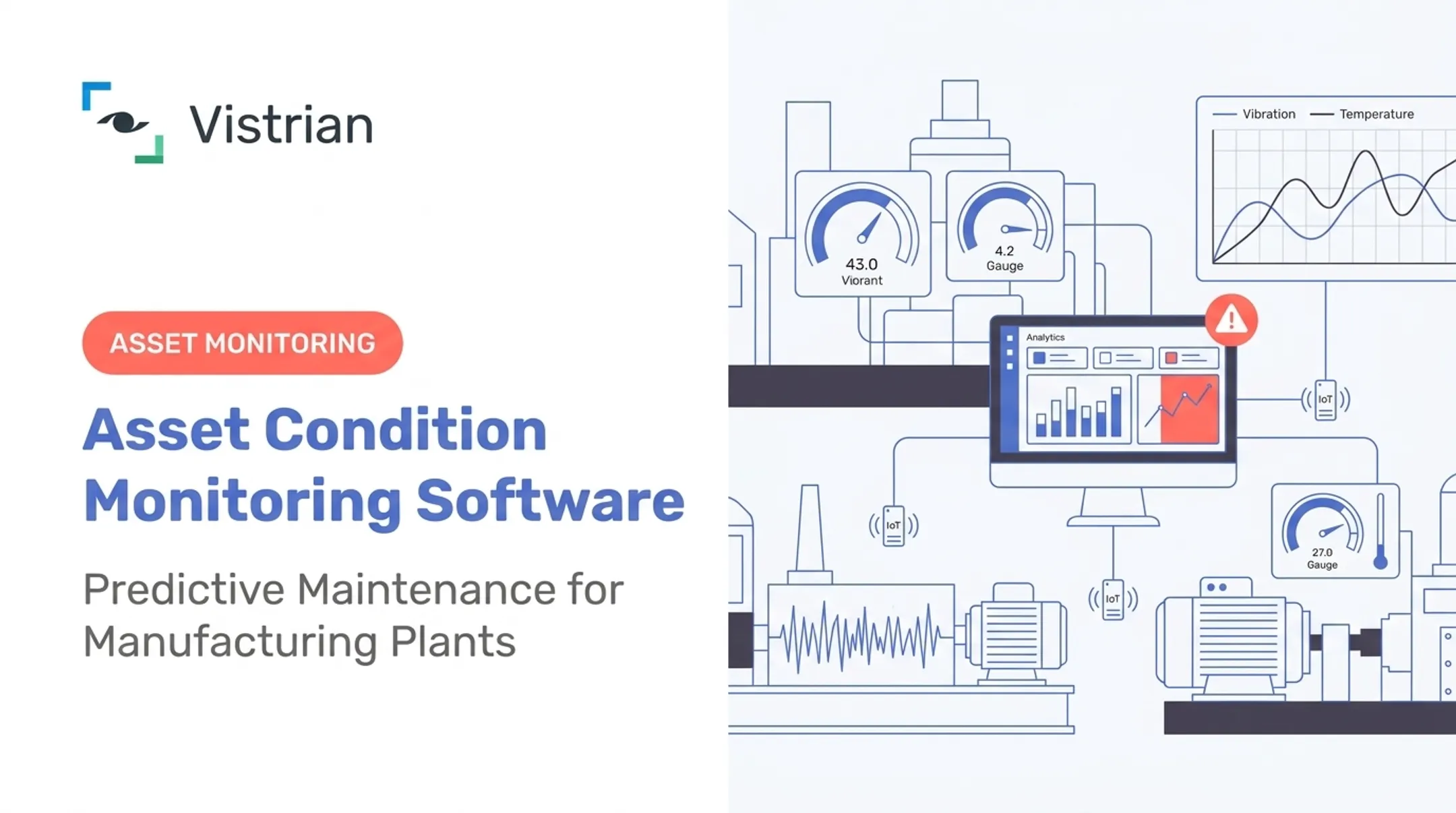
Asset performance management (APM) software pulls together asset data, analytics, condition monitoring, and maintenance insight so teams can catch problems before they cause a line stoppage.
This guide compares five APM platforms built for different manufacturing needs. The right pick depends on your asset types, your existing CMMS or EAM systems, your connectivity requirements, and the outcomes you need to improve.
Key Takeaways
- APM software monitors asset health, flags performance risk, and supports proactive decisions.
- Strong platforms tie data to action, not just dashboards.
- Evaluate connectivity, analytics depth, reliability workflows, integration, and total cost before buying.
- Vistrian, IBM Maximo, SAP APM, GE Vernova, and AVEVA suit different asset types and IT maturity levels.
Overview of Asset Performance Management Software in the US Manufacturing Market
APM software collects data from controllers, historians, sensors, and SCADA systems, then turns that raw signal into asset-health scores, performance trends, and maintenance recommendations. It's less about record-keeping and more about spotting trouble early.
How APM Differs from CMMS and EAM
This distinction trips people up constantly:
- APM focuses on reliability and performance decisions, such as detecting abnormal vibration before a bearing fails.
- CMMS/EAM manages the execution side: work orders, asset records, inventory, and lifecycle administration.
- Most manufacturers eventually run both, with APM feeding alerts into a CMMS work order.
Confusing the two costs money: buying an analytics platform when the real gap is work-order discipline, or vice versa, wastes budget and delays fixes. Knowing where reliability decisions end and maintenance execution begins determines which system to fix first, and it sets up the step-by-step workflow that follows, from detection through resolution.
The Typical APM Workflow
- Connect to machine data sources, from PLCs to legacy controllers.
- Collect performance, condition, and process data continuously.
- Detect anomalies against expected behavior.
- Diagnose the likely root cause.
- Prioritize based on criticality and risk.
- Act by routing the issue to a technician or work order.
- Improve by feeding outcomes back into the model.

For example, a stamping press showing a gradual cycle-time drift might trigger an alert days before a full stoppage, giving maintenance a window to intervene on their schedule instead of the machine's.
Why US Manufacturers Are Investing Now
Adoption is accelerating for practical reasons, not hype. Deloitte's 2025 smart manufacturing survey of 600 executives found 57% of manufacturers now use cloud computing and data analytics at the facility level, with 40% planning further data-analytics investment within 24 months. Drivers include:
- Higher uptime targets and thinner production margins
- Better allocation of scarce maintenance labor
- Connectivity for legacy equipment that was never built to talk to software
- Measurable OEE gains that justify the software spend
- Consistent visibility across multiple plants, not just one
Top Asset Performance Management Software for US Manufacturers
This is a practical shortlist, not a strict ranking. Each platform below fits different industries, asset classes, and levels of IT maturity.
We evaluated every entry on:
- Industrial fit for US manufacturing environments
- Data connectivity across machines, historians, and enterprise systems
- Analytics depth for reliability and performance insights
- Maintenance workflow integration with CMMS and work orders
- Scalability from single-plant to multi-site operations
- Documented business value from real deployments
Vistrian Manufacturing Suite and Analytics
Best for: small to large manufacturing plants that need near-real-time machine visibility without a heavy IT lift.
Vistrian's Manufacturing Suite combines FactoryLOOK, Vistrian Dashboards, Vistrian Analytics, and Vistrian Industrial IoT into one modular, cloud-enabled platform built for manufacturers.
Capabilities and Differentiators
FactoryLOOK connects to machine controllers, logs, databases, and standard protocols, and Vistrian's IIoT layer adds sensors to equipment that lacks a digital interface. That matters for plants running mixed-vintage equipment.
Once connected, Vistrian Analytics tracks:
- Downtime, OEE, throughput, yield, and cycle time
- Root-cause patterns behind recurring losses
- Deviation alerts pushed through mobile app and email
- Multi-plant comparisons for enterprise reporting
The platform also bundles SPC, e-Recording, data historian functions, and virtual factory modeling, so teams get acquisition, analytics, and reporting in one modular deployment rather than stitching together separate tools.
Comparison Summary
| Category | Details |
|---|---|
| Primary use cases | Machine status, OEE, downtime, throughput, yield, root-cause analysis |
| Data sources | Controllers, PLCs, logs, databases, IIoT sensors, legacy machines up to 40 years old |
| Deployment | Cloud-based or on-premises, browser and mobile access |
| Maintenance integration | Connects with VistrianMMS for alert-to-work-order handoff |
| Pricing | Not publicly published; quote-based |
| Ideal customer | Discrete manufacturers and semiconductor fabs needing multi-plant visibility |
Blommer Chocolate used FactoryLOOK to pin down a production bottleneck; Thomas Bruguier reported the tool helped avoid more than $1 million in unnecessary capital spending.
Vistrian cites this and similar customer-reported results as typical payback in under a year—not an independent audit.
IBM Maximo Application Suite
Best for: large, complex, or highly governed organizations that want asset lifecycle management and predictive capability in a connected suite.
Maximo pulls together several distinct applications rather than a single monolithic tool:
- Maximo Manage — asset, location, and work-process records
- Maximo Health — condition indicators tied to work orders
- Maximo Monitor — real-time and historical device trends
- Maximo Predict — AI-driven predictive models using historical and near-real-time data
- Maximo Mobile — technician-facing inspections and work execution
Fit and Trade-offs
Maximo can be deployed on-premises or in the public cloud. Licensing runs on an AppPoints model with Limited, Base, and Premium entitlement tiers.
IBM's public "Essentials" pricing starts under $40,000 per year for individual modules like Maintenance or Inspection. Full Standard or Premium SaaS pricing runs through a quote or estimator rather than a published rate.
That flexibility comes with complexity. Smaller manufacturers often need dedicated IT resources to manage configuration, integration, and licensing tiers correctly.
| Category | Details |
|---|---|
| Deployment | On-premises or public cloud |
| Integrations | ERP, IoT, CMMS |
| Pricing model | AppPoints licensing; Essentials tiers under $40K/year, Standard/Premium by quote |
| Ideal customer | Large, multi-site organizations with dedicated IT and reliability teams |
SAP Asset Performance Management
Best for: manufacturers already standardized on SAP S/4HANA or SAP Enterprise Asset Management.
SAP APM analyzes asset health, IoT sensor data, and maintenance records. It supports:
- Reliability-method selection
- FMEA/RCM-based strategy assessments
- Remaining-useful-life estimates
The catch: SAP's own product page states that SAP APM requires SAP EAM running on S/4HANA Cloud or a compatible ERP 6.0 environment. This isn't a standalone tool you bolt onto any tech stack.
Trade-off Worth Weighing
If you're already deep in the SAP ecosystem, this native integration is a real advantage. If you're not, the prerequisite infrastructure, skills, and governance requirements can outweigh the benefit.
| Category | Details |
|---|---|
| Deployment | Cloud (SaaS), browser-based |
| Dependencies | SAP EAM, S/4HANA or compatible ERP |
| Pricing | Price upon request; sold in blocks of 100 objects, 6–60 month contracts |
| Ideal customer | Existing SAP shops with EAM already in place |
GE Vernova APM
Best for: asset-intensive organizations needing predictive analytics, risk-based inspection, or digital-twin capability across complex operations.
GE Vernova's APM suite includes four core modules:
- APM Strategy: criticality assessment and asset strategy management
- APM Health: diagnostics and mobile data collection
- APM Reliability: AI/ML-driven predictive maintenance and MTBF analysis
- APM Integrity: mechanical integrity, risk-based inspection, and corrosion management

While GE Vernova has deep roots in energy, its connected APM offering also supports automotive, chemical, food and beverage, and life sciences. The platform’s composable, microservice-based architecture lets you deploy applications individually instead of buying an all-or-nothing suite.
That modularity is a strength for large operations, but it typically requires specialist implementation support and internal reliability expertise to configure well.
| Category | Details |
|---|---|
| Deployment | Composable, cloud-edge architecture |
| Integrations | EAM data import/export for maintenance plans |
| Key strengths | Criticality assessment, RAM modeling, mechanical integrity |
| Ideal customer | Large asset-intensive manufacturers with in-house reliability teams |
AVEVA Asset Performance Management
Best for: industrial manufacturers with process-heavy operations wanting risk-based maintenance built on established operational technology data.
AVEVA APM monitors sensor, operational, and engineering data continuously, layering AI/ML predictive and prescriptive analytics on top to catch early failure signs and recommend specific maintenance actions.
Its foundation is the AVEVA PI System, an established operational data historian, with AVEVA Data Hub extending PI data to the cloud for broader sharing. APM is designed to integrate with existing CMMS, ERP, and data historians rather than replace them.
Deployment centers on cloud-based predictive and prescriptive insight with no-code templates that can shorten setup time. Data readiness and user training still matter for distributed, process-oriented plants.
| Category | Details |
|---|---|
| Deployment | Cloud-based, no-code templates |
| Data foundation | AVEVA PI System, AVEVA Data Hub |
| Integrations | CMMS, ERP, industrial historians |
| Ideal customer | Process manufacturers with existing OT infrastructure |
How We Chose the Best Asset Performance Management Software
We weighted operational fit and measurable outcomes above brand recognition. Vendor claims, customer reviews, and analyst commentary were treated as separate categories of evidence, not interchangeable proof.
Core Criteria We Evaluated
- Connectivity: legacy-equipment support, sensor and historian integration, protocol coverage
- Analytics depth: condition monitoring, anomaly detection, predictive modeling, root-cause analysis
- Workflow fit: CMMS/EAM/ERP integration, work-order handoff, API access, mobile use
- Commercial factors: pricing model, implementation effort, scalability, total cost of ownership
Common Selection Mistakes to Avoid
- Choosing a platform before defining target assets and KPIs.
- Assuming a dashboard equals predictive capability.
- Overlooking legacy-machine connectivity until after purchase.
- Ignoring how alerts actually reach a maintenance team.
- Accepting ROI claims without checking the baseline they're measured against.

Before committing, run a proof of value on representative assets. Track baseline unplanned downtime, OEE, mean time between failures (MTBF), and mean time to repair (MTTR), then measure the change.
IoT Analytics' 2023 research found 95% of predictive-maintenance adopters reported positive ROI, with 27% of those seeing payback in under a year. That figure is a proxy for predictive maintenance broadly, not a guarantee for any single vendor.
Conclusion
The best asset performance management software connects trustworthy equipment data to decisions your team can act on. It should align with your reliability, production, quality, and cost goals—not win on feature count alone.
Before you sign anything, compare:
- Integration requirements
- Asset coverage
- Analytics maturity
- Total cost
Feature counts and brand names won't tell you whether a tool fits your plant floor.
If you're evaluating options, Vistrian's modular, cloud-enabled Manufacturing Suite, FactoryLOOK, and Vistrian Analytics are built to give manufacturers real-time visibility across individual machines, full plants, and multi-site operations without a heavy IT build-out.
Frequently Asked Questions
What is asset performance management software?
APM software is a data-driven solution that monitors, analyzes, and improves the reliability, availability, and lifecycle performance of physical assets. It combines connected data, analytics, and proactive workflows to catch problems before they cause downtime.
What is the difference between APM software and EAM or CMMS software?
APM focuses on asset health, performance, and reliability decisions. EAM and CMMS manage asset records, maintenance work, and inventory execution. Most manufacturers run both together, with APM alerts feeding CMMS work orders.
What features should manufacturers look for in APM software?
Look for industrial connectivity, real-time and historical monitoring, anomaly or predictive analytics, root-cause analysis, KPI dashboards, and integrations that route alerts into an actionable maintenance workflow.
Can APM software connect to legacy manufacturing equipment?
Many platforms connect through controllers, historians, databases, standard protocols, gateways, or added IIoT sensors. Verify supported interfaces and test data quality during a proof of value before committing.
Is APM software suitable for small and mid-sized manufacturers?
Yes, cloud-enabled and modular platforms can work well for smaller operations, especially when you start with critical assets and one focused use case. Check implementation effort, usability, and pricing before scaling up.
How do you measure the ROI of APM software?
Establish a baseline, then track changes in unplanned downtime, OEE, maintenance cost, throughput, and asset life over time. Keep measured outcomes separate from vendor projections until you've verified them yourself.