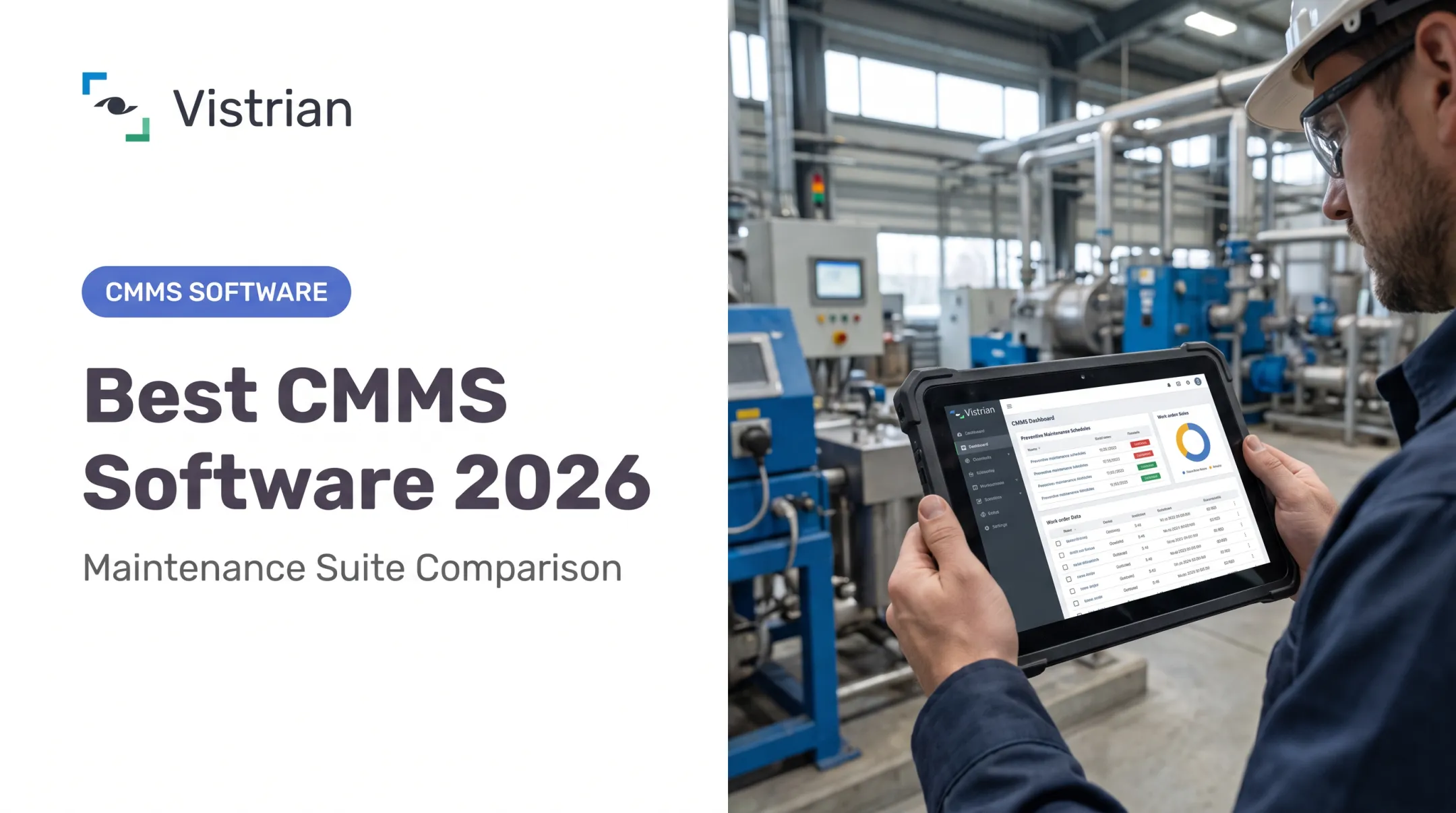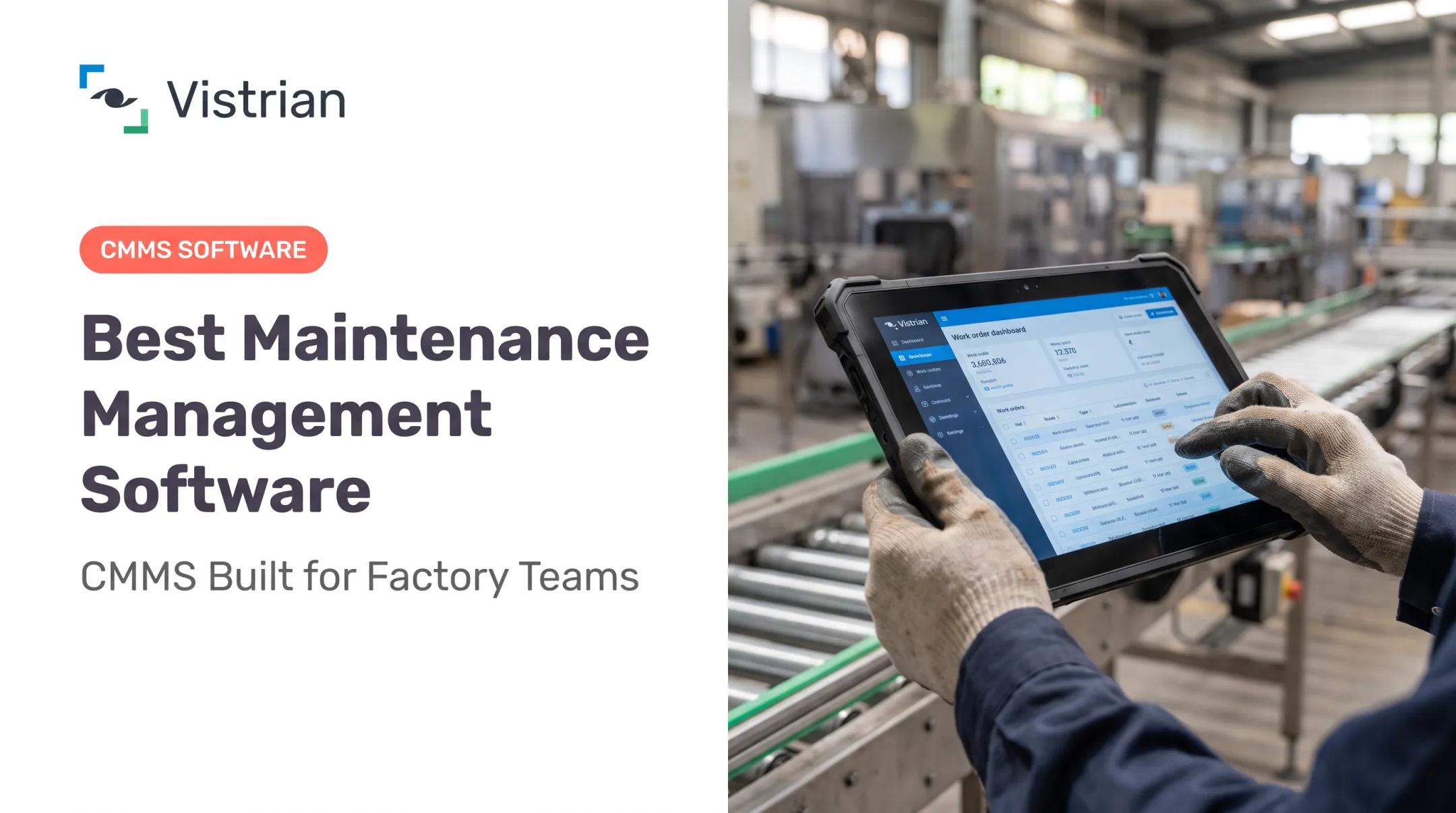

That patchwork approach costs real money. The best CMMS software isn't the platform with the longest feature list — it's the one that matches your asset complexity, technician workflow, manufacturing environment, and budget. A five-person facilities team and a 200-technician semiconductor fab need very different tools.
This article compares five CMMS platforms relevant to US manufacturing and maintenance teams: manufacturing fit, mobile usability, preventive maintenance depth, reporting, scalability, and pricing transparency. We'll break down where each one fits — and where it doesn't.
Key Takeaways
- CMMS software centralizes work orders, preventive maintenance, asset histories, spare parts, and reporting in one system.
- VistrianMMS leads for manufacturers that need CMMS built on 25+ years of advanced manufacturing experience.
- Match the platform to your needs: small teams, mobile-first crews, manufacturing plants, or enterprise asset programs.
- Validate mobile workflows, integrations, data migration, support, and total cost before you commit.
Overview of CMMS Software in the US Manufacturing and Maintenance Market
A computerized maintenance management system connects maintenance requests, work orders, preventive-maintenance schedules, asset records, parts inventory, technician activity, and performance reporting into a single digital workflow. Instead of a technician hunting through binders for an asset's repair history, that history is a click away.
Why CMMS Adoption Matters
According to NIST's survey on manufacturing machinery maintenance, manufacturers relying more heavily on predictive and preventive maintenance reported 52.7% less unplanned downtime and 78.5% fewer defects than those still leaning on reactive repairs.

Better maintenance visibility translates directly into:
- Higher equipment utilization and throughput
- Fewer quality escapes tied to worn or miscalibrated equipment
- Cleaner compliance documentation for audits
- Data-backed capital planning instead of guesswork
CMMS vs. MES, ERP, and EAM
These systems get confused often, and the distinction matters when you're evaluating a purchase:
- CMMS focuses on maintenance execution — work orders, PM scheduling, parts.
- MES manages production execution on the plant floor.
- ERP handles finance, HR, procurement, and supply-chain planning.
- EAM extends into full asset lifecycle management beyond day-to-day maintenance.
A CMMS typically connects to these systems rather than replacing them.
Manufacturing-Specific Capabilities to Look For
Not every CMMS was built with a factory floor in mind. Before shortlisting anything, check for:
- Mobile work orders technicians can actually use on the floor
- Meter- or condition-based maintenance triggers, not just calendar-based ones
- Asset hierarchies that reflect real equipment structures
- Downtime and failure-code tracking
- Inventory control tied to spare-parts usage
- APIs and ERP/MES connectivity
- Support for legacy equipment alongside modern IIoT sensors
Use those criteria as the filter when you compare the platforms below — fit on the floor matters more than feature count on a datasheet.
Top CMMS Software for US Maintenance and Manufacturing Teams
We evaluated each platform against core CMMS capability, manufacturing relevance, mobile execution, preventive-maintenance depth, asset and inventory management, integrations, scalability, customer feedback, and total cost of ownership.
| Platform | Best For | Deployment | Starting Price |
|---|---|---|---|
| VistrianMMS | Manufacturing teams needing equipment-connected maintenance | Cloud or on-premises | Custom quote |
| Fiix | Structured workflows across connected systems | Cloud | Free tier; $45/user/month Basic |
| MaintainX | Frontline mobile teams | Cloud, mobile-first | Free tier; $20/user/month Essential |
| UpKeep | Small businesses, quick mobile adoption | Cloud, mobile-first | $24/user/month Essential |
| IBM Maximo | Large enterprises with complex assets | Cloud (SaaS) or client-managed | Custom quote |
VistrianMMS
VistrianMMS is Vistrian's CMMS offering, built to digitize and centralize equipment maintenance for manufacturers rather than being adapted from a generic facilities tool. It handles work-order management, preventive-maintenance scheduling, equipment checklists, spare-parts inventory, calibration management, Total Production Maintenance (TPM) activities, and repair-center workflow control.
What sets it apart for manufacturing teams is where it comes from. Vistrian brings more than 25 years of hands-on experience in demanding manufacturing environments, starting in semiconductor and data-storage industries.
In those sectors, a missed calibration or unplanned tool outage carries real financial weight, and that background shows up in the product's focus on real-time equipment condition rather than pure scheduling.
Capabilities worth verifying during evaluation:
- Equipment and asset records with maintenance history
- Preventive-maintenance scheduling using automated triggers based on usage, time, or condition monitoring
- Work-order workflows accessible through any browser on desktop, tablet, or mobile
- Spare-parts tracking integrated with repair-center workflows
- Real-time dashboards with maintenance KPIs
- Multi-site deployment with centralized dashboards and local scheduling autonomy
VistrianMMS also connects with FactoryLOOK, Vistrian's broader manufacturing-data platform, and its Analytics engine to support condition-based and predictive maintenance.
FactoryLOOK connects machine controllers, logs, databases, and IIoT devices, including older equipment through standard industrial protocols. That connectivity belongs to Vistrian's Manufacturing Suite; VistrianMMS is the maintenance layer that draws on the data once it exists.
Ian Chizmar, Systems Architect at MTS/Soraa, noted that Vistrian's products and implementation team integrated smoothly with existing legacy semiconductor fab tools and MES systems. That matters for any plant still running older equipment alongside newer machines.
Where to dig deeper: Vistrian doesn't publish CMMS pricing publicly, so request a quote directly. Ask specifically about mobile offline capability, security documentation, and current customer references, since these details aren't standardized across every deployment.
Fiix
Fiix is a cloud CMMS commonly considered by manufacturing and industrial maintenance teams. It covers work orders, preventive maintenance, asset management, reporting, and integrations through its Integration Hub and open API.
Best fit: Organizations needing structured maintenance workflows across multiple connected systems, or teams already running an industrial technology stack that Fiix can plug into.
Fiix supports time-, use-, condition-, and event-based PM triggers, asset profiles with full history, and mobile work orders with QR/barcode access and offline use. Enterprise plans add custom workflows, e-signatures, audit trails, and SSO.
Pricing (US, current vendor page):
- Free: $0, limited users, 25 active PMs
- Basic: $45/user/month
- Professional: $75/user/month
- Enterprise: custom quote
Drawbacks to investigate: Capterra reviews flag a cumbersome work-order process (cited by 36% of negative reviewers) and challenges creating custom reports (40% of negative reviewers). Configuration complexity and yearly-contract terms also come up in independent reviews, so ask about contract flexibility before signing.
MaintainX
MaintainX targets frontline maintenance teams who need work orders, procedures, inspections, checklists, and team communication — all built mobile-first rather than mobile-adapted.
Best fit: Small and mid-sized plants or distributed teams prioritizing technician adoption and standardized execution over deep enterprise configuration.
The platform includes digital procedures with signatures, conditional logic, offline mode for saved work orders, parts inventory with low-stock alerts, and dashboards covering PM compliance, equipment health, and cost tracking.
Pricing tiers:
- Basic: free forever, limited attached-procedure work orders
- Essential: $20/user/month (annual) or $25/month
- Premium: $65/user/month (annual), adds meter-based maintenance and open REST API
- Enterprise: custom, adds IoT integrations and multi-site support
Independent feedback is strong here. MaintainX holds a 4.8/5 rating from 1,062 Capterra reviews, with users praising setup speed, team coordination, and customizable checklists. Reported concerns include occasional sync issues and reporting that can feel limited for complex, multi-site operations — worth testing before scaling beyond a single facility.
UpKeep
UpKeep is a mobile-first CMMS built for teams managing work orders, preventive maintenance, assets, and parts directly from the field or plant floor.
Best fit: Smaller businesses, facilities teams, and manufacturing groups that value fast adoption and straightforward mobile execution over deep customization.
UpKeep's Edge sensors can monitor temperature, vibration, and runtime, automatically triggering a work order when readings drift out of range. PM scheduling supports calendar, meter, and sensor-based triggers.
Pricing:
- Essential: $24/user/month
- Premium: $55/user/month
- Professional and Enterprise: custom quote (Professional adds offline mode and full analytics history; Enterprise adds API access and multi-site support)
Limitations to verify: Offline mobile mode is locked behind the Professional tier, and API/custom integrations require Enterprise. Capterra reviews note that advanced reporting and customization can feel restricted without additional configuration — ask specifically how much setup work that requires before assuming out-of-the-box readiness.
IBM Maximo
IBM Maximo is an enterprise asset-management platform with CMMS functionality built in, aimed at organizations with complex assets, strict governance needs, and multi-site or multi-country operations.
Best fit: Large enterprises needing asset lifecycle management, compliance, procurement, labor, inventory, and analytics inside one ecosystem — not smaller teams looking for a quick rollout.
Maximo Application Suite unifies maintenance, inspections, and reliability with AI-driven asset insights. Maximo Mobile supports work execution, inspections, offline access, and barcode scanning. Real customer outcomes back this up: IBM's case studies report Downer improved reliability by 51%, and utility provider Ellevio shifted from scheduled to condition-based predictive maintenance using the platform.
Trade-offs to weigh:
- Requires specialist administration and significant training investment
- Implementation effort is considerably higher than lightweight CMMS options
- Deployment options include client-managed infrastructure, BYOL on major cloud providers, or IBM-managed SaaS, each with different cost and IT overhead implications
- Pricing uses credit-based AppPoints across Essentials, Standard, and Premium SaaS packages; IBM directs buyers to request a custom quote
TrustRadius shows a 7.6/10 rating across 196 reviews, with users citing strong facility-maintenance utility. Total cost of ownership will almost certainly exceed lightweight CMMS platforms, so budget for implementation and ongoing administration—not license fees alone.
How We Chose the Best CMMS Software
We combined documented product capabilities, current pricing pages, independent customer reviews, and relevance to US maintenance and manufacturing operations — not vendor marketing copy alone.
Core workflow evaluation: We traced each platform's path from request or failure report through a full work-order lifecycle:
- Triage and technician assignment
- Completion, parts, and labor logging
- Approval and searchable asset history
Preventive-maintenance depth: Calendar-only scheduling is not enough for most manufacturing assets. We checked for meter, usage, condition, and production-aware triggers, since a press that runs 20 hours one day and 4 the next needs more than a fixed monthly reminder.
Technician adoption factors:
- Mobile usability and offline capability
- QR or barcode support for asset lookup
- Photo and document capture on work orders
- Number of steps required to close a work order
- Role-based permissions
Data and integration capability: We also scored how well each platform handles plant data and systems connections:
- Asset hierarchy structure
- ERP, MES, and API connectivity
- PLC or IIoT support
- Legacy equipment compatibility
- Multi-site reporting dashboards
Total cost of ownership goes well beyond the subscription line. Factor in:
- Implementation and configuration time
- Data migration from spreadsheets or legacy systems
- Training hours across shifts
- Integration development or middleware costs
- Ongoing administration
- The hidden cost of poor technician adoption: a CMMS nobody uses is worse than the spreadsheet it replaced

TCO only holds up if the tool fits real work. Before signing anything, run a demo using your team's actual maintenance scenarios, not a canned vendor script.
Conclusion
There is no single best CMMS—only the best fit for your operation. Match the platform to how your team works, what systems it must connect to, and how far maintenance data needs to travel beyond the work order.
Strong fits by use case:
- VistrianMMS — Manufacturing teams that want maintenance tied to equipment-level and plant-wide visibility, backed by Vistrian's 25+ years in advanced manufacturing
- Fiix and MaintainX — Teams prioritizing structured workflows or frontline mobile adoption
- UpKeep — Smaller operations that want fast setup
- IBM Maximo — Enterprises with complex, multi-site asset governance
Before you buy:
- Shortlist two or three platforms
- Run request-to-completion and preventive-maintenance workflows on your own equipment data
- Confirm integration and security requirements with each vendor
- Compare total cost of ownership, not sticker price alone
If maintenance visibility should also connect to equipment utilization, multi-site monitoring, and continuous improvement, VistrianMMS is built for that broader manufacturing context—and worth evaluating directly.
Frequently Asked Questions
Which CMMS programs are best for small businesses?
Simple, mobile-first options like MaintainX or UpKeep tend to fit small teams best, thanks to lower administration overhead and free or low-cost entry tiers. The right choice still depends on asset count, technician numbers, and future scalability needs.
Is there a free CMMS program?
Several providers, including Fiix and MaintainX, offer free plans or trials. Check user limits, active PM caps, reporting depth, and whether manufacturing integrations are included before relying on a free tier long-term.
What are the best CMMS programs for maintenance and manufacturing?
VistrianMMS stands out for manufacturing environments needing equipment connectivity and multi-site visibility, while Fiix and MaintainX suit structured or mobile-first maintenance teams. IBM Maximo fits large enterprises needing full asset lifecycle management.
What is the best software to track manufacturing processes?
CMMS software tracks maintenance and asset performance, not production workflows. MES or manufacturing-intelligence platforms are better suited to throughput, quality, and real-time process control — often used alongside a CMMS rather than instead of one.
What is the most popular CMMS software?
Popularity varies by industry, company size, and review source, so it isn't proof of suitability. Compare independent review volume against manufacturing fit, technician adoption, and your specific workflow requirements instead.
What is CMMS in manufacturing?
A CMMS in manufacturing manages work orders, preventive maintenance, asset records, spare parts, downtime history, and maintenance reporting. It supports equipment reliability and helps keep production running without unplanned interruptions.