
The Internet of Things (IoT) is the key. By connecting sensors, controllers, and manufacturing software, you can finally see what’s happening on your plant floor as it happens. But where do you start?
This article will define what a meaningful IoT solution looks like in a manufacturing setting. We'll explore the most valuable use cases, from predictive maintenance to OEE monitoring, and provide a practical framework for choosing and implementing the right solution for your plant.
Key Takeaways
- IoT in manufacturing connects machines, sensors, and business systems to collect and act on operational data.
- Top use cases include predictive maintenance, OEE and downtime monitoring, quality control, and energy management.
- The right starting point depends on your specific business goals, equipment connectivity, and data security needs.
- A phased pilot focused on a clear KPI is the best way to reduce risk and build a case for wider adoption.
What Is IoT in Manufacturing and Why Does It Matter?
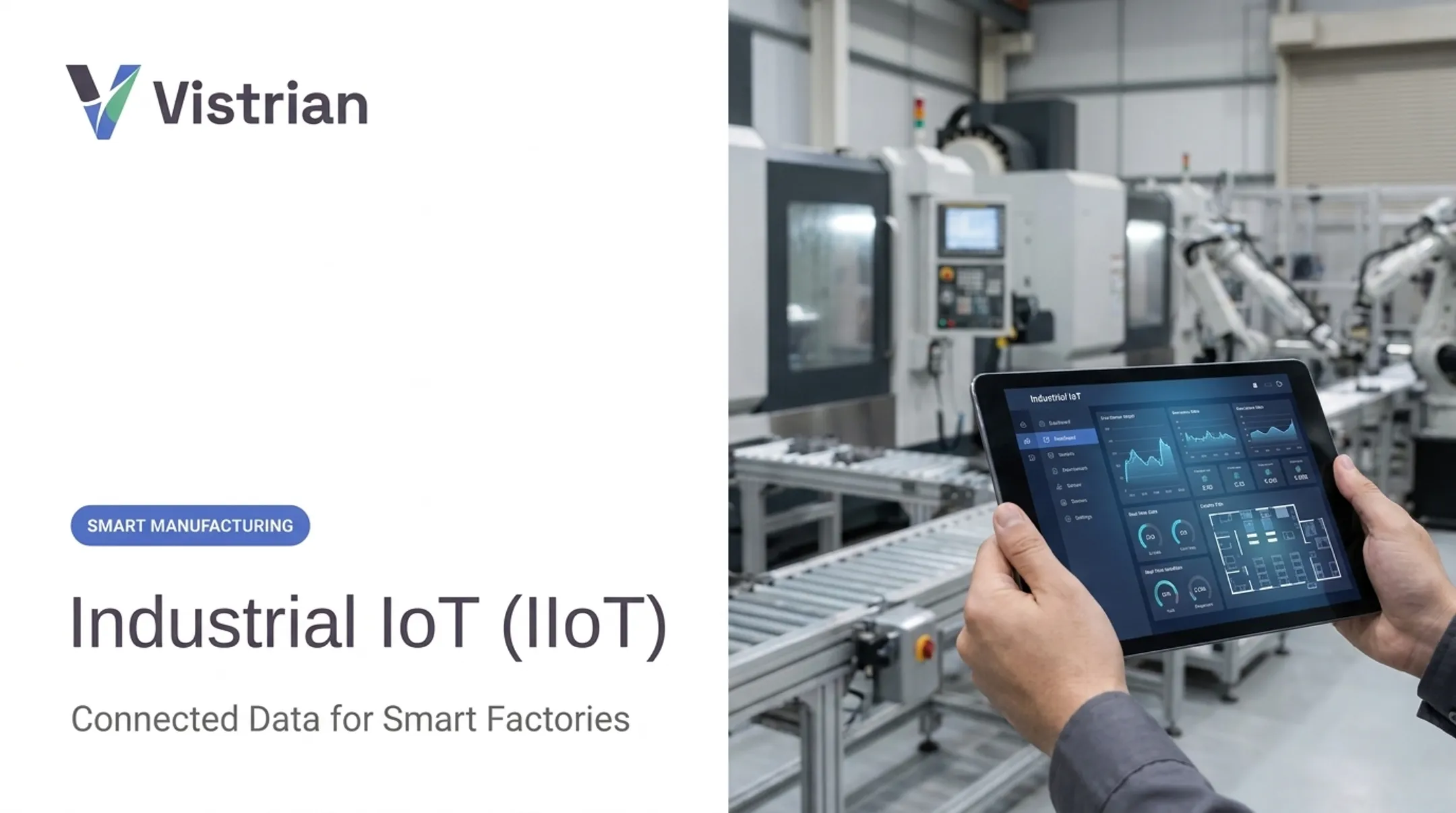
Manufacturing IoT is a system of connected sensors, machines, software, and analytics that captures operational data and turns it into insight or action. Plants use that data to make better, faster decisions on the floor.
The typical data flow starts at the equipment. A sensor or a direct connection to a machine's controller (PLC) captures data. This information moves through a gateway to an on-site or cloud platform where it's processed into dashboards, alerts, or analytics reports.
The real value appears when this data drives a workflow—automatically creating a maintenance task, flagging a quality deviation, or identifying a production bottleneck.
Without this connected visibility, operations often rely on:
- Spreadsheet-based reporting with multi-day delays.
- Inconsistent definitions of downtime and its causes.
- Reactive, "firefighting" maintenance cycles.
- Difficulty comparing performance across lines or sites.
This is why investment is growing. According to a 2025 Deloitte survey of large US manufacturers, 46% have already adopted Industrial IoT (IIoT), with many reporting production output improvements between 10% and 20%. They see that real-time data directly impacts uptime, throughput, yield, and equipment utilization.
Key IoT Use Cases in Manufacturing
IoT solutions start with connected data. Most plants begin with basic visibility, then add predictive analytics and multi-site optimization as the data foundation matures. These are the use cases manufacturers prioritize first.
Predictive Maintenance and Asset Health Monitoring
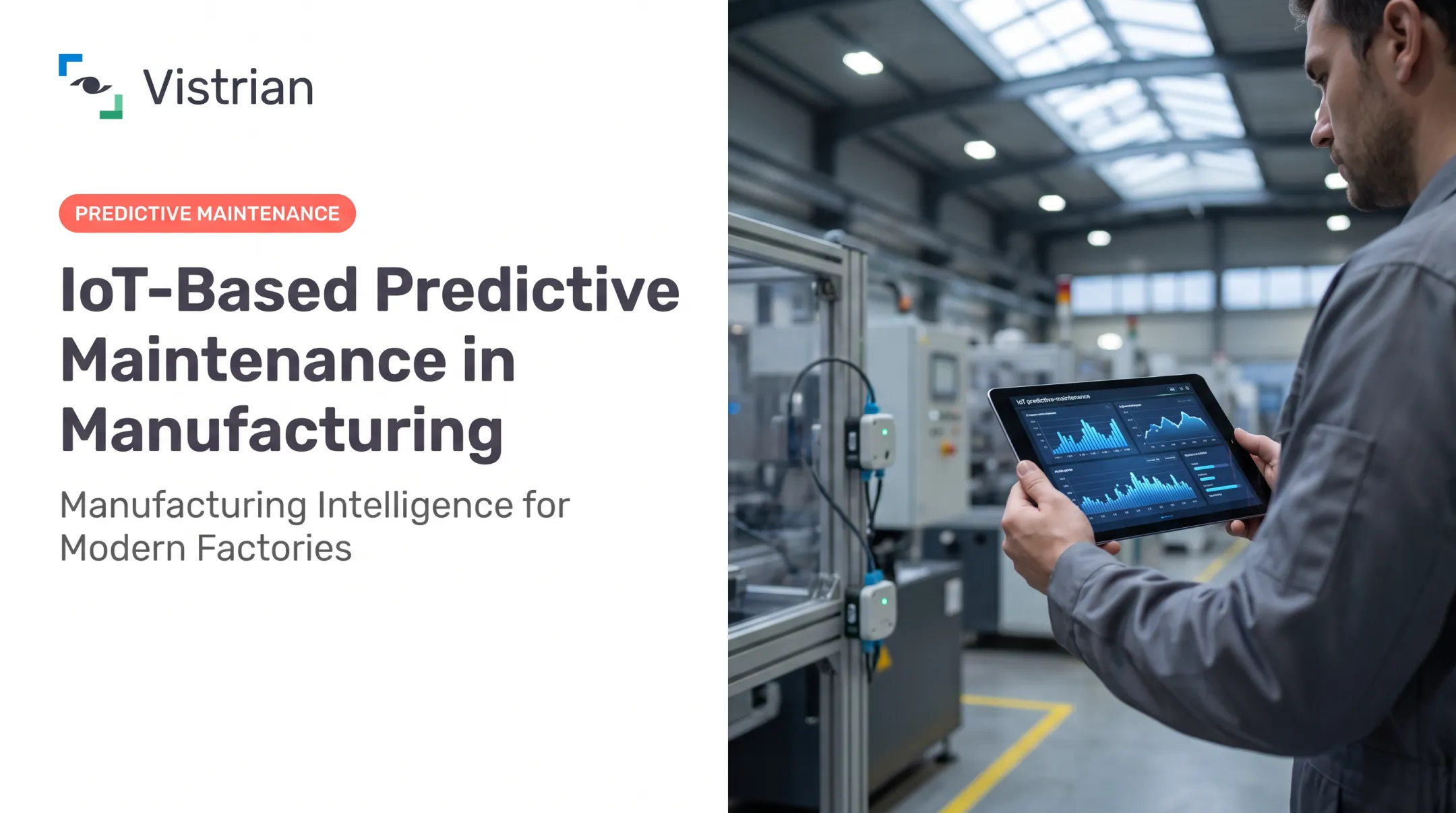
Instead of waiting for a machine to fail, predictive maintenance uses IoT data to anticipate problems before they cause unplanned downtime. Sensors monitoring vibration, temperature, pressure, or motor current can detect abnormal conditions that signal a future failure.
The workflow is straightforward:
- Data from sensors or controllers establishes a baseline for normal operation.
- The system detects an anomaly (unusual vibration or a temperature spike).
- An alert goes automatically to the maintenance team.
- A work order is created, often with diagnostic data attached.
- After the repair, data confirms the asset has returned to a healthy state.

This approach fits critical rotating equipment, CNC machines, pumps, and compressors. A platform like Vistrian's Maintenance Suite (VistrianMMS) can use vibration sensors to flag bearing wear or thermal imaging to spot electrical issues early.
It does need reliable historical data and well-governed alerts. The payoff is less reactive maintenance: a World Economic Forum report highlighted a heavy industry manufacturer that cut its equipment failure rate by 28% with intelligent predictive maintenance.
Real-Time Production, OEE, and Bottleneck Visibility
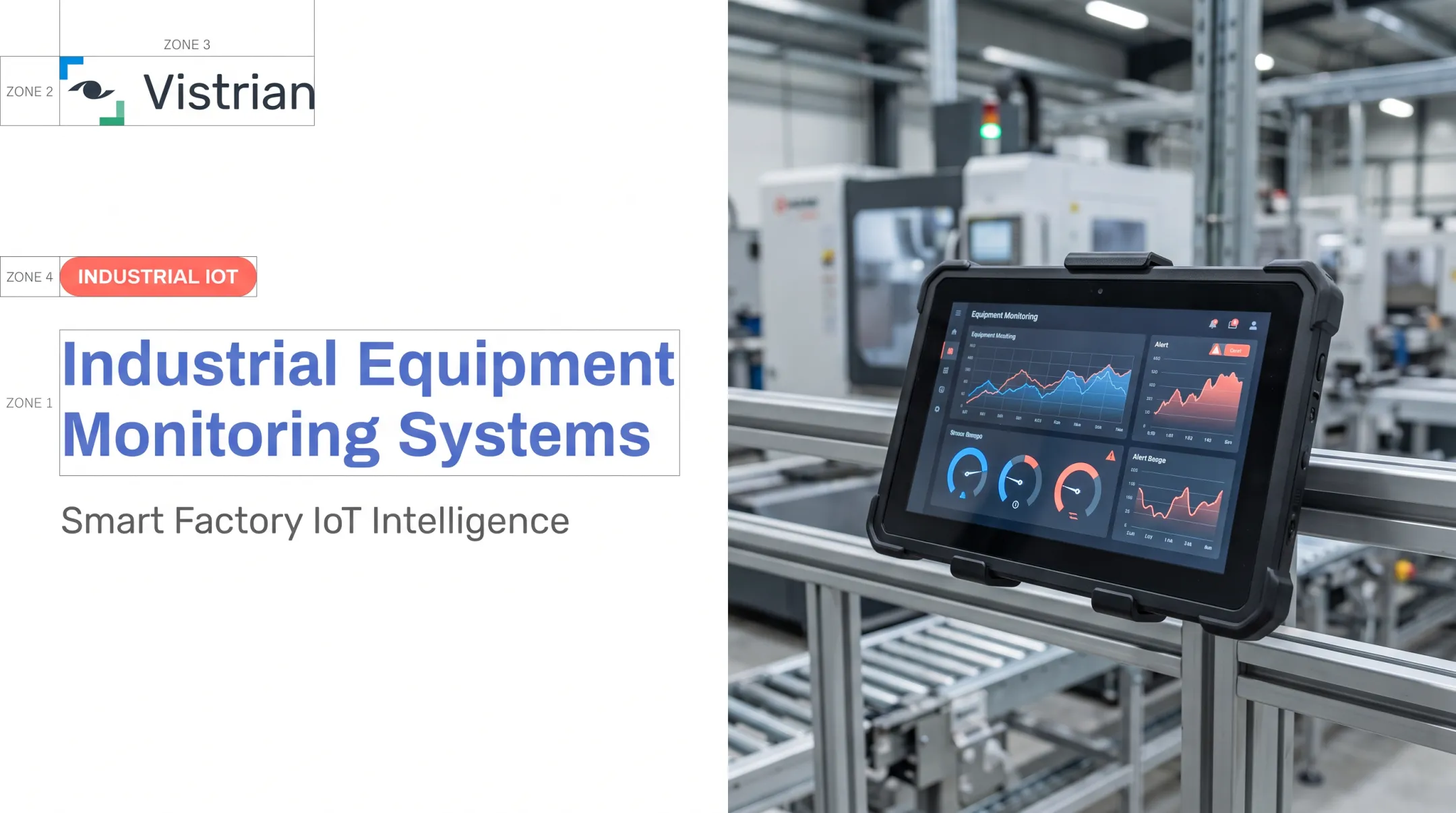
How well are your lines really running? IoT systems answer this by automatically capturing machine states, cycle counts, part counts, and downtime reasons. This data feeds directly into KPIs like Overall Equipment Effectiveness (OEE).
OEE measures manufacturing productivity across three factors:
- Availability: Is the machine running when scheduled? (Unplanned stops)
- Performance: Is it running at ideal speed? (Slow cycles)
- Quality: Is it producing good parts? (Rejects and rework)
With a shared dashboard, operators and supervisors see live performance, while plant leaders compare historical trends across lines or sites. That replaces whiteboards and delayed spreadsheet reports, so teams can spot bottlenecks and respond faster.
Platforms like Vistrian's FactoryLOOK connect to controllers and sensors to turn raw machine signals into actionable OEE metrics and downtime analysis.
Quality Control and Process Monitoring
Traditional quality control often relies on final inspection, where defects show up after time and materials are already wasted. IoT enables in-process quality monitoring so deviations are caught as they happen.
By monitoring parameters like temperature, pressure, torque, or dimensional measurements in real time, you keep production conditions inside specified limits. If a variable drifts, the system can trigger an alert for immediate containment. This approach supports:
- Faster root-cause analysis — traceability links each batch to the machine, operator, and process parameters at production time
- Less scrap and rework — early detection stops bad parts before more are made
- Simpler audits — electronic records give a complete, unalterable compliance history
For example, a pharmaceutical site featured in the same World Economic Forum report reduced its non-perfect batches by 80% using AI and connected quality systems.
Inventory, Energy, Safety, and Remote Operations
IoT also pays off outside the individual machine cell, across inventory, utilities, safety, and multi-site operations.
- Inventory and material flow: RFID tags, location trackers, and weight sensors improve visibility of raw materials, WIP, and finished goods
- Energy management: Machine-level meters show which assets drive consumption, flag abnormal use, and surface savings
- Worker safety: Sensors can monitor hazardous conditions and trigger automated alerts; the U.S. GAO notes evidence on wearables is still limited, yet plants keep adopting them for hazard monitoring in sectors with 700,000+ nonfatal injuries in 2022
- Remote operations: For distributed equipment or multi-plant networks, a centralized dashboard gives leadership one view of enterprise performance
How to Choose and Implement an IoT Solution
The best IoT solution is the one that solves your most pressing business problem—not the flashiest AI model or the biggest sensor catalog. Use a practical, three-phase approach: define the objective, assess your stack, then pilot and scale.
1. Define the Business Objective and Baseline
First, identify the pain. Are you struggling with unplanned downtime, inconsistent quality, or a lack of OEE visibility? Pick one priority problem to solve.
Before you look at any technology, establish your current state.
- What is the operational cost of this problem?
- What is your baseline for KPIs like OEE, first-pass yield, or MTBF?
- Who owns the process (operations, maintenance, quality)?
- What data do you already have, and where are the gaps?
2. Assess Connectivity, Architecture, and Integration
Next, inventory the systems you already run. You may have more usable data than you think:
- PLCs and CNCs
- SCADA systems and historians
- MES or ERP databases
A flexible IoT platform should connect to the protocols and sources you already use, including legacy equipment. Vistrian's Manufacturing Suite, for example, is a software-led platform that ties into existing controllers and machines. Where digital interfaces are missing, IIoT sensors can fill the gaps on older assets.
Decide what must run at the edge for low-latency decisions versus what can go to the cloud for historical analysis and multi-site reporting.
The platform also needs a clear path from insight to action—dashboards, alerts, or direct integration with your maintenance system.
3. Start with a Focused Pilot and Scale in Phases
Keep the first scope narrow. Select one production line, a group of critical assets, or a single plant where the problem is significant and stakeholders are engaged.
Involve a cross-functional team from day one:
- Operations
- Maintenance
- IT
- Quality
- Frontline users
That mix keeps the pilot tied to a real shop-floor problem instead of another unused dashboard.
During the pilot, validate:
- Data accuracy
- Alert usefulness
- User adoption
Use those results to build the business case for wider rollout. A focused pilot—like one Vistrian customer project that helped avoid over $1 million in capital spending—creates the momentum to scale across the enterprise.

What to Check Before Finalizing an IoT Solution
As you evaluate vendors, run through this checklist before you commit:
- Addresses the specific business objective you defined up front
- Connects to legacy equipment, standard protocols, and existing MES, ERP, and CMMS systems
- Covers device identity, network segmentation, access control, and encryption aligned to NIST SP 800-82 or ISA/IEC 62443
- Reflects full TCO beyond subscription fees: sensors, integration, training, support, and internal management time
- Scales to more lines, plants, and users without creating data silos
- Shows proven manufacturing experience via case studies, implementation support, and a clear training plan
Score each item against your shortlist so the final pick holds up on the plant floor, not just in a demo.
Conclusion
IoT solutions turn equipment and process data into decisions that raise uptime, throughput, quality, and profitability. The use cases span basic machine monitoring to predictive analytics—but you do not need to tackle all of them at once.
Start with one measurable manufacturing problem. Run a focused pilot, prove value against clear KPIs, then expand the same approach across lines and plants.
Frequently Asked Questions
How is IoT used in manufacturing?
Connected sensors, machines, and software collect real-time operational data. Manufacturers use that data across production monitoring, predictive maintenance, quality control, inventory tracking, and energy management.
What are some examples of Industrial IoT?
Typical deployments include vibration sensors for predictive maintenance, real-time OEE dashboards, quality systems that track process parameters, RFID asset tracking, and remote equipment monitoring across multiple plants.
What are the main benefits of IoT in manufacturing?
Plants gain clearer operational visibility, higher equipment utilization and uptime, increased throughput, more consistent quality, better maintenance planning, and faster root-cause analysis.
How does IoT support predictive maintenance?
Condition data like vibration, temperature, and pressure can identify abnormal patterns in equipment behavior. This allows teams to trigger maintenance alerts before a catastrophic failure occurs, reducing unplanned downtime.
Can IoT connect to legacy manufacturing equipment?
Yes. Gateways, protocol adapters, and direct controller connections can integrate older equipment. For machines without digital interfaces, adding modern IIoT sensors is a cost-effective way to bring them online.
How should a manufacturer start an IoT implementation?
Start by defining a clear business objective and establishing baseline KPIs. Then, assess your existing equipment and systems, run a focused pilot on one line or asset group, and ensure you have cross-functional ownership before scaling.