
Introduction
A bearing starts vibrating outside its normal range at 2 a.m. Nobody notices until the motor seizes three shifts later, taking a production line down for the rest of the day. This scenario plays out across US manufacturing plants every week, and the cost adds up fast.
More than two-thirds of plant-maintenance decision-makers report at least one unplanned outage every month, with typical costs near $125,000 per hour, according to a 2023 ABB survey of over 3,200 maintenance leaders.
Condition-based maintenance (CBM) software addresses this directly. Instead of servicing equipment on a fixed calendar or waiting for it to break, CBM platforms use real equipment-condition data such as vibration, temperature, and current to tell teams when maintenance is actually needed.
This guide compares leading CBM platforms on sensor connectivity, condition monitoring, analytics, work-order execution, manufacturing fit, scalability, usability, and implementation effort.
Key Takeaways
- CBM software should turn asset data into completed maintenance work, not just display sensor charts.
- Require monitoring, alerts, prioritization, work orders, analytics, and CMMS/ERP integration together.
- Vistrian, Fracttal One, IBM Maximo, eMaint, and Fiix differ on visibility depth and connected maintenance.
- Choose based on asset criticality, sensors, legacy equipment, and technician workflows.
- Have vendors prove the full path from abnormal signal to documented work order.
Overview of Condition-Based Maintenance Software in the US Manufacturing Market
Condition-based maintenance software collects or receives equipment-health data, compares it against baselines or thresholds, and helps teams decide when to act, based on actual asset condition rather than a fixed schedule.
How CBM differs from other maintenance models:
- Preventive maintenance runs on time or usage intervals, whether the asset needs work or not.
- Predictive maintenance uses historical data, statistical models, or machine learning to estimate when failure is likely.
- CBM sits between them and triggers work from the asset's current condition.

Many modern platforms, including several covered below, support both CBM and predictive workflows in the same system.
Where the Data Comes From
Industrial CBM programs typically draw on:
- Vibration and ultrasound readings
- Temperature and thermal imaging
- Pressure, flow, and current/energy signals
- Oil quality and tribology data
- Inspection results and machine logs
- PLC/SCADA signals and IIoT sensors
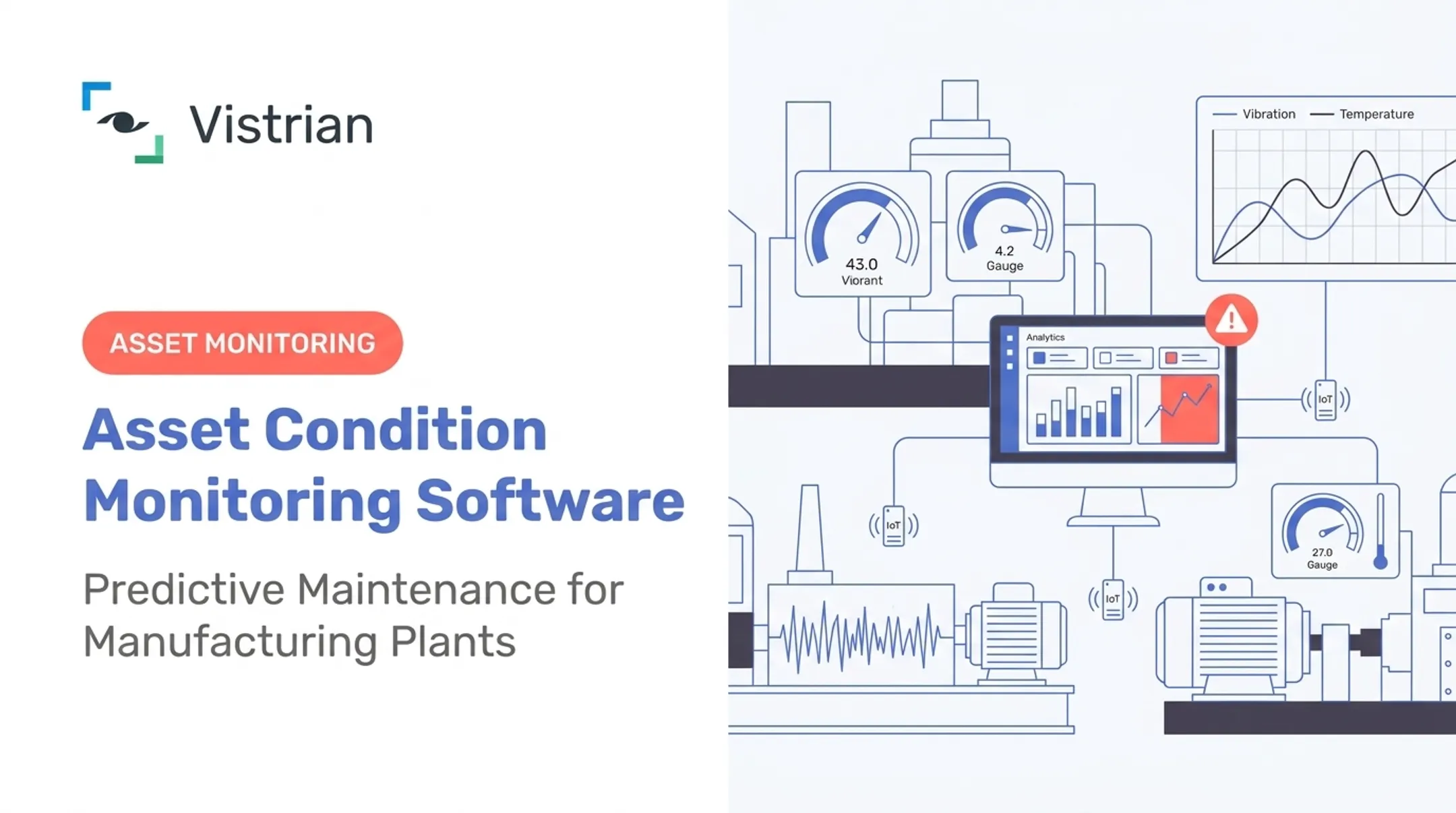
Fluke's condition-monitoring documentation ties these signals to specific failure modes. Vibration analysis flags imbalance, looseness, and bearing damage; thermography catches motor overheating and gearbox friction before they escalate.
The stakes are well documented. NIST's Advanced Manufacturing Series report found establishments in the top quartile for reactive maintenance experienced 3.3 times more downtime than peers relying more heavily on preventive and predictive approaches. That gap is exactly what CBM software is built to close.
The platforms below are evaluated on how well they turn raw condition data into timely, traceable maintenance action.
Best Condition-Based Maintenance Software for US Manufacturers
This comparison covers software with documented CBM, CMMS, EAM, IIoT, or analytics capability relevant to US manufacturing plants. Rankings reflect current, verifiable product functionality.
Vistrian Manufacturing Suite and Maintenance Suite
Vistrian's modular, cloud-enabled platform connects equipment data from machine controllers, logs, databases, standard protocols, and IIoT sensors through its FactoryLOOK module. Its Maintenance Suite (VistrianMMS) then turns that data into maintenance workflows. What sets it apart:
- Vistrian Industrial IoT adds sensors to machines that lack digital interfaces, useful for plants running older or mixed-vendor equipment.
- FactoryLOOK's rules engine detects anomalies against predefined thresholds and pushes alerts into work orders with owners, due dates, and parts lists attached.
- Vistrian Analytics provides OEE, throughput, and utilization tracking alongside root-cause analysis.
- Dashboards support centralized monitoring across multiple factories, from machine level up to enterprise level.
Internally documented results show Vistrian's Maintenance Suite associated with a 20-50% reduction in equipment downtime, along with material-cost reductions of up to 19.4%.
One deployment for North America's largest cocoa processor helped the customer avoid more than $1 million in ineffective capital spending after FactoryLOOK exposed a hidden production bottleneck.
Best fit Condition data sources Deployment Pricing Manufacturing plants replacing spreadsheets, fabs monitoring capital equipment, multi-plant operations Machine controllers, PLCs, sensors, IIoT devices, legacy systems Cloud or on-premises, browser/mobile access Quote-based Who should look at it: - Manufacturing plants moving off spreadsheets or disconnected systems
- Semiconductor and electronics fabs monitoring capital equipment
- Plants with legacy or mixed-vendor machines
- Operations leaders who need consolidated analytics across several sites Note: Vistrian is not a sensor manufacturer. It is a manufacturing intelligence and maintenance platform—fit depends on whether your use case matches its Manufacturing Suite, Maintenance Suite, Analytics, and IIoT capabilities.

Fracttal One
Fracttal One combines CMMS functionality with condition monitoring, IoT inputs, and more advanced predictive-maintenance workflows. It connects IoT sensors to monitor equipment conditions, detect deviations, and trigger action, backed by a field app that supports offline task execution, readings, and photo documentation. Key considerations:
- Alerts from abnormal readings can prioritize maintenance and connect directly to work orders.
- A documented API supports connections between Fracttal's maintenance management tools and external applications.
- Pricing is quote-based; there's no published tier structure on the official site.
Best fit Notable strength Pricing Teams wanting CMMS plus condition monitoring and offline mobile access Field app with offline capability Quote-based Before signing on, ask about data quality controls, how customizable alert thresholds are, and whether the platform connects to your existing CMMS or ERP without brittle custom integration.
IBM Maximo Application Suite
Maximo is built for organizations that need full asset lifecycle management at enterprise scale: work orders, inspections, condition data, analytics, governance, and broad integration. Condition Insight turns real-time and historical asset data into health trends, anomaly alerts, and prioritized corrective actions. IBM's Asset Performance Management layer adds reliability engineering and AI-assisted decision support on top. Enterprise trade-offs to weigh:
- Broad functionality often requires specific modules or add-ons rather than being bundled by default.
- Deployment supports on-premises, hyperscaler, or SaaS models, with subscription licensing tied to a minimum 12-month term.
- Configuration, change management, and training typically demand more investment than a focused maintenance platform.
IBM points to Spendrups, a brewery that shifted to condition-based and predictive upkeep with Maximo to improve reliability and efficiency, and Novate Solutions, which uses Maximo Monitor for real-time asset performance visibility.
Best fit Notable strength Pricing Complex or regulated plants needing enterprise EAM depth Condition Insight plus full asset lifecycle scope Subscription; 12-month minimum Best fit: complex or regulated manufacturing operations that need enterprise EAM depth and can support the implementation effort.
eMaint
eMaint is a CMMS/EAM platform built around detailed asset hierarchies, connected reliability, and Fluke sensor integration. Its condition-monitoring module generates alarms for overall vibration and narrowband fault signatures, automatically creating prioritized work orders routed to the right technician once readings exceed defined limits. Notable capabilities:
- A master-child hierarchy standardizes work orders, assets, and parts across hundreds of sites.
- Technicians can pull asset history, manuals, and spare-parts availability from a mobile device in the field.
- Official SCADA/PLC integration is documented, alongside ERP and BI connectivity.
Best fit Strength Pricing Plants with complex equipment hierarchies and multi-site standardization needs Fluke sensor mapping to automatic work orders Quote/demo-based Buyers should confirm configuration effort up front and be clear on which capabilities are native to eMaint versus delivered through Fluke sensors or higher-tier plans.
Fiix
Fiix, part of Rockwell Automation's MaintenanceSuite, leans on integration strength over standalone sensor hardware. Its condition-based workflow monitors equipment readings and automatically generates work orders once predefined thresholds are crossed, pulling real-time data from PLCs into the CMMS. Pricing (published on Fiix's site):
- Free: $0
- Basic: $45/user/month
- Professional: $75/user/month
- Enterprise: custom pricing Condition-based triggers and ERP/custom API integrations are Enterprise-tier features. In a published Fiix case study, manufacturer PCI reported 54% less reactive maintenance, 47% fewer after-hours call-ins, and roughly $40,000 in annual maintenance savings after adopting condition-based workflows. Best fit: plants that already run SCADA, PLC, or ERP infrastructure and want a CMMS that plugs into that stack rather than replacing it. Confirm data latency before rollout, and decide who owns interpretation of abnormal readings.
How We Chose the Best Condition-Based Maintenance Software
We evaluated each platform against the full CBM workflow, not isolated features.
The test covered the full loop:
- Identify critical assets and collect reliable condition data
- Establish baselines and detect abnormal conditions
- Generate an actionable alert and prioritize the work
- Document the intervention and feed it back into asset history

Evaluation criteria included:
- Condition-monitoring coverage – vibration, temperature, pressure, electrical, oil, ultrasound, inspection, PLC/SCADA, and IIoT data, with third-party-dependent features flagged clearly.
- Integration and technical fit – legacy-machine connectivity, standard protocols, APIs, cloud/on-premises options, and multi-site architecture.
- Maintenance usability – asset hierarchy, criticality ranking, threshold configuration, mobile and offline access, and role-based permissions.
- Business fit and implementation risk – manufacturing-industry experience, training requirements, scalability, support model, and pricing transparency.
Reliabilityweb's Asset Condition Monitoring framework, a widely referenced (if dated) industry guide, informed this structure. A platform earns credit only where it can assess condition, diagnose early, and support corrective action, not merely display a reading.
Conclusion
The best condition-based maintenance software connects trustworthy equipment data to decisions and work your team can execute every day. A long feature list means little if alerts never become completed jobs.
Shortlist based on:
- Asset criticality and failure consequences
- Current plant systems (SCADA, PLC, ERP)
- Legacy-equipment connectivity needs
- Technician adoption and mobile/offline requirements
- Scalability across sites and security posture
Before committing, request a proof of concept using your own representative assets and a realistic alert-to-work-order scenario. Watch how each platform handles the full path, from an abnormal signal to a documented, completed job.
If your plant needs real-time visibility that connects machine data to maintenance action, without ripping out legacy equipment, Vistrian's Manufacturing Suite, Maintenance Suite, Analytics, and IIoT capabilities are worth evaluating against your current condition-monitoring gaps.
Frequently Asked Questions
What are examples of condition-based maintenance software?
Vistrian, Fracttal One, IBM Maximo, eMaint, and Fiix all offer CBM-relevant functionality. Capabilities and required modules vary, so verify specifics against each vendor's current documentation.
Can you give me an example of condition-based maintenance?
A pump's vibration sensor crosses its established threshold. The system alerts maintenance, a technician assesses the bearing, schedules a repair before failure, and logs the work order for future reference.
What features should condition-based maintenance software include?
Core features include condition-data ingestion, asset records, baselines and thresholds, anomaly alerts, prioritization, work-order management, mobile technician access, and integrations with ERP or SCADA systems.
What is the difference between condition-based maintenance and predictive maintenance software?
CBM triggers action from an asset's observed current condition. Predictive maintenance uses historical data and statistical or machine-learning models to forecast a future failure point. Many platforms now support both.
Which sensors are used for condition-based maintenance?
Common sensor types include vibration, temperature, pressure, current, oil quality, ultrasound, and acoustic sensors. The right choice depends on the asset type and its likely failure modes.
How do I choose the best condition-based maintenance software?
Assess your critical assets, existing sensors and controls, integration requirements, and technician workflows. Run a pilot to confirm the alert-to-work-order path actually works before committing.