
This is what happens when maintenance runs on tribal knowledge instead of a system. Records live in someone's notebook. Repairs happen after equipment fails, not before. Safety incidents climb because inspections get skipped when things feel "fine."
Maintenance management fixes this by coordinating people, processes, asset data, work, materials, and technology to keep equipment safe, reliable, and cost-effective. It's not a repair function bolted onto operations. It's an operating discipline.
This guide covers the strategies available to you, what a maintenance manager actually does day to day, how to build a program from scratch, what a CMMS can (and can't) do for you, and the KPIs that tell you whether any of it is working.
Key Takeaways
- Maintenance management is an operating system for planning, executing, and improving asset care, not a repair task or a software purchase
- Strategy selection depends on asset criticality, failure patterns, and the cost of intervention, not a one-size-fits-all rule
- A CMMS centralizes work orders, preventive schedules, inventory, and reporting into one trustworthy record
- Results stick only when data is accurate, technicians actually use the system, and leadership reviews outcomes regularly
What Is Maintenance Management?
Maintenance management is the coordinated planning, scheduling, execution, monitoring, and improvement of maintenance work across every physical asset your facility relies on. It touches inspection routines, preventive schedules, emergency repairs, parts procurement, technician assignments, and the reporting that tells leadership whether reliability is improving or slipping.
Three terms get used interchangeably, and they shouldn't be.
- Maintenance management is the overall discipline: how work gets identified, planned, executed, and reviewed.
- Maintenance strategy determines how work is triggered, whether that's a calendar date, a sensor reading, or a breakdown.
- CMMS software is the tool that organizes and documents the work once the strategy decides what needs doing.

For US manufacturers and multi-site facilities teams, this discipline directly connects to uptime, throughput, product quality, safety compliance, energy consumption, and the lifecycle cost of every machine on the floor. A poorly maintained press doesn't just risk a breakdown. It risks scrap rates, OSHA exposure, and a shortened asset life that forces early capital replacement.
Siemens reports that one hour of unproductive time now costs automotive manufacturers an average of $2.3 million, roughly double what it cost in 2019.
Broader manufacturing data puts average unplanned downtime above $260,000 per hour. The figure varies by industry and plant size, but the point holds: downtime is expensive, and it's getting more expensive.
The core objectives of maintenance management are straightforward:
- Maximize asset reliability and availability
- Reduce avoidable downtime and rushed repairs
- Control labor and materials costs
- Extend useful equipment life
- Improve workplace safety
- Support smarter repair-versus-replace decisions
Maintenance Management vs. Asset Management and EAM
Maintenance management and asset management often get lumped together, but they answer different questions. Maintenance management asks, "How do we keep this equipment running safely and reliably?" Asset management asks a bigger question: "What's the best decision for this asset across its entire lifecycle, including its financial and operational value?"
The ISO 55000 asset management standard defines asset management as the coordinated activity an organization undertakes to realize value from its assets, balancing cost, risk, and performance against organizational goals. That scope covers acquisition, financing, procurement, and disposal decisions, well beyond what a maintenance team typically owns.
Enterprise Asset Management (EAM) sits in between. A CMMS is often the execution and data layer that feeds a broader EAM or asset management program.
A practical example: At a food manufacturing plant, the maintenance team tracks work orders and failure history on a packaging line through its CMMS. That same data feeds into a facility-wide asset management review that decides whether to repair the aging line again or replace it during next year's capital budget. Same asset, same data, two different decisions being made from it.
Core Functions and Responsibilities
Maintenance management breaks down into five practical functions that happen on a rolling basis, not in a strict sequence:
- Inspection and condition assessment — routine checks that catch problems before they escalate
- Preventive or planned maintenance — scheduled work based on time, usage, or manufacturer guidance
- Corrective work — fixing issues identified through inspection or reported by operators
- Emergency response — restoring function fast after an unplanned failure
- Performance improvement — reviewing what failed, why, and how to prevent it next time

What a Maintenance Manager Actually Does
The role is equal parts scheduler, negotiator, and analyst. Day to day, a maintenance manager:
- Sets priorities across competing work requests
- Builds technician schedules around production needs
- Coordinates equipment availability with production or facilities leadership
- Manages contractor relationships and spare parts inventory
- Owns safety and compliance accountability
- Reports reliability results, backlog, and costs to leadership
The job needs technical fluency and organizational judgment together—not one without the other.
The Five Skills That Make Maintenance Teams Effective
- Technical troubleshooting — diagnosing root causes, not just symptoms
- Planning and scheduling — sequencing work to minimize disruption
- Safety awareness — lockout/tagout, PPE, and hazard recognition as second nature
- Documentation and data literacy — closing out work orders with information someone can actually use later
- Communication and teamwork — coordinating across shifts, departments, and contractors
None of this works if it's siloed inside a maintenance department. Operators, reliability engineers, inventory teams, and production leaders all touch the process.
In practice, that handoff looks like this: an operator notices unusual vibration on a mixer and logs it through VistrianMMS. The system routes the alert to the responsible technician, who reviews equipment history, confirms parts availability, and schedules the repair during the next planned downtime window instead of waiting for a breakdown.
The completed work order feeds back into the asset's history and shapes the next round of preventive scheduling.
Maintenance Strategies and Types
There's no single "correct" maintenance strategy. The right approach depends on what the asset does, how it fails, and what a failure actually costs you.
Reactive (corrective) maintenance means running equipment until it breaks, then fixing it. The DOE Federal Energy Management Program describes this as "run it till it breaks," with clear tradeoffs:
- Unplanned downtime and overtime labor
- Secondary damage to related components
- Inefficient use of parts and crew time
It's a reasonable choice for low-risk, inexpensive, or easily replaceable parts. It's a poor choice for anything tied to safety or production continuity.
Preventive maintenance schedules work based on time, usage hours, or manufacturer recommendations. It's predictable and easy to plan around, but without reviewing schedules against actual failure data, plants end up over-maintaining equipment, replacing parts that still have useful life left.
Condition-based and predictive maintenance both respond to equipment condition rather than the calendar, but they're not identical.
Reliabilityweb defines condition-based maintenance as directing action from measured operating indicators, such as temperature or vibration thresholds.
Predictive maintenance goes further. It uses historical and real-time data with analytics or machine learning to forecast when a failure is likely—not only whether current readings look abnormal.
Reliability-centered maintenance (RCM) prioritizes asset functions and the consequences of failure, formalized in the SAE JA1011 standard. Total Productive Maintenance (TPM), developed by the Japan Institute of Plant Maintenance, brings operators and the broader workforce into daily equipment care rather than isolating it within the maintenance department.
Choosing the Right Strategy
Match the approach to these factors:
| Factor | Leans toward reactive/preventive | Leans toward condition-based/predictive |
|---|---|---|
| Asset criticality | Low | High |
| Failure consequence | Minor, easily contained | Safety or production-critical |
| Sensor availability | Limited | Available and reliable |
| Intervention cost | Low | High enough to justify monitoring |
TBM and CBM Within TPM
Inside a TPM program, two scheduling philosophies do most of the work. Time-based maintenance (TBM) performs tasks at fixed intervals, regardless of actual condition—think scheduled lubrication every 90 days. Condition-based maintenance (CBM) waits for a measured signal, like a vibration reading crossing a threshold, before triggering work.
TBM is simple to govern and predictable to staff. Its weakness is timing: work can happen before it's needed, or a failure can occur between scheduled intervals. CBM avoids unnecessary servicing and catches developing problems, but it depends on reliable sensors and someone actually analyzing the data. Safety procedures and manufacturer requirements always take priority over either method.

When you run both methods in one system, scheduling and condition signals need to live in the same place. VistrianMMS supports TBM and CBM side by side—usage- or time-based triggers plus condition data from FactoryLOOK's IoT connections—so teams can flag developing issues before they become failures.
How to Build an Effective Maintenance Management Program
Start with an asset register. List every piece of equipment, its location, its owner, its operating context, its maintenance history, and the consequences if it fails. Without this foundation, every decision after it is a guess.
Next, classify asset criticality. Score each asset on safety risk, environmental exposure, production impact, quality impact, and cost of failure. Reliabilityweb's asset criticality guidance recommends tiering assets this way, but treats the model as customizable—not a universal formula. Food-grade equipment and forklifts should not share the same weighting.
Once tiers are set, match work to risk:
- Select tactics per asset and failure mode — combine reactive, preventive, and condition-based work where each makes sense
- Build standard work — job plans, lockout/tagout steps, parts lists, labor estimates, and acceptance criteria
- Establish a planning and scheduling cycle — separate urgent work from planned work and track backlog weekly
- Close the loop with root-cause analysis — every recurring failure should update the maintenance plan, not just get logged and forgotten
Implementation Without the Chaos
Don't roll this out plant-wide on day one. Start with a pilot area, one production line or one equipment group. Clean up its asset data, document the current process honestly, and set two or three measurable objectives before expanding further.
Adoption hinges on making the system easy to use:
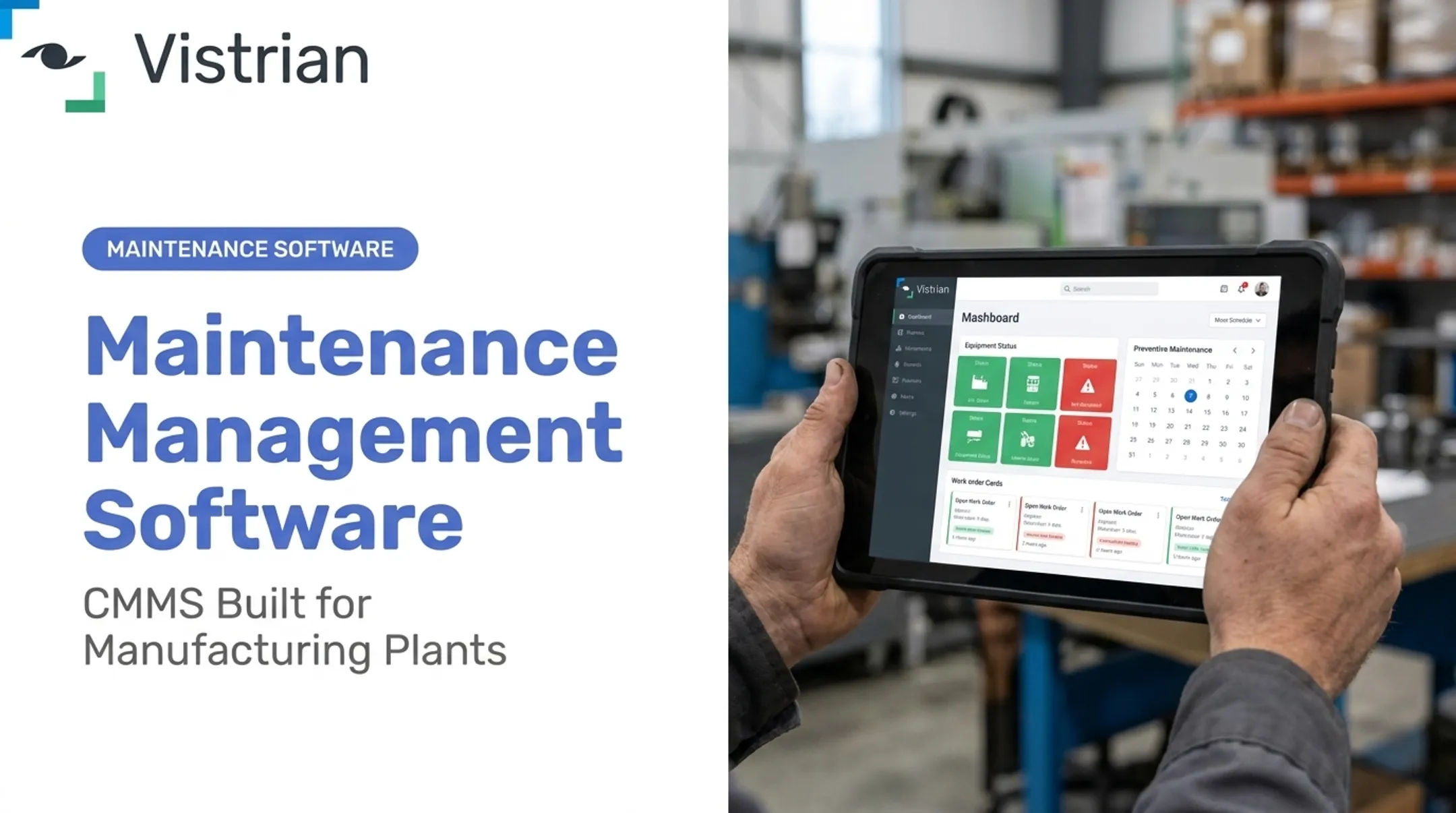
- Mobile access for technicians on the floor
- Simple, fast work-order fields, not 30-field forms
- Practical training instead of a manual dump
- Leadership visibly using the reports, not just requesting them
Data governance matters more than most teams expect. Standardize asset names, failure codes, and closeout fields early, because inconsistent naming quietly wrecks reporting accuracy six months in. Also lock down cybersecurity basics: user permissions, backup retention, and clear ownership of any integrations with production or ERP systems.
Structured programs can deliver large gains. Buzzi Unicem USA, which operates seven cement plants and 34 terminals across the US, worked with a condition-monitoring partner and reportedly avoided more than 600 hours of unplanned downtime and saved roughly $1 million in production losses and emergency repairs.
That figure is specific to one case and approach—not a guaranteed result for every plant.
CMMS, Technology, and KPIs
A CMMS centralizes the records that make maintenance management possible: asset data, work requests, work orders, preventive schedules, inspections, parts inventory, labor assignments, and the audit trail leadership needs during a compliance review. A practical CMMS feature checklist should cover:
- Mobile workflows for technicians away from a desk
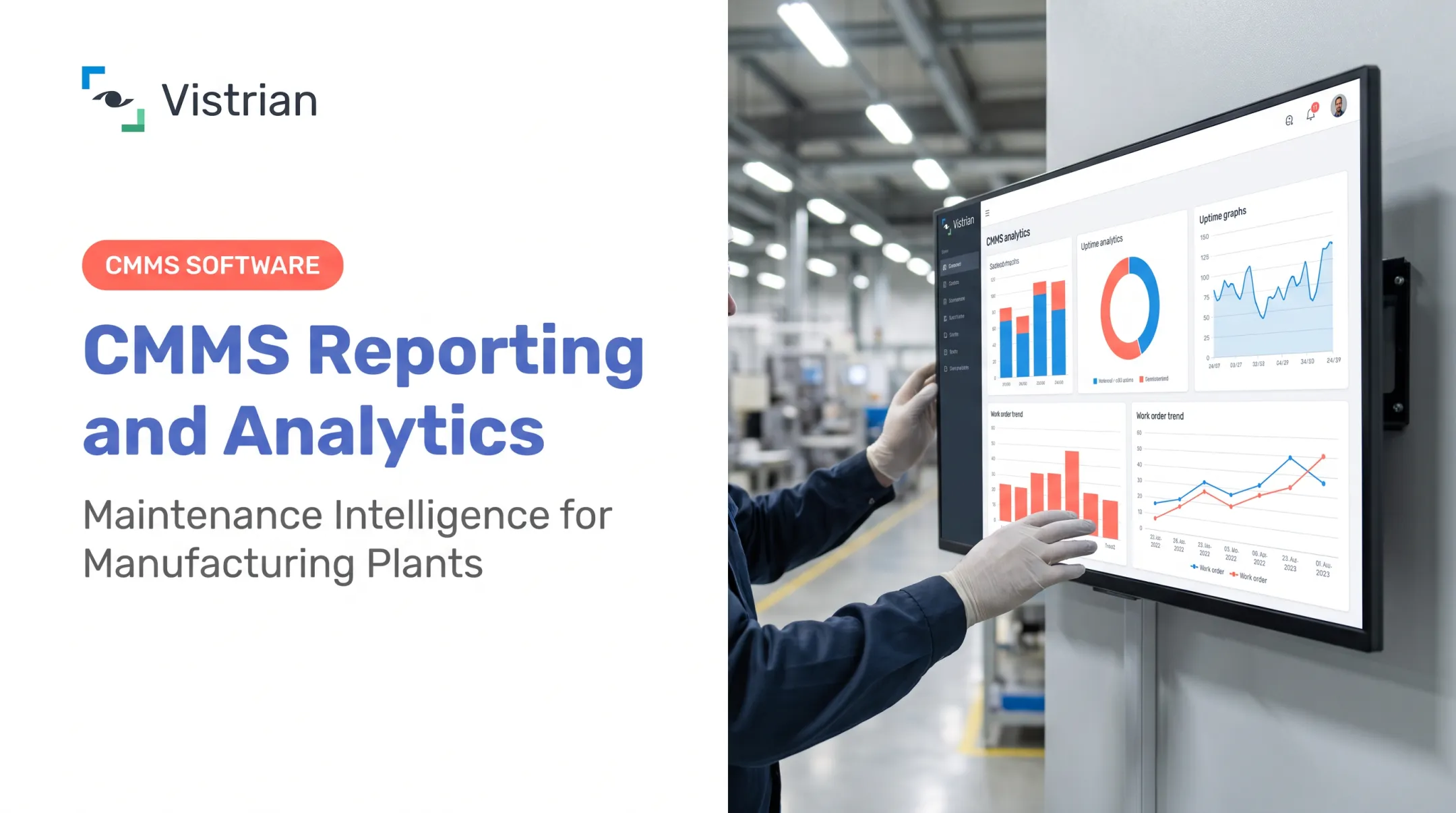
- Dashboards and configurable reporting
- Role-based access and approval routing
- Notifications and alerts tied to schedules or thresholds
- Multi-site visibility for operations spanning several plants Plant Engineering's industry survey found that 88% of industrial facilities already use preventive maintenance, while 52% run a CMMS, up slightly from 51% five years earlier. Adoption is growing, but there's still a meaningful gap between plants running structured preventive programs and those with a system actually tracking it.
Where IoT Connectivity Fits In
IoT sensors and industrial connectivity extend a CMMS by feeding it near-real-time data from modern IIoT devices, legacy controllers, and machine logs. Collecting this data is not the same as analyzing it. A sensor reading temperature every few seconds is useless until something, or someone, decides what that reading means for a maintenance decision. This is where Vistrian's modular approach fits mixed-technology environments. VistrianMMS, part of the Maintenance Suite, handles work orders, preventive scheduling, spare parts, and maintenance history in one system. FactoryLOOK connects to machine controllers, PLCs, and IIoT sensors regardless of vintage, feeding condition data into VistrianMMS for condition-based and predictive triggers. Vistrian Analytics applies predictive models on top of that data to forecast likely equipment issues before they become downtime. Together they give plants with mixed legacy and modern equipment one usable view instead of disconnected data silos.
KPIs Worth Tracking
Organize maintenance metrics by the decisions they support:
- Reliability: MTBF and MTTR show whether equipment is getting more or less dependable
- Work management: Planned-versus-reactive work ratio and schedule compliance reveal proactive work vs. firefighting
- Asset performance: Uptime and utilization rates connect maintenance directly to production output
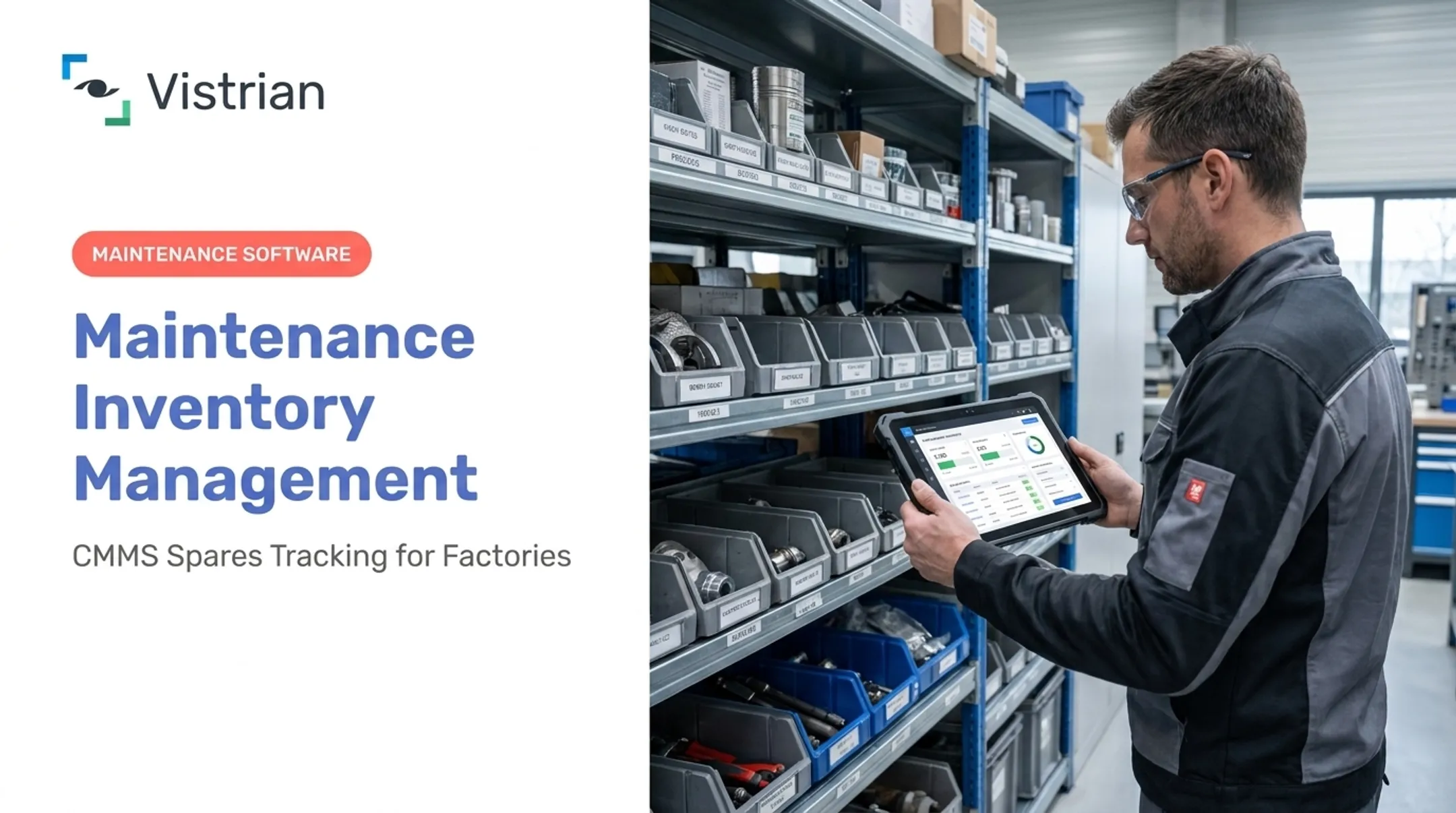
- Inventory: Stockout frequency and carrying cost balance parts availability against tied-up capital
- Safety and compliance: Overdue inspections and repeat findings flag risk before it becomes an incident VistrianMMS surfaces most of these on real-time dashboards, so reviewing them doesn't require pulling data from three separate spreadsheets before a Monday meeting.

Frequently Asked Questions
What do you mean by maintenance management?
Maintenance management is the coordinated planning, execution, tracking, and improvement of asset upkeep. It supports reliability, safety, uptime, and cost control across every piece of equipment a facility depends on.
What does a maintenance manager do?
A maintenance manager plans and prioritizes work, coordinates technicians and contractors, oversees budgets and spare parts, ensures safety and compliance, and reports reliability performance to leadership.
What are the 5 basic functions of maintenance?
Inspection, preventive maintenance, corrective maintenance, emergency response, and continuous improvement. Terminology varies by organization, but these five activities cover most maintenance work.
What are the 5 basic maintenance skills?
Technical troubleshooting, planning and scheduling, safety awareness, documentation and data literacy, and communication and teamwork. These skills apply whether you're managing one asset or an entire plant.
What are TBM and CBM in TPM?
Time-based maintenance (TBM) performs work at scheduled intervals regardless of condition. Condition-based maintenance (CBM) triggers work based on measured equipment condition. Both operate within a broader TPM program.
What is an example of CMMS?
VistrianMMS is an example of a CMMS, managing assets, work orders, preventive maintenance schedules, spare parts inventory, and maintenance reporting in a single, web-based platform.