
Manufacturing plants that lean on reactive maintenance pay for it. NIST's national analysis found that the top 25% of facilities relying on reactive maintenance had 3.3 times more downtime than facilities in the bottom quartile, and preventable maintenance losses across US manufacturing reached $119.1 billion in a single year.
This article breaks down what inspection and preventive maintenance actually mean, how they work together, and how manufacturing teams can build a program backed by accurate records and plant-floor data.
Key Takeaways
- An inspection assesses an asset's current condition; preventive maintenance performs planned work to reduce failure risk
- Inspection findings should drive work orders and follow-up, not sit in a logbook
- Strong programs rely on asset-specific checklists, trained staff, OEM guidance, and documented history
- Maintenance software connects inspections, work orders, and equipment data across one plant or many
What Inspection and Preventive Maintenance Mean
An equipment inspection is a structured assessment of an asset's condition, performance, and safety. NIST defines inspection (adapting ISO/IEC 17000) as an examination that determines conformity with specified or general requirements. In a plant, that typically means checking:
- Visual signs of wear, corrosion, or damage
- Abnormal noise, vibration, or heat
- Leaks, loose connections, or worn guarding
- Pressure, temperature, and sensor readings against expected ranges
- Alarm history and general operating behavior
Preventive maintenance (PM) is servicing performed on a fixed schedule or triggered by a prescribed criterion. The goal is to detect or prevent degradation before it becomes failure. Under OEM instructions and site safety rules, common PM tasks include:
- Cleaning and lubrication
- Tightening and calibration
- Filter changes and component swaps
- Functional tests
How These Differ From Other Maintenance Strategies
Inspection and PM often overlap on the same asset, but they differ from other maintenance approaches:
| Approach | When it happens | Trigger |
|---|---|---|
| Reactive/corrective | After failure or breakdown | Equipment has already stopped |
| Preventive | On schedule or set criterion | Calendar, usage, or defined condition |
| Predictive | Before failure, based on data trends | Vibration, temperature, current signals |
| Prescriptive | Data-driven, AI-assisted recommendations | Analyzed patterns suggesting specific action |
None of these strategies work in isolation. A well-run plant typically runs all four side by side, matching the approach to the asset's criticality and cost of failure.
How Inspections and Preventive Maintenance Work Together
Here's the distinction that trips up a lot of maintenance teams: an inspection gathers evidence about condition. Maintenance changes, restores, or preserves that condition. One tells you what's happening. The other does something about it.
A typical workflow looks like this:
- Identify the asset and pull its history and applicable checklist
- Perform the inspection using defined steps and acceptance criteria
- Record findings, both normal and abnormal, with readings or observations
- Assess risk based on severity and operational context
- Create or update a work order if action is needed
- Complete the maintenance following safety procedures
- Verify the result and log it in the asset's history

Take a production machine showing rising vibration and a small hydraulic leak. The inspection documents both symptoms with readings and photos.
The follow-up might be a scheduled seal replacement, added lubrication, or a recommendation to monitor the trend weekly. The inspection didn't fix anything. It pointed the team toward what needed fixing.
Triaging What You Find
Not every finding needs the same urgency. Teams sort results into categories:
- Safe to continue operating — no action needed right now
- Monitor — track the trend at set intervals
- Schedule during planned downtime — non-urgent but necessary
- Remove from service — risk is too high to keep running
- Escalate for specialist evaluation — beyond the technician's scope
A solid inspection record captures:
- Asset ID, date, and technician
- Readings and checklist results
- Severity and recommended action
- Work-order status and verification notes
Photos help when a written description won't cut it.
Repeated findings on the same component are worth watching closely. If the same bearing keeps showing up on inspection reports every quarter, that's a pattern, not a coincidence, and it should prompt a look at maintenance intervals, spare-parts stock, or a root-cause investigation.
Types of Preventive Maintenance
Preventive maintenance covers several approaches, each triggered differently.
| Type | Trigger | Best fit |
|---|---|---|
| Time-based | Calendar interval | Cleaning, lubrication, calibration |
| Usage-based | Operating hours, cycles, batches | High-use production equipment |
| Condition-based | Measured or observed condition | Assets with clear wear indicators |
| Predictive | Sensor data and trend analysis | Critical assets with expensive failure modes |
Time-based maintenance runs on a set calendar, regardless of how hard the equipment has worked. It's simple and predictable, which makes it a good fit for tasks like filter swaps or scheduled inspections.
Usage-based maintenance ties tasks to actual wear, such as operating hours, production cycles, or units produced. A press that runs three shifts should hit its maintenance triggers faster than one running a single shift, even if the calendar says otherwise.
Condition-based maintenance kicks in when an inspection or reading crosses a defined threshold. If vibration exceeds a set limit, the work order gets created, whether or not the calendar says it's "time."
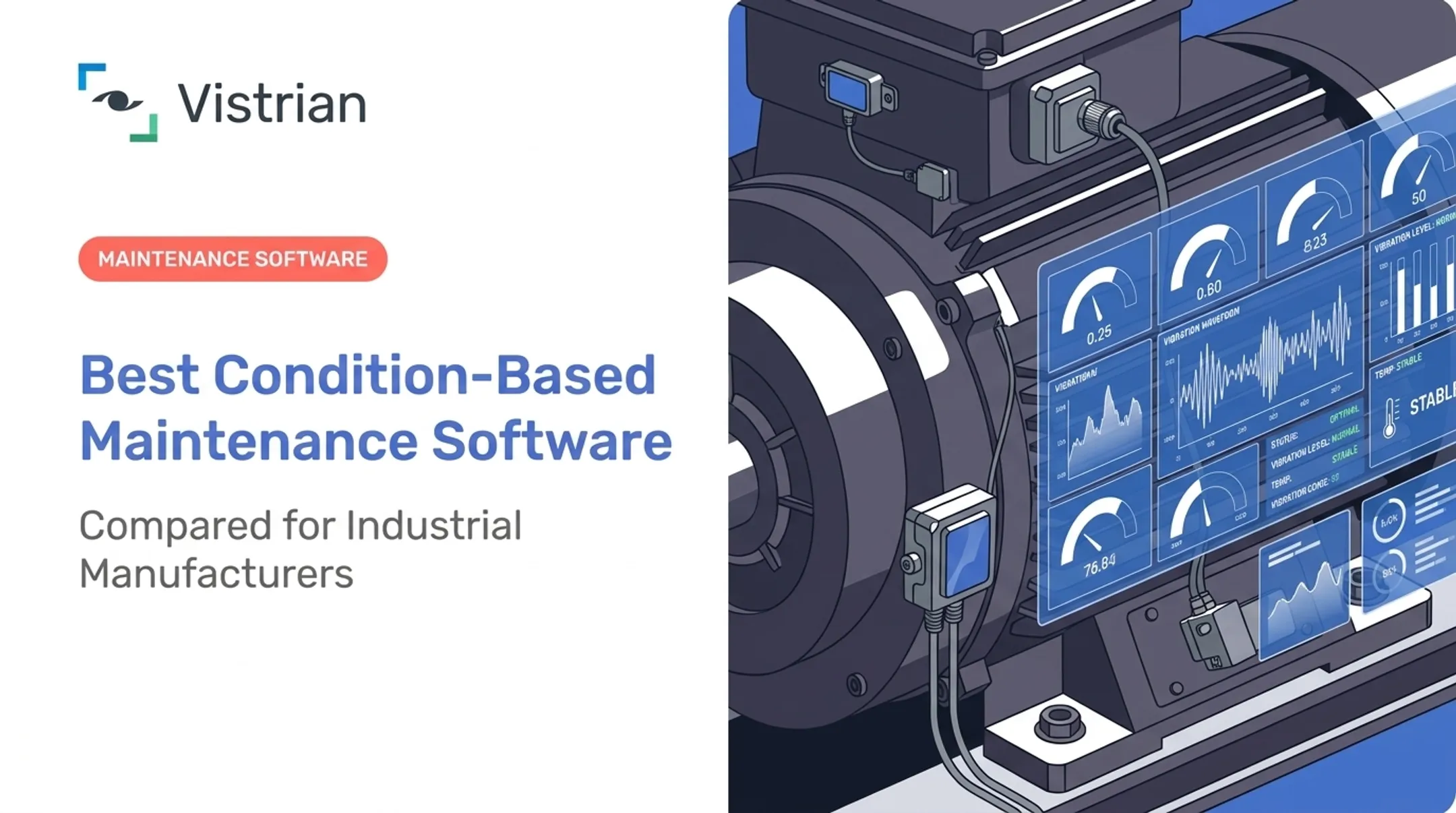
Predictive maintenance goes a step further, using sensor data, vibration signatures, thermal readings, or current draw to estimate developing failure conditions before they show up as obvious symptoms. According to NIST, facilities that leaned more on predictive approaches saw 15% less downtime and 87% lower defect rates than peers using reactive strategies.
Most mature programs blend all four:
- Calendar tasks for known wear items
- Usage triggers for heavily run assets
- Inspections for ongoing visibility
- Predictive signals where data quality and failure cost justify the investment
Vistrian's Maintenance Suite supports this mix directly. Teams can set recurring PM schedules and pull condition data from connected sensors for condition-based and predictive triggers on the same asset.
Benefits and Common Challenges
Done well, inspection and PM programs deliver measurable operational gains:
- Fewer unexpected failures and less emergency work
- Improved equipment availability and throughput
- Safer operating conditions for technicians and operators
- More consistent product quality
- Longer asset life and better labor planning
These outcomes show up in standard maintenance metrics: mean time between failures (MTBF), mean time to repair (MTTR), throughput, yield, and overall equipment effectiveness (OEE). Reliabilityweb's benchmark work suggests roughly 15% of total maintenance labor hours typically go toward PM work, though that figure shifts based on plant type, age, and equipment complexity.
Where Programs Break Down
The same challenges show up across plants of every size:
- Incomplete or outdated asset registers
- Generic checklists copied across dissimilar machines
- Missed schedules and inconsistent technician notes
- Insufficient training on new equipment
- Parts shortages that delay planned work
- Intervals set too frequently (wasted labor) or too infrequently (missed failures)
Not every asset deserves the same level of PM investment, either. Prioritization should weigh safety, production criticality, failure consequences, and the cost of intervention against historical performance. A low-cost, easily replaceable part doesn't need the same rigor as a single point of failure on your main production line.
Safety note: Inspections and maintenance must follow applicable OSHA requirements. OSHA's lockout/tagout standard (29 CFR 1910.147) requires periodic energy-control inspections at least annually, performed by an authorized employee other than the one using the procedure.
Machine guarding, electrical safety practices, and OEM instructions all apply. Only qualified personnel should perform certain tasks.
How to Build an Effective Inspection and Preventive Maintenance Program
A program built without structure tends to drift into checkbox exercises. Here's a sequence that holds up:
1. Build an accurate asset register. Document each asset's identity, location, function, manufacturer information, criticality, and existing maintenance instructions. You can't prioritize what you haven't cataloged.
2. Create asset-specific checklists. Skip the one-size-fits-all approach. Each checklist should include clear steps, acceptable conditions, required measurements, pass/fail fields, and space for observations.
3. Set frequencies deliberately. Combine OEM guidance, asset criticality, operating hours, environmental conditions, and inspection history. A conveyor running in a dusty environment needs different intervals than the same model in a clean room.
4. Define who does what. Operators, technicians, supervisors, and planners each play a role. Spell out who performs the inspection, who approves an escalation, and who verifies completion.
5. Close the loop. Link inspection findings to work orders, parts, labor, and downtime windows, then document post-maintenance verification.
6. Review performance regularly. Look at overdue tasks, repeat findings, emergency work, and inspection compliance to spot where the program needs adjustment.

VistrianMMS supports this closed-loop structure directly:
- Digital checklists matched to asset-specific procedures
- Automated scheduling triggers based on usage, time, or condition data
- Audit-ready maintenance logs from inspection through verified completion
That record trail matters when you're trying to spot a pattern six months later.
Using Maintenance Software and Equipment Data
A CMMS pulls together what used to live in binders, spreadsheets, and a maintenance manager's memory:
- Asset records and equipment history
- Recurring PM schedules and digital checklists
- Work orders and completion records
Plant Engineering's 2020 industrial maintenance survey found 52% of facilities already used a CMMS, alongside 88% running some form of preventive maintenance.
Plant-floor data strengthens that foundation by connecting machine controllers, legacy equipment, and IIoT sensors to the same system that manages work orders.
Where Vistrian Fits
Vistrian's Manufacturing Suite and Maintenance Suite, including VistrianMMS, support scheduled maintenance, work-order management, equipment history, and centralized visibility across one plant or several. None of this replaces qualified technicians. It gives them better information and less paperwork.
On the data side, FactoryLOOK and Vistrian Analytics surface equipment events and performance metrics so teams can spot loss drivers early:
- Utilization and throughput
- Yield and cycle time
- OEE and related downtime signals
In one implementation, continuous OEE visibility from FactoryLOOK showed engineers that plumbing between refiners and holding tanks—not refiner deterioration—was the real bottleneck. That insight helped avoid more than $1 million in unnecessary capital spending.
Rolling It Out Without Breaking Things
A sensible implementation sequence:
- Start with your most critical assets and confirm data capture is reliable
- Standardize naming conventions and checklists before you scale
- Integrate machine signals only where they add real value
- Train users thoroughly before expanding scope
- Expand only after the workflow produces trustworthy records
Software still has limits. Poor data quality, disconnected systems, alert fatigue, and weak adoption can undermine even a strong platform. Digital tools support root-cause analysis and human review—they don't replace technician judgment or disciplined inspection and PM work.
Frequently Asked Questions
What is a preventive maintenance inspection?
It's a scheduled assessment of equipment condition used to spot wear, damage, or abnormal performance before it causes failure. Findings from this inspection may lead to a preventive or corrective work order.
What are the four main types of preventive maintenance?
Time-based, usage-based, condition-based, and predictive maintenance. Terminology varies by organization, and most programs combine several of these approaches on different assets.
What is a PM checklist?
An asset- and task-specific list of inspection points, maintenance steps, required measurements, acceptance criteria, safety requirements, and escalation instructions for a particular piece of equipment.
What are the 7 elements of preventive maintenance?
Generally: asset identification, task definition, frequency or trigger, assigned responsibility, required tools and parts, documentation, and review. Adapt these elements to fit your specific asset and site.
What is the difference between an inspection and preventive maintenance?
An inspection evaluates condition. Preventive maintenance performs planned servicing to preserve or restore performance. Inspections often determine exactly what maintenance should happen next.
How often should preventive maintenance inspections be performed?
Frequency depends on asset criticality, OEM recommendations, operating hours, environment, and historical findings. There's no single universal interval that fits every asset.