
This explanation is written for plant managers, operations leaders, engineers, IT/OT teams, and anyone connecting sensors, machines, or legacy equipment to modern software. If your team still relies on whiteboards, shift-end spreadsheets, or a machine screen nobody checks until something breaks, this is for you.
Getting this right affects real-time visibility, equipment performance, quality, maintenance planning, and throughput. Getting it wrong means dashboards nobody trusts. This article walks through the workflow, where it applies, what influences success, and where a full IoT build-out simply isn't worth it.
Key Takeaways
- IoT data acquisition captures signals and events from sensors, machines, controllers, and logs.
- Integration standardizes that data into consistent units, names, and timestamps so systems can use it.
- The typical flow runs from sensing through edge processing, storage, analytics, and alerts.
- Legacy-equipment compatibility, data quality, security, and clear use cases determine whether a project succeeds.
- Collecting more data doesn't create value on its own — it has to answer a specific operational question.
What Is IoT Data Acquisition and Integration?
IoT data acquisition is the process of capturing measurements, states, events, and signals from physical assets. That includes sensors, PLCs, gateways, machine controllers, and even software logs that already exist on the plant floor.
IoT data integration takes that raw information and makes it usable. It applies consistent names, units, timestamps, and asset identifiers, then delivers the result to a shared platform, historian, or business application.
Put simply: acquisition collects the readings, integration turns them into information a team can trust and act on.
These functions aren't interchangeable with analytics or control, though people often blur the lines:
| Function | What It Does |
|---|---|
| Acquisition | Captures raw signals from equipment, sensors, or logs |
| Integration | Standardizes and contextualizes that data across systems |
| Analytics | Interprets the integrated data to surface trends or root causes |
| Control/Automation | Acts on the analysis, often without human intervention |

Those distinctions matter on the floor because manufacturing plants rarely have one clean data source. A typical facility runs equipment from multiple vendors, controllers from different decades, a few manual logbooks, and a scattering of IIoT sensors bolted on after the fact. That mix is exactly why both acquisition and integration matter — one without the other leaves you with either no data or unusable data.
Not every use case needs the same speed:
- Real-time control for closed-loop processes
- Near-real-time monitoring for live status and alerts
- Scheduled exports or event-driven triggers for routine reporting
- Historical pulls for weekly continuous-improvement reviews
The workflow should match the decision it supports, not the other way around.
Why and Where IoT Data Acquisition and Integration Is Used in Manufacturing
Most plants don't adopt connected data because it sounds modern. They adopt it because the old way stopped working. Fragmented spreadsheets, whiteboards on the shop floor, and isolated machine interfaces create delayed, inconsistent views of what's actually happening in production. Connected data replaces that fog with a single source of truth. It directly supports:
- Equipment utilization and uptime tracking
- Overall Equipment Effectiveness (OEE) and throughput monitoring
- Quality monitoring and yield improvement
- Maintenance planning and root-cause analysis The stakes are real. McKinsey found that more than 70% of manufacturers struggle to scale advanced technologies enough to produce meaningful ROI or KPI improvement, citing non-interoperable plant systems and equipment as a core technical barrier — with organizational barriers proving even harder to solve, according to McKinsey's guide to scaling Industrial IoT. Without integration, the failures are predictable: inconsistent tag names across lines, missing timestamps, incompatible units, duplicated records, and dashboards nobody believes anymore. Acquisition and integration are operational best practices, not regulatory mandates. Industries like semiconductor, food and beverage, and life sciences often add their own traceability, quality-record, or auditability requirements on top. A concrete example: a vibration sensor on a mixer picks up an unusual signature. On its own, that's just a number. Integrated with the asset ID, product batch, and maintenance history, it becomes an alert routed to the right technician, a work order, or a quality flag before the batch ships. This pattern shows up across environments:
- Discrete manufacturing — machine-status and downtime tracking on assembly lines
- Process manufacturing — batch and continuous-process monitoring
- Semiconductor and electronics — tool-level condition monitoring
- Mixed-vendor or legacy plants — bridging old controllers with modern analytics Common triggers for starting a project include unreliable manual reporting, expanding from a single pilot machine to dozens of assets, or needing to compare performance across plants. High-frequency vibration monitoring looks nothing like a monthly energy report, and that's fine. The acquisition method should fit the use case, not a one-size-fits-all template.
How IoT Data Acquisition and Integration Works
The path from a physical measurement to a business decision runs through several stages:
- Asset or sensor
- Signal capture
- Gateway or controller
- Connectivity and edge processing
- Integration layer
- Storage, analytics, and visualization
- Response or action
What flows through this pipeline includes:
- Analog measurements and digital states
- Controller tags and machine events
- Production counts, alarm logs, and quality results
- Maintenance records tied to the asset
Each reading also needs context: which asset, product, operator, and order it belongs to.

Before any of that reaches an integration layer, teams condition, convert, filter, sample, and timestamp raw signals. A poorly sampled signal or a missing timestamp can quietly undermine everything built on top of it later.
Why Edge Processing Matters
Edge processing filters noise, aggregates readings, detects events, and reduces the bandwidth needed to send data upstream. It also lets equipment keep functioning locally if the network connection drops, which matters more in a plant than in most other environments.
The Integration Stage
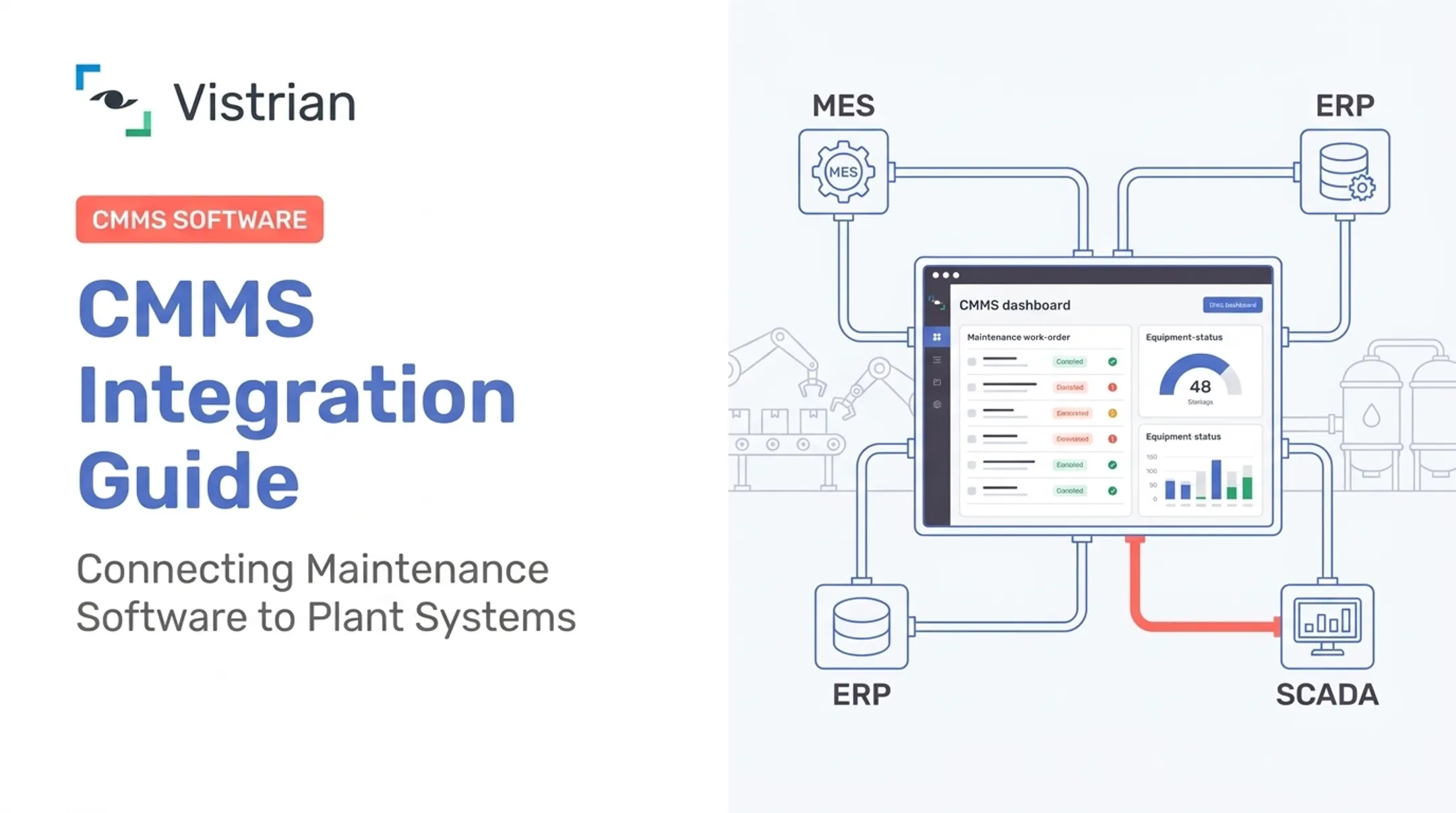
This is where protocols and source systems connect, asset and tag identities map, units and naming standardize, and metadata attaches. The integration layer then exposes validated data to historians, MES, ERP, CMMS platforms, or dashboards.
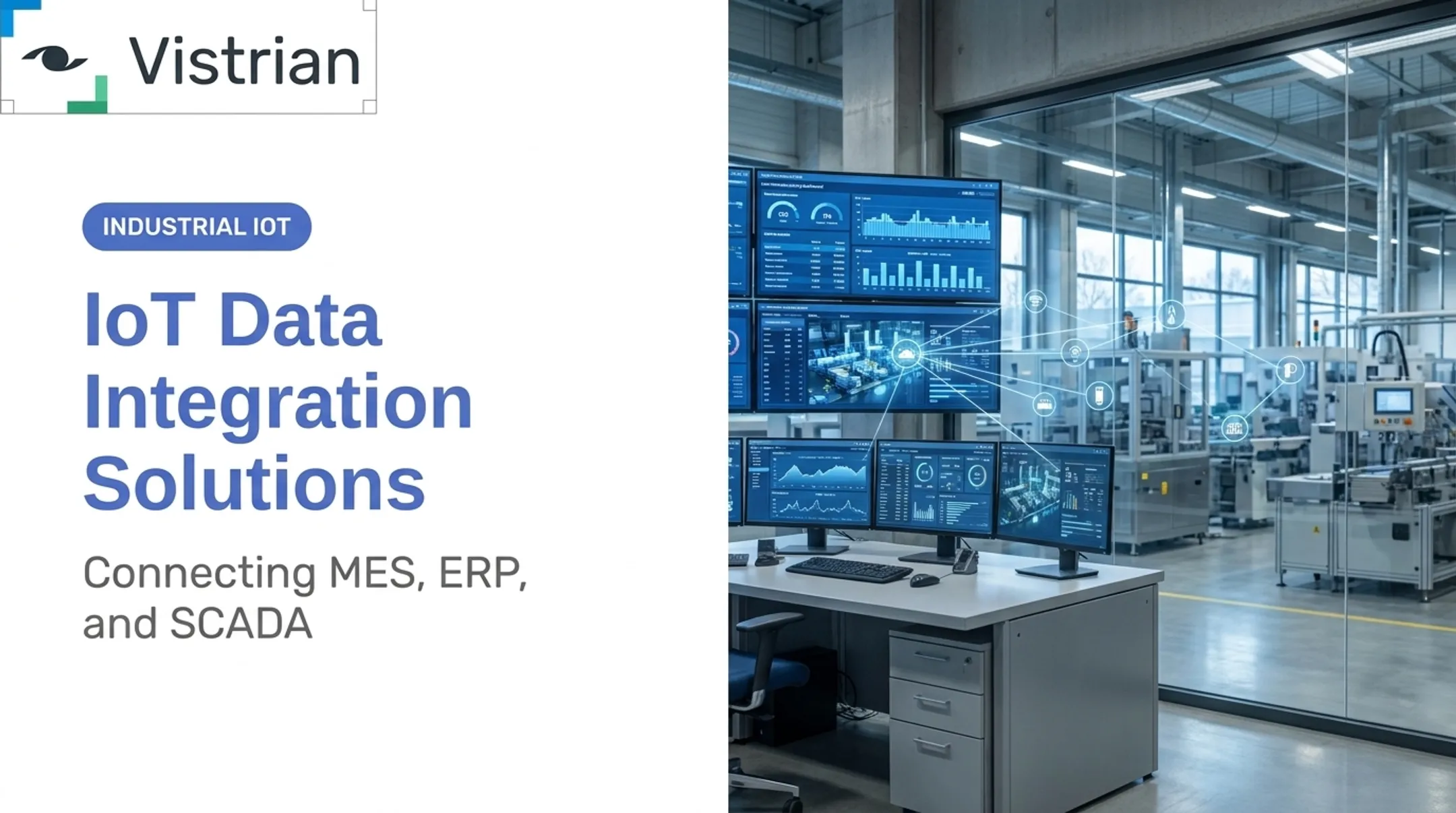
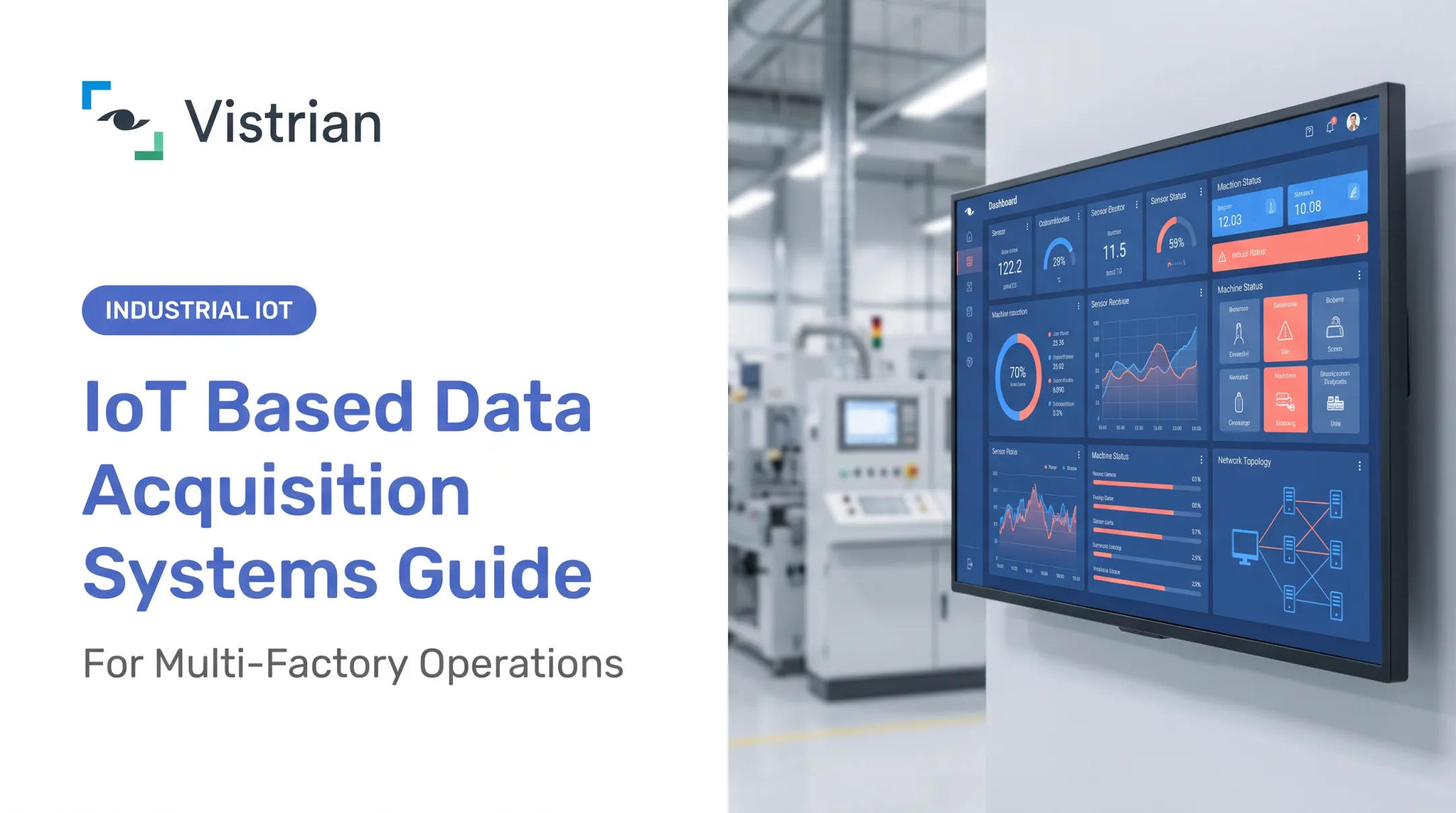
Vistrian's FactoryLOOK is one example of this architecture in practice. It connects machine controllers, logs, databases, legacy equipment, and IIoT sensors regardless of vendor or vintage, then runs that data through a rules engine for near-real-time equipment visibility and analytics.
In one deployment, FactoryLOOK extracted an average of 20 parameters per production tool at roughly one reading per second. Not every plant configures things identically, but the underlying pattern holds across most implementations.
Step 1: Define the Operational Question
Before selecting a single sensor, define what decision the data needs to support. Are you trying to find the cause of recurring downtime? Monitor a critical process condition? Improve OEE? Support predictive maintenance? The answer determines everything downstream.
Step 2: Identify Data Sources and Connect Equipment
Map out where the data already exists, and where it doesn't:
- Check existing controllers and logs — many useful signals are already sitting in a PLC or historian
- Use standard protocols or gateways where direct controller access is possible
- Add sensors to machines with no digital interface at all
- Pull from databases where records already live but aren't connected
Step 3: Clean, Contextualize, and Act
Normalize raw data, add asset and order context, store it, and surface it through dashboards or alerts. Then do the step teams skip too often: validate that the dashboard matches what is actually happening on the floor.
Key Factors That Affect IoT Data Acquisition and Integration
Several variables determine whether a deployment succeeds or stalls out. McKinsey's research on manufacturing data quality flags missing data points, broken or miscalibrated sensors, incomplete data mappings, and weak governance as recurring roadblocks to high-value use cases.
Beyond data quality itself, account for these deployment factors:
- Inputs and sources — sensor type, measurement range, controller tags, and the contextual data needed to interpret each reading
- Data semantics — consistent units, asset names, timestamps, and validation rules before comparing anything across machines
- Operating conditions — electrical noise, vibration, humidity, and whether the system needs to keep running through a network outage
- Equipment and protocol dependencies — legacy controllers, proprietary interfaces, and machines with no digital interface at all
- Architecture choice — edge processing for latency and resilience, centralized processing for multi-site visibility, or hybrid when the use case needs both
- Scale and throughput — the number of assets, sampling rate, retention period, and concurrent users all shape bandwidth and storage needs
- Security and governance — network segmentation, authentication, encryption, and audit trails, following frameworks like NIST SP 800-82r3 for OT environments
- Lifecycle management — sensor calibration, gateway health checks, and clear ownership after go-live
Common Issues, Misconceptions, and When It Might Not Fit
A lot of failed projects share the same root cause: they started with sensors instead of a question.
The Biggest Misconceptions
- "It's just about installing sensors." Plenty of useful signals already exist in controllers, logs, historians, and existing software. Check there first.
- "A dashboard fixes bad data." It doesn't. Missing context, inconsistent units, and wrong timestamps will make even a well-designed dashboard useless.
- "More data is always better." NIST warns that assuming more data automatically creates more value can misdirect improvement efforts, per NIST's manufacturing data curation guidance.
- "Real-time means instantaneous." Define the actual latency your process needs, whether that's immediate control, near-real-time monitoring, or a shift report.
These misconceptions have real costs. Cisco's 2017 IoT project survey found that 60% of IoT initiatives stalled at the proof-of-concept stage, and only 26% of companies called their initiative a success.
Troubleshooting checklist when the numbers look wrong:
- Validate the source against a physical measurement
- Check time synchronization across systems
- Confirm network health and connectivity gaps
- Review tag mapping and unit conversions
- Look for duplicate records or missing data windows

Even clean data won't justify a large program if the use case is thin. That is when scope—not sensors—should drive the decision.
When a Full Build-Out Isn't Warranted
Not every plant needs enterprise-wide integration. Skip it, or start smaller, when:
- Reporting needs are infrequent and nobody acts on the data anyway
- The process is stable with no actionable response to variation
- Only a handful of assets are involved
- An existing system already provides trustworthy information
Watch for signs you're adopting technology by default: no defined KPI, no data-quality plan, no responsible owner, or no lifecycle-cost review. In those cases, a focused condition-monitoring project, a local data logger, or a small pilot beats a full rollout.
Vistrian deployments often follow that path. One customer started with five production tools across three processes, then expanded to nine plants in four countries after the pilot proved out.
Conclusion
IoT data acquisition captures information from physical assets. Integration gives that information consistent meaning and connects it to the systems people actually use. Neither one matters much without the other.
Manufacturers get real value when both are tied to a specific decision: reducing downtime, spotting quality drift earlier, or comparing performance across plants. That's the difference between a dashboard nobody trusts and one that shapes the next shift.
Start with the use case, not the sensor list:
- Assess what data already exists
- Plan for legacy equipment and security from day one
- Validate before you scale
Done well, acquisition and integration turn plant-floor signals into data teams can trust—and act on—in the same shift.
Frequently Asked Questions
What is data acquisition in IoT?
Data acquisition in IoT is the collection of physical measurements, machine states, events, and other signals from connected devices or equipment. That data feeds monitoring, analysis, or automated action.
What are the three main types of data acquisition?
Common categories include analog acquisition (converting continuous physical signals to digital form), digital acquisition (capturing discrete states or events), and hybrid or mixed-signal acquisition combining both. Classifications vary by source and industry.
What are the 7 layers of IoT?
The commonly referenced model includes physical devices, connectivity, edge or gateway processing, data accumulation, data abstraction, applications, and collaboration or business processes. Other models group these layers differently.
What is the difference between IoT data acquisition and data integration?
Acquisition captures raw data from devices, sensors, or logs. Integration normalizes, contextualizes, and combines that data so it's consistent and usable across analytics tools or business applications.
How is IoT data used in manufacturing?
Manufacturers use it for machine monitoring, OEE tracking, downtime analysis, quality control, maintenance planning, and throughput reporting. It also supports multi-plant comparisons so teams can turn scattered readings into decisions they can act on quickly.