
In fact, a recent survey from the Manufacturing Leadership Council found that 70% of manufacturers are still entering data manually. This reliance on outdated methods creates a barrier between raw data and the actionable insights needed for confident, real-time decisions.
This guide explores how IoT data integration provides a solution. We'll explain what it is, why it's critical for modern manufacturing, and the architecture behind it. We will also walk through the steps to implement a solution and how to choose the right partner for your factory.
Key Takeaways
- Unify Your Operations: IoT data integration breaks down data silos by connecting machines, sensors, and enterprise systems into a single, reliable source of truth.
- Enable Real-Time Decisions: Access to live data from the plant floor allows teams to respond instantly to downtime, quality issues, and bottlenecks instead of waiting for shift-end reports.
- Start with a Focused Goal: Successful implementation begins with a single, high-value use case, such as monitoring machine downtime or tracking OEE on a critical line.
- Data Quality is Paramount: The process is not just about connecting devices; it's about cleaning, standardizing, and contextualizing data so it becomes trustworthy and actionable.
- Drive Measurable ROI: By connecting equipment signals to operational outcomes, manufacturers can improve OEE, reduce maintenance costs, and avoid unnecessary capital expenditures.
What Is IoT Data Integration?
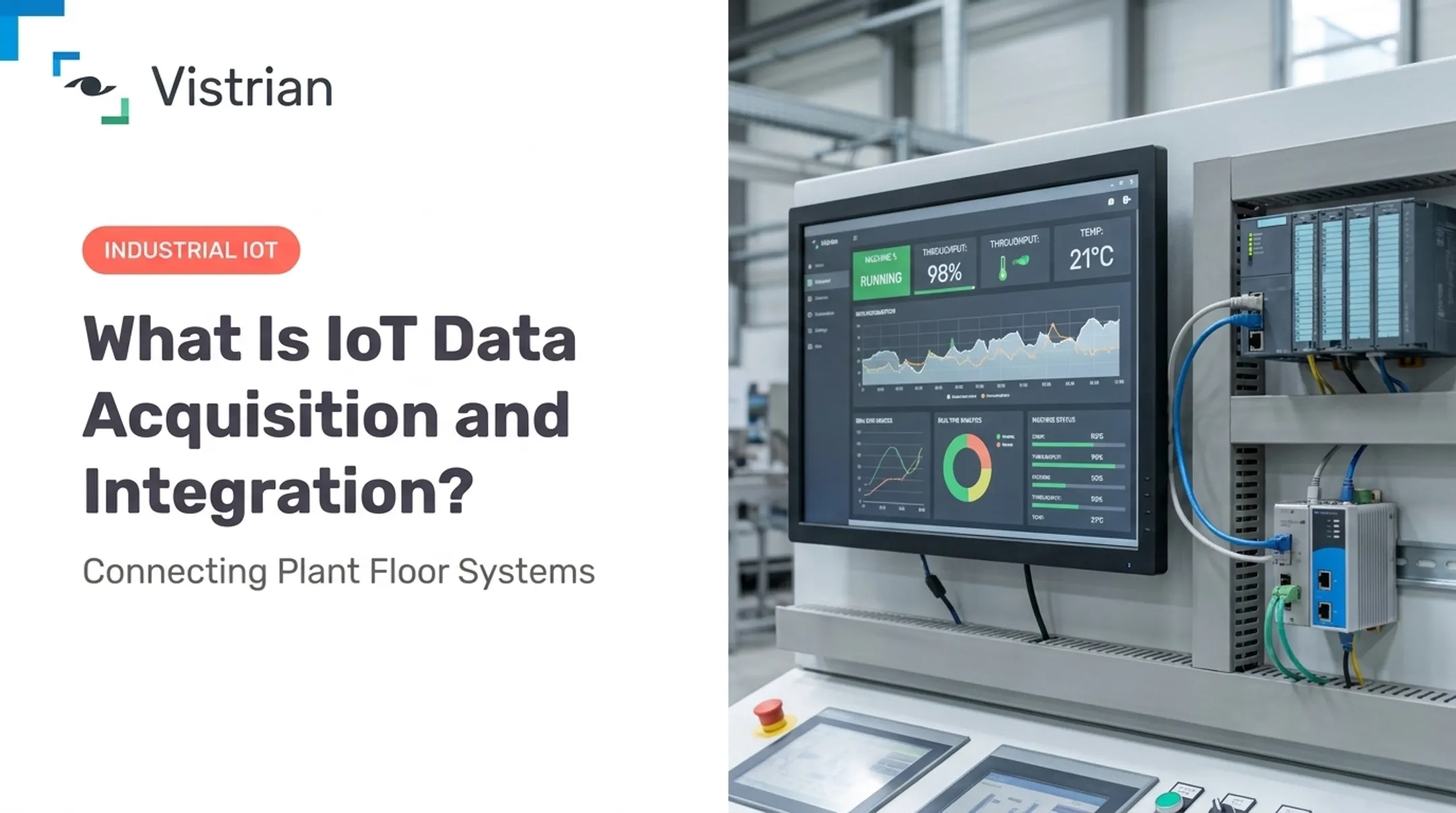
IoT data integration is the process of collecting data from all your connected devices—like machine controllers, PLCs, and sensors—and combining it into a consistent, unified flow. This harmonized data is then routed to other systems for analysis, reporting, and operational action. It turns factory-floor signals into data your MES, ERP, and analytics tools can actually use. Integration sits between device connectivity and the analytics or automation layers that act on the data.
Connectivity vs. Integration vs. Analytics vs. Automation
Think of it as a four-step journey from raw signal to intelligent action:
- Connectivity: Devices and sensors send data over the network using protocols such as Ethernet, Wi-Fi, or MQTT.
- Integration: Raw feeds are cleaned, standardized (units, timestamps), and enriched with context such as product run or shift. Vistrian’s FactoryLOOK connects directly to equipment and processes this data in near real time.
- Analytics: Integrated data becomes insight—from live OEE dashboards to models that flag likely equipment failure.
- Automation: Insights trigger action—for example, alerting a supervisor or stopping the line when quality drifts.

Common Industrial IoT Data Sources
In a typical manufacturing environment, data comes from a wide variety of sources, including:
- Machine controllers (PLCs, CNCs) and equipment logs or alarm histories
- IIoT sensors (vibration, temperature, pressure, and similar signals)
- Manufacturing Execution Systems (MES) and ERP systems
- Computerized Maintenance Management Systems (CMMS)
- Energy meters and building management systems
- Quality and SPC applications An effective integration solution can connect to all these sources, creating a complete digital picture of your operations.
Why IoT Data Integration Matters for Manufacturers
Without integration, you have isolated islands of data. Maintenance has its data, production has its own, and quality has another set entirely. IoT data integration connects them so you can act on one shared picture of the plant.
Achieve a Complete View of Plant-Floor Performance
Connecting data from different systems lets you answer questions that siloed tools cannot. From one unified view, you can:
- Correlate an energy spike with a specific production run
- Link a machine fault code to a maintenance work order
- Track how a raw material batch affects final product quality
Enable Faster, Data-Driven Responses
When data is collected manually at the end of a shift, you’re always looking in the rearview mirror. Real-time data integration means you see problems as they happen. This allows teams to respond immediately to downtime events, quality deviations, and production bottlenecks, minimizing their impact.
The cost of inaction is enormous. A 2024 analysis from Siemens found that the cost of downtime ranges from $36,000/hour in consumer goods to over $2.3 million/hour in automotive manufacturing. Shortening response times by even a few minutes can translate into substantial savings.
Unlock Predictive and Preventive Maintenance
Reactive maintenance (fixing things after they break) is disruptive and expensive. IoT data integration supports a proactive model instead. Connect real-time signals such as vibration, temperature, and runtime to a CMMS like VistrianMMS, and you can shift to condition-based and predictive maintenance.
Research from NIST shows a strong association between proactive maintenance and better performance. Facilities in the top half for using predictive maintenance techniques experienced 15% less downtime and an 87% lower defect rate.
Support OEE and Continuous Improvement
Overall Equipment Effectiveness (OEE) is a critical KPI for measuring manufacturing productivity. But accurate OEE calculation requires reliable data on availability, performance, and quality. IoT integration automates the collection of this data directly from the source, eliminating manual tracking errors and providing a true measure of performance.
That same data fuels continuous improvement. One Vistrian customer, a large chocolate manufacturer, used FactoryLOOK for a clear OEE view.
Integrated data showed the real bottleneck was not the refiner machines, as assumed, but the plumbing to holding tanks. That insight helped them avoid more than $1 million in unnecessary capital spend.
Standardize Multi-Plant Operations
For companies with multiple facilities, data integration is key to standardizing metrics and enabling cross-site comparisons. With a common data model, leadership can compare the same metrics across plants:
- OEE
- Downtime reasons
- Production yields
High-performing sites surface best practices that other plants can adopt, so standards stay consistent across the enterprise.
IoT Data Integration Architecture and Technologies
A solid IoT data integration architecture is a defined pipeline from machine to decision-maker. Each layer handles a distinct job so plant data stays usable from the floor to the people who act on it.
The End-to-End Data Flow
- Collection: Capture data from machines, controllers, and sensors on the plant floor.
- Edge processing: Filter, aggregate, and normalize data on a gateway near the equipment.
- Ingestion: Send processed data to a central platform in the cloud or on-premises.
- Storage and contextualization: Store data in a fit-for-purpose database (such as a time-series historian) and enrich it with context—part number, work order, operator ID.
- Analytics and visualization: Feed integrated data into analytics and visualization tools for dashboards, reports, and alerts.
- Action: Route insights to the right people or systems so they can trigger an operational response.

The Role of Edge Computing and Gateways
Shipping every raw sensor reading to the cloud is costly and often unnecessary. Edge computing processes data closer to the source so only useful signals move upstream. An edge gateway can:
- Strip noise from sensor readings before they leave the line
- Translate between different machine protocols
- Buffer data when network connectivity drops
- Run real-time calculations and send results, not raw streams, to the cloud
That cut in volume lowers bandwidth use and latency for time-sensitive decisions. It also keeps local operations running if the main network goes down.
Key Protocols and Integration Methods
Mixed new and legacy equipment needs more than one connection path. Common methods include:
- MQTT: Lightweight publish-subscribe messaging that has become a default for efficient IoT device traffic
- OPC UA: Secure, platform-independent standard for industrial automation data exchange
- REST APIs: HTTP-based interfaces used by most modern software applications
- Database connections: Direct queries against SQL databases tied to MES or quality systems
- Log file parsing: Extraction from text logs produced by older equipment
Vistrian’s Manufacturing Suite supports these methods and other standard protocols, including SECS/GEM for semiconductor tools.
Cloud, On-Premises, or Hybrid?
Where you host the integration platform is a trade-off among scale, control, and latency:
- Cloud: Scalability, lower upfront infrastructure cost, and easier access—strong fit for large-scale analytics and multi-plant visibility
- On-premises: Maximum control over security and data sovereignty; preferred when low-latency control loops or factory-bound data rules apply
- Hybrid: Edge or on-premises systems handle real-time control and collection; the cloud covers long-term storage, advanced analytics, and enterprise reporting
How to Implement an IoT Data Integration Solution
A phased approach that delivers incremental value is far more effective than a "big bang" attempt to connect everything at once. Prove one use case, then expand with controlled steps.
Start with a Measurable Business Use Case Pick one specific, high-impact problem to solve first. Strong pilot projects often focus on:
- Real-time downtime and status monitoring for a critical production line
- Automated OEE tracking for bottleneck equipment
- Predictive maintenance alerts for a problematic asset
- Energy monitoring to identify waste
Inventory Your Current Environment Before you connect anything, you need a map of your existing landscape. Document your equipment types, controller interfaces, network conditions, and the key operational decisions you want to improve. Identify the data you need and who owns it.
Design the Integration and Governance Model Define governance before you scale connectivity. Cover data ownership, access permissions, naming standards, and data retention policies. Define what constitutes a "downtime" event and set thresholds for alerts to avoid overwhelming users with notifications.
Connect, Normalize, and Test Begin connecting your selected data sources, then test for accuracy, latency, and completeness. Simulate network interruptions and device outages to confirm the system recovers gracefully and holds data quality under failure conditions.
Integrate with Operational Systems Data is most powerful when it's available where people work. Integrate the curated data streams with your existing MES, CMMS, ERP, or business intelligence platforms. The goal is to embed insights into daily workflows, not create another isolated data silo.
Validate the Pilot Against Business Metrics Measure results against the KPIs you set at the start. Track downtime reduction, OEE improvement, or maintenance response time, and use those gains to build a clear business case before you expand.
Scale in Controlled Phases After the pilot proves value, scale in stages. Add equipment, production lines, and then additional plants while monitoring system performance, data quality, and user adoption at each step.

Choosing an IoT Data Integration Solution
IoT platforms vary widely in capability. When evaluating solutions, U.S. manufacturers should look for a partner that understands the unique challenges of the industrial environment.
Use this checklist to guide your evaluation:
- Connectivity: Does it support both modern IIoT sensors and legacy machine controllers? Can it handle the mix of protocols in your plant?
- Architecture: Does it offer flexible deployment options (cloud, on-premises, hybrid) and strong edge computing capabilities?
- Data Management: What tools does it provide for data cleansing, normalization, and contextualization? A good platform ensures data is trustworthy.
- Scalability: Can the solution grow with you from a single-line pilot to an enterprise-wide deployment across multiple factories?
- Manufacturing Focus: Is the platform built specifically for manufacturing, with built-in support for concepts like OEE, SPC, and root-cause analysis?
- Integration: How easily does it connect with your existing systems like MES, ERP, and CMMS?
Platforms also differ in focus: some prioritize high-volume data ingestion, while others center on application workflows. For manufacturers, a solution that combines both is often ideal.
For instance, a manufacturing-focused platform like Vistrian's Manufacturing Suite is designed with these needs in mind. It combines FactoryLOOK for data acquisition from a wide range of equipment with tools for analytics, dashboards, and reporting.
With over 25 years of experience rooted in demanding semiconductor and high-tech manufacturing, it supports equipment utilization, OEE, bottleneck analysis, and predictive maintenance.
Before committing, always request a proof of concept. Test the solution with your own equipment and validate its performance, security, and total cost of ownership.
Conclusion
IoT data integration builds a reliable data path from plant-floor equipment to the people who act on it. When machine, process, and quality data stay connected, teams can make faster calls with fewer blind spots.
Breaking down data silos gives operators and leaders the real-time visibility to cut downtime, lower waste, and spot root causes sooner. Start with one high-value use case, set clear data governance from day one, and expand only after you can show measurable results.
Frequently Asked Questions
What exactly is data integration?
Data integration is the process of combining data from different sources into a single, consistent, and unified view. This harmonized data can then be used for analysis, reporting, and other business operations.
Can you give me an example of data integration?
In manufacturing, one example is connecting live machine status data with your production schedule and maintenance system. This creates a unified view that can automatically calculate OEE and trigger a maintenance work order when a machine goes down.
What are IoT integrations?
IoT integrations connect sensors, gateways, and smart equipment to applications, databases, and analytics platforms. That connection lets IoT data move between systems to support decisions and automated actions.
What does IoT stand for?
IoT stands for the "Internet of Things." It means physical devices—sensors, machines, and controllers—that connect over a network and exchange data with other systems.
What are 5 IoT device examples?
- Vibration Sensors: Monitor machine health to predict mechanical failures.
- Temperature Sensors: Ensure processes are running within specified thermal limits.
- Smart Meters: Track energy consumption for specific machines or lines.
- Connected Machine Controllers (PLCs): Provide real-time data on cycle times, status, and fault codes.
- Asset Tracking Devices: Monitor the location and status of tools, jigs, or high-value inventory in the factory.