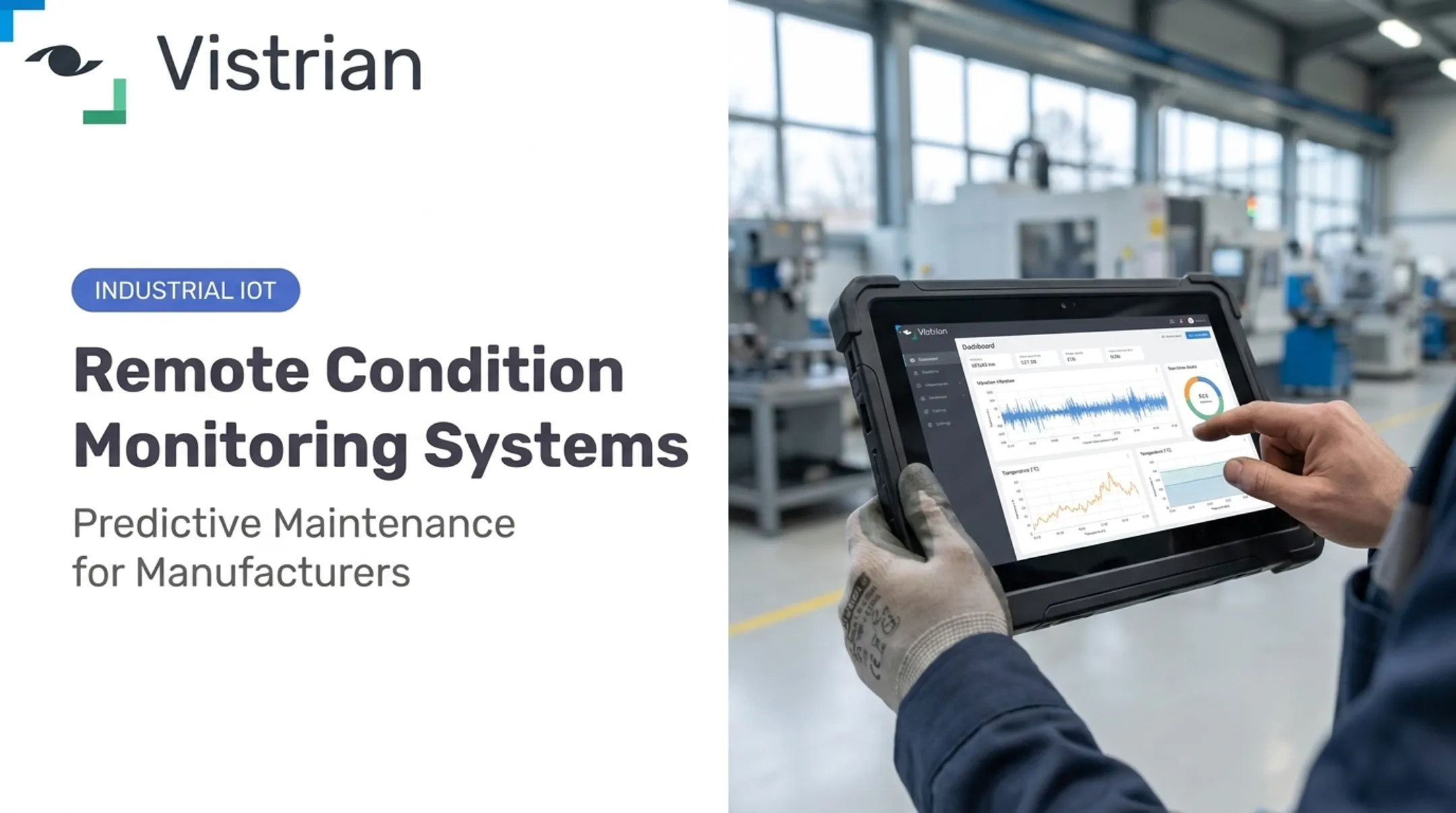

Predictive maintenance takes a different route. It's a data-driven approach that tracks real equipment condition, vibration, temperature, current draw, and other signals, so problems surface early enough for a planned fix instead of an emergency one. Instead of guessing when a bearing might fail, teams watch the wear pattern develop weeks ahead of time.
This article covers how predictive maintenance systems are built, which monitoring technologies fit which equipment, manufacturing use cases from motors to CNC spindles, and how legacy machines can join a monitoring program without a full controls upgrade. We'll also walk through implementation steps that hold up on a real plant floor.
Key Takeaways
- Predictive maintenance uses equipment data, condition monitoring, and analytics to flag faults before downtime hits.
- Strong programs baseline assets, match sensors to real failure modes, and turn alerts into work orders.
- Motors, pumps, CNC machines, robotics, conveyors, and compressors are common starting points for a pilot.
- A focused pilot with reliable data and technician buy-in beats deploying sensors across every asset at once.
What Is Predictive Maintenance for Industrial Equipment?
Predictive maintenance for industrial equipment means monitoring actual machine condition, continuously or at set intervals, to catch developing faults before they become failures. Instead of servicing a pump because the calendar says so, the system watches vibration, temperature, or current signatures and flags work only when data shows it's actually needed.
The U.S. Department of Energy's Federal Energy Management Program describes this plainly: measurements detect degradation early enough to manage stressors before physical damage gets serious. Maintenance need is based on actual condition, not a preset schedule.
Predictive vs. Preventive vs. Reactive Maintenance
These terms get used loosely on plant floors, but they mean different things:
- Reactive maintenance: repair happens only after equipment breaks down.
- Preventive maintenance: work is scheduled at fixed intervals regardless of actual condition.
- Predictive maintenance: work is triggered by measured degradation, not a calendar.
- Condition-based maintenance: a closely related term some practitioner groups use interchangeably with predictive maintenance.

Predictive maintenance doesn't replace preventive schedules, lubrication routines, or statutory inspections. It layers on top of them, catching failures that fixed schedules miss and helping teams avoid replacing parts that still have useful life left.
Who Should Prioritize It
Predictive maintenance delivers the most value where downtime actually hurts. Strong candidates include plants with:
- Costly unplanned downtime, especially on bottleneck lines
- High-value or safety-critical assets
- Recurring, unexplained equipment failures
- Maintenance teams stretched thin across too many assets
- Limited real-time visibility into current machine condition
If a plant still runs on whiteboards and gut instinct, that's usually the first sign predictive maintenance would help.
How Predictive Maintenance Systems Work
A predictive maintenance system isn't a single sensor or dashboard. It's a workflow that runs continuously.
From Signal to Action
The basic sequence looks like this:
- Identify critical assets by downtime cost, failure history, and safety risk.
- Collect signals from sensors, controllers, and existing systems.
- Establish a baseline for what "healthy" looks like on that specific machine.
- Analyze for change by comparing live data against the baseline.
- Generate a prioritized alert for anomalies that actually matter.
- Complete the maintenance response: inspect, repair, verify, document.
Vistrian's FactoryLOOK follows a similar structure on the shop floor. It connects to machines, PLCs, and sensors, applies a rules engine to detect anomalies in real time, and surfaces alerts on dashboards once a threshold is crossed.
What the System Actually Measures
Depending on the asset, a system may track:
- Vibration, temperature, and pressure
- Motor current, voltage, and speed
- Acoustic signals and operating cycles
- Load, alarms, and process conditions
- Historical work-order and failure records
Context matters as much as the raw number. A 5°C temperature rise on a lightly loaded conveyor motor means something different than the same rise on a spindle running a demanding cut. The same reading can point to different problems depending on machine type, operating mode, load, and maintenance history, which is why generic thresholds rarely work well across a whole fleet.
Separating Real Alerts from Noise
Not every threshold crossing deserves a work order. A useful program distinguishes:
- A genuine degradation trend building over days or weeks
- A one-off spike tied to a known process event, like a startup or changeover
- A sensor fault or calibration drift
Vistrian Analytics applies this logic by comparing historical and live data for trends and process drift, so alerts point to something worth investigating instead of flooding technicians with noise.
Closing the Loop
Once an alert fires, the action layer takes over: review, inspection, root-cause investigation, work-order creation, spare-parts planning, and scheduling. VistrianMMS turns these findings into scheduled work based on actual machine state rather than a fixed calendar, then keeps an audit-ready log of what was done.
The step teams skip most often is feedback. Comparing predictions against what technicians actually found, plus downtime, OEE, and yield data, shows whether alerts catch real problems or just generate extra inspections.
Predictive Maintenance Technologies and Industrial Equipment Use Cases
Matching Monitoring Methods to Equipment
Vibration analysis is the workhorse for rotating equipment: motors, pumps, fans, gearboxes, spindles, and compressors. According to Fluke's vibration monitoring guide, it most reliably catches imbalance, misalignment, looseness, and bearing wear.
Other methods fill gaps vibration can't cover:
| Method | Best for detecting | Common assets |
|---|---|---|
| Thermal/IR | Overheating, insulation faults, loose connections | Motors, switchgear, gearboxes |
| Motor current | Load changes, winding issues, drive wear | Motors, pumps, spindles |
| Acoustic/ultrasound | Leaks, cavitation, parts seating | Compressors, pumps, valves |
| Oil analysis | Lubrication breakdown, contamination | Gearboxes, hydraulics, bearings |
| Pressure monitoring | Clogged filters, cavitation, leaks | Hydraulic systems, pumps |

Vistrian's Maintenance Suite documentation points to the same pairing in practice: vibration sensors for catching bearing wear before it becomes a breakdown, thermal imaging for spotting electrical issues before they cause a trip.
CNC Equipment: Machine Health vs. Tool Life
CNC monitoring covers two related but distinct questions. Machine-health monitoring watches spindle vibration, motor current, temperature, alarm history, and cycle data for developing mechanical or electrical problems. Tool-life management tracks how much useful cutting life a tool has left, based on usage counters rather than a health diagnosis.
Both feed into uptime and quality, but they answer different questions. A spindle can be perfectly healthy while a worn tool starts producing out-of-spec parts, and the reverse holds too.
Beyond CNC: Motors, Pumps, and the Rest of the Floor
The same signal-to-action logic applies across the rest of the plant floor:
- Motors — rising current or vibration often signals bearing wear or misalignment; schedule a bearing swap before a trip takes down the line
- Pumps — pressure drops or cavitation noise point to clogged suction or seal wear; catching either early avoids a full rebuild
- Conveyors — belt-drive vibration or motor overheating usually means a bearing or drive fault, with a full line stoppage as the alternative
- Robotics — joint-motor current drift can flag gearbox wear well before a positioning fault shows up in the finished part
- Compressors — vibration and temperature trends often catch valve or bearing degradation before an unplanned trip
Connecting Legacy and Mixed-Vendor Equipment
Plants running 15- or 20-year-old machines don't need a controls rip-and-replace to get useful data. Most plants already have usable data paths:
- Tap controllers, machine logs, historians, and standard industrial protocols directly
- Pull from databases when live controller access isn't available
- Add retrofit sensors where a machine has no digital interface at all
This is where Vistrian's FactoryLOOK and Industrial IoT modules typically fit. FactoryLOOK connects to PLCs or PC-based systems using standard industrial protocols, and pulls from machine logs or databases when direct integration isn't possible. Vistrian's Manufacturing Suite has supported controllers as old as 40 years.
Where a machine lacks a digital interface entirely, Vistrian IoT adds sensors that sync data directly into the same platform.
Turning Signals into Plant-Wide Visibility
Individual alerts matter, but plant leaders also need aggregate visibility. Dashboards that roll up OEE, utilization, throughput, yield, cycle time, and downtime by root cause let a plant manager or multi-site operations leader see where reliability problems concentrate. Vistrian Dashboards, for example, centralizes these metrics at machine, line, plant, or enterprise level.
Business Benefits and Success Measures
What Predictive Maintenance Actually Saves
The DOE's Federal Energy Management Program estimates that a solid predictive maintenance program saves 8% to 12% over preventive maintenance alone. For plants still leaning hard on reactive maintenance, savings can reach 30% to 40%, per its Operations & Maintenance Best Practices Guide.
Those savings show up in concrete ways:
- Fewer emergency repairs and after-hours callouts
- Less unnecessary part replacement
- Reduced production disruption and scrap
- Longer asset life and better spare-parts planning
Vistrian customers using the Maintenance Suite report a similar range: equipment downtime down 20% to 50%, a 28.3% lift in maintenance productivity, and up to 19.4% lower scrap and material costs.

Beyond Uptime: The Ripple Effect
Equipment health doesn't stay isolated to a maintenance budget. It feeds directly into:
- Throughput and yield — fewer surprise stops means more good parts per shift
- Quality consistency — catching drift before it produces defects
- Labor productivity — technicians spend time on real problems, not wasted inspections
- Capital planning — more life from existing equipment delays unnecessary replacement spend
Measuring a Pilot or Rollout
Establish a baseline and measurement period before deploying anything. Useful metrics include:
- Unplanned downtime, in hours or incidents per month
- Mean time between failures (MTBF) and mean time to repair (MTTR)
- Ratio of planned to emergency work orders
- Alert precision, meaning real detections versus false positives
- Maintenance cost per asset
- OEE, scrap rate, and production interruptions
Capture those "before" numbers first. Without them, even a strong pilot is hard to defend when leadership asks what changed.
How to Implement a Predictive Maintenance Program
Start with a Business Case and Asset Priority List
Not every machine needs a sensor on day one. Rank assets by:
- Failure frequency and downtime consequence
- Replacement or repair cost
- Safety or quality risk
- Data availability (whether a controller already exposes signals)
- Whether a repair can realistically be scheduled once flagged
Ingredion's North Kansas City plant offers a real example. The team prioritized critical pumps and hard-to-reach equipment prone to alignment problems, bearing wear, and lubrication issues, then deployed vibration sensors and AI-based diagnostics.
The result: roughly $1.0 million in production savings, $223,000 in maintenance savings, and 168 avoided downtime hours, with the program later scaled company-wide, according to Plant Services' 2025 case study roundup.
Audit What You Already Have
Before buying anything new, check what's already collecting data:
- Existing PLCs, controllers, and historians
- CMMS or maintenance records
- Machine logs and databases
- Network connections and cybersecurity requirements
Document the gaps too: missing failure codes, inconsistent asset naming, unreliable timestamps. Modeling on bad data produces bad alerts, no matter how strong the analytics engine is.
Match Monitoring to Failure Modes
Skip the one-size-fits-all sensor kit. A CNC spindle, a hydraulic press, and a conveyor motor fail differently, so they need different signals. A modular, cloud-enabled platform makes this easier. It combines legacy-machine connectivity, IIoT sensors, analytics, dashboards, and maintenance workflows in one place, instead of stitching together separate point tools.
Vistrian's Manufacturing Suite and Maintenance Suite work this way. Equipment visibility from FactoryLOOK feeds into VistrianMMS, so an alert can turn into a scheduled work order without a manual handoff between systems.
Run a Controlled Pilot
Once monitoring matches the failure modes that matter, keep the first pilot small and specific:
- Pick a handful of assets, not the whole plant.
- Define the baseline period before going live.
- Assign clear alert ownership and response times.
- Involve operators, technicians, reliability engineers, and safety stakeholders from day one.

A disk-media manufacturer's pilot with Vistrian FactoryLOOK started with just 5 production tools across 3 processes, pulling around 20 parameters per tool at 2 to 5 readings per second. That scope was small enough to validate quickly and detailed enough to catch a real problem: a slowly deteriorating pneumatic actuator causing throughput variance.
Improve, Then Scale
Once the pilot runs:
- Review false positives and missed detections with technicians
- Adjust thresholds and data-quality rules based on what inspections actually find
- Expand to new lines or plants only after alerts prove reliable
- Keep cybersecurity, access control, and training as ongoing requirements, not one-time setup tasks
Frequently Asked Questions
What is industrial predictive maintenance?
Industrial predictive maintenance is condition monitoring—real-time or periodic—paired with analytics that detect developing equipment faults early. The goal is planned maintenance instead of a surprise breakdown.
How does predictive maintenance work for CNC equipment?
CNC monitoring uses spindle vibration, motor current, temperature, cycle behavior, alarms, and quality signals to spot developing issues. Anomalies trigger an inspection or scheduled repair before failure stops production.
How is predictive maintenance different from preventive maintenance?
Predictive maintenance triggers work from actual measured equipment condition. Preventive maintenance runs on a fixed time or usage schedule regardless of condition. Most plants use both together.
What equipment is best suited for predictive maintenance?
Critical, failure-prone, expensive, or safety-sensitive assets benefit most: motors, pumps, CNC machines, compressors, robotics, conveyors, and gearboxes are common starting points.
Can predictive maintenance work with legacy industrial equipment?
Yes. Controllers, machine logs, databases, and standard protocols often expose usable data directly, and retrofit IIoT sensors cover machines without a digital interface at all.
How do manufacturers measure the success of a predictive maintenance system?
Compare a pre-deployment baseline to results over a set period. Track unplanned downtime, MTBF, MTTR, planned-versus-emergency work, alert precision, maintenance cost, OEE, and scrap.