
Introduction
Walk onto most US shop floors today and you'll still find a whiteboard next to a CNC machine, or a shift supervisor keying yesterday's numbers into a spreadsheet. Manufacturing data collection software changes that picture.
It captures, contextualizes, stores, and presents production information from machines, sensors, operators, and connected business systems, replacing guesswork with something closer to ground truth.
2026 matters because the gap between spreadsheet-based plants and connected ones is widening fast. In Deloitte's 2025 Smart Manufacturing and Operations Survey of 600 US manufacturing executives, 57% already use cloud computing and data analytics at the facility or network level, and 40% ranked data analytics among their top investment priorities.
This article walks through five software trends shaping 2026 buying decisions, what's driving them, how they're reshaping plant operations, and what to check before you sign a contract.
Key Takeaways
- Data collection now spans production, quality, energy, maintenance, orders, and operator context, far beyond machine uptime alone.
- Strong 2026 platforms blend automated machine signals with manual input, edge processing, and cloud analytics.
- Address legacy connectivity, data quality, and cybersecurity before investing in advanced AI features.
- Starting with one high-value bottleneck reduces implementation risk and builds the case for scaling.
- Industry surveys show cloud and analytics adoption is already mainstream among large US manufacturers.
Key Trend 1: Automated and Real-Time Data Capture
Paper logs and end-of-shift reporting have a built-in delay problem. By the time someone writes down a downtime event, the plant has often already lost the window to fix it fast. Automated data capture pulls information directly from PLCs, CNC controls, SCADA systems, IIoT sensors, machine logs, and digital operator interfaces as it happens.
What gets captured automatically:
- Machine states and cycle times
- Part counts and scrap
- Downtime events and changeovers
- Quality checks and process parameters
- Energy consumption
The payoff shows up fastest in downtime response. When production data arrives hours late, a problem solvable in minutes can cascade into a full line stoppage, quality escapes, and missed targets. Real-time visibility closes that gap and gives root-cause analysis something solid to work from, rather than a shift-end summary written from memory.
Automation Still Needs Human Context
Machines can tell you what happened. They usually can't tell you why.
During Vistrian's FactoryLOOK deployment at North America's largest cocoa processor and ingredient chocolate manufacturer, the system extracted an average of 20 parameters per production tool at roughly one reading per second. Real-time refiner-utilization data alone wasn't the whole story. It surfaced plumbing between refiners and holding tanks, not the refiners themselves, as the actual bottleneck.
That insight helped the customer avoid more than $1 million in unnecessary capital spending.
Operators still matter here. They record the inspection notes, exceptions, and root-cause context a sensor can't detect. That's why tools like e-recording exist alongside automated capture: browser-based digital forms replace paper without eliminating the human observations that give machine data meaning.
Key Trend 2: Legacy-Machine Connectivity and Hybrid Collection
Not every plant is running 2026-model equipment, and few manufacturers can justify ripping out a working machine just to modernize their data stack. That demand is shifting toward software that connects existing assets to modern data collection—without a full equipment refresh.
Common connectivity approaches include:
- Standard industrial protocols and controller-level data
- Digital and analog signal capture
- Machine logs and historical databases
- Gateways and retrofit sensors for equipment with no digital interface
Vistrian's FactoryLOOK is one example of a platform built around this problem. It connects to machine controllers, logs, databases, and IIoT devices, and it's designed to support controllers as old as 40 years. When a controller simply isn't reachable, a retrofit sensor (Vistrian calls it the Spider) can be installed to collect data continuously instead. Other vendors take different paths; use this as a reference point for the capabilities buyers should compare.
What to Validate Before Buying
Before committing to any legacy-connectivity approach, check:
- Compatibility with your specific controller brands and vintages
- Installation requirements and how much downtime integration needs
- Data frequency and edge buffering when the network drops
- Network architecture that segments OT traffic appropriately

Western Digital's FactoryLOOK deployment is a useful benchmark. It integrated a wide mix of equipment types and controllers, the rollout went smoothly, and the project exceeded its original goals—the kind of outcome a mixed-vendor connectivity project should aim for.
Key Trend 3: Cloud-Enabled, Edge-to-Enterprise Manufacturing Data Platforms
Cloud and edge aren't competing architectures anymore. Most 2026 platforms use both. Edge computing handles low-latency, safety-critical decisions locally, right where milliseconds matter. Cloud platforms handle the things that benefit from centralization: storage, cross-site analytics, software updates, and multi-plant visibility. Cloud-enabled doesn't mean every control decision travels to a data center; it means the right decisions travel there. A shared data model is what makes this useful day-to-day. Plant teams see line-level performance in real time, while corporate leadership compares standardized KPIs across facilities without waiting for someone to compile a report. In Vistrian's deployments, this shows up as production managers comparing OEE across facilities on the same dashboard framework, while each site still retains local customization. Before selecting a platform, evaluate:
- Uptime guarantees and role-based access controls
- Data ownership, encryption, and retention policies
- API availability for ERP, MES, CMMS, and BI integration
- Backup and disaster recovery provisions
Cybersecurity guidance matters here too. The Cybersecurity and Infrastructure Security Agency's OT asset inventory guidance treats a complete inventory of connected devices as a foundation for defensible architecture. That inventory is a good first question to ask any vendor touting cloud connectivity. NIST's SP 800-82 also recommends segmenting IT and OT networks, often with a DMZ between them, which should inform how any new data platform gets wired into your existing network.
Key Trend 4: Contextual Analytics, OEE, and Root-Cause Intelligence
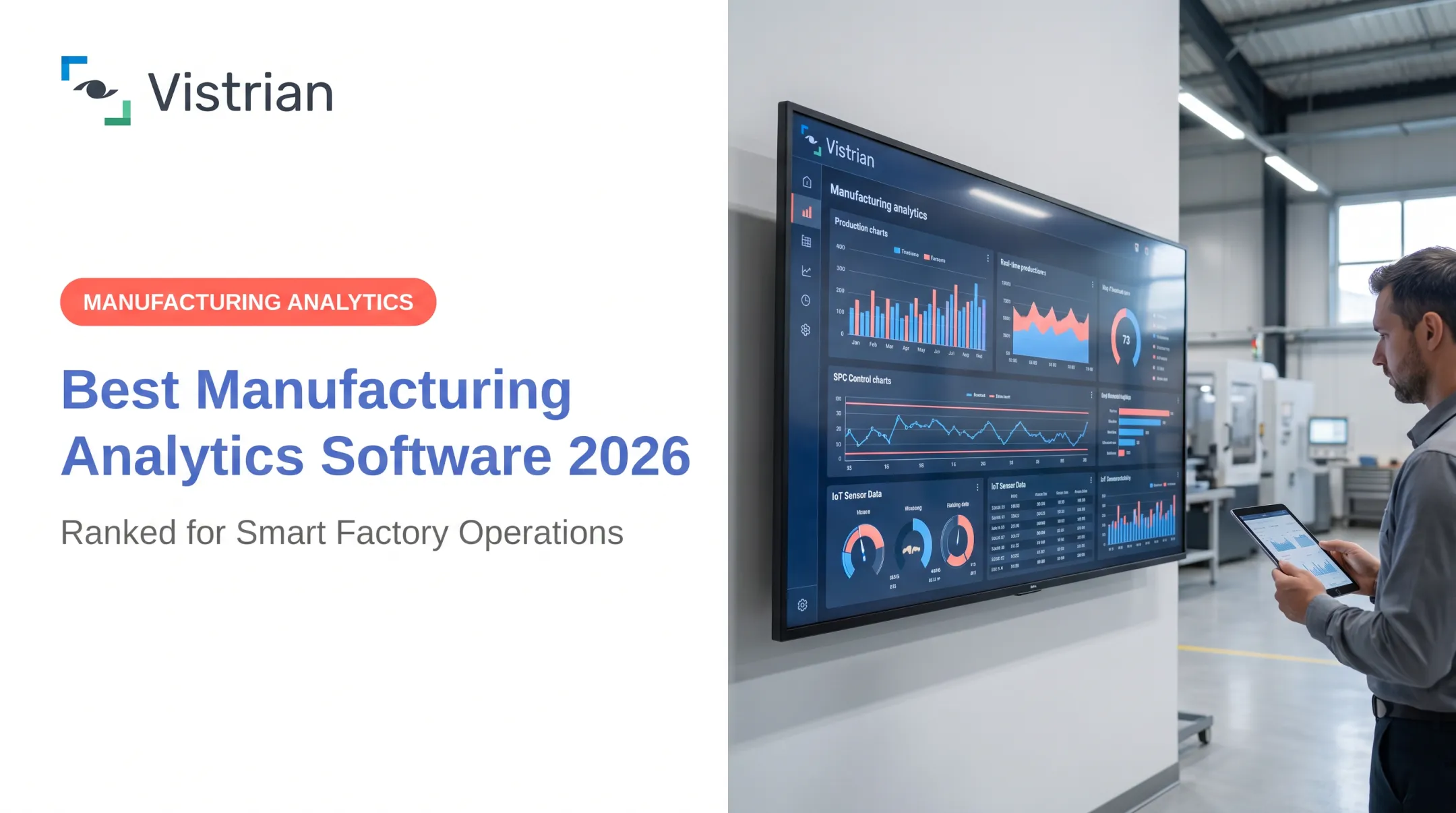
Raw signals aren't insight. A stop count means little until software converts it into shared metrics: availability, performance, quality, OEE, throughput, yield, cycle time, MTBF, and MTTR. Those numbers let two people in the same plant talk about the same problem in the same language.
The real value shows up when software links a machine event to its surrounding context: product, shift, order, operator, and maintenance history. That turns "the line stopped 14 times today" into "changeovers on third shift are driving 60% of our unplanned stops."
McKinsey's research on a large, anonymized food manufacturer shows the payoff at scale: across more than 40 plants, 20 factories were transformed within 12 months using over 6,000 sensors, resulting in a 10% increase in line throughput, plus immediate energy savings.
Typical analytics progression:
- Descriptive dashboards showing current state
- Threshold-based alerts
- Pareto analysis of recurring losses
- Statistical process control and anomaly detection
- Predictive maintenance and recommended actions

Vistrian's FactoryLOOK deployments put pieces of that progression to work:
- Event and Alarm Pareto charts compared robotic packing-line behavior across shifts and days, driving corrective actions and productivity gains within days
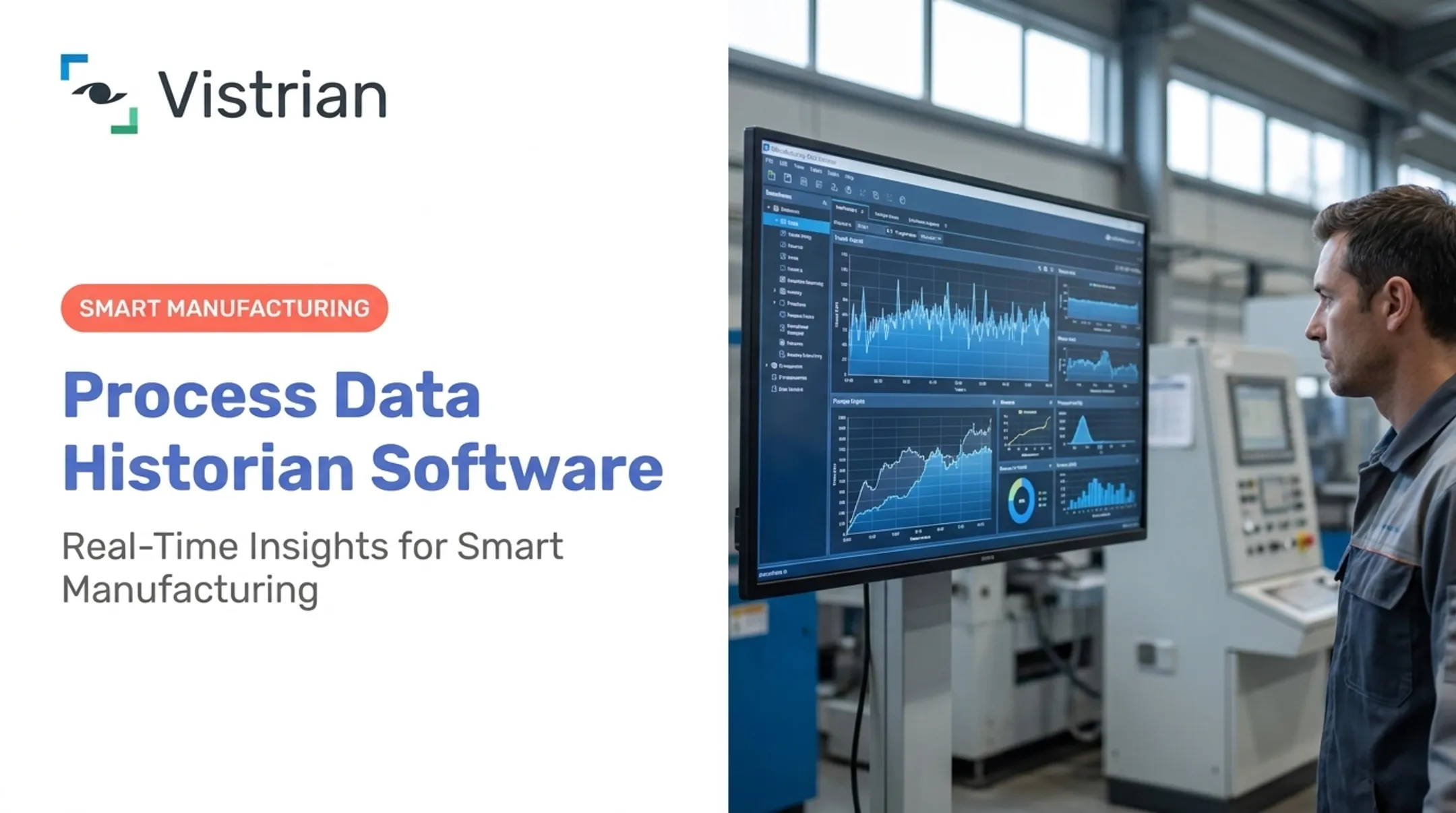
- Historian data and real-time alerts verified liquid-chocolate temperature compliance continuously, helping the plant avoid a costly recall
None of it holds without foundation work underneath. Analytics are only as reliable as the timestamps, downtime taxonomy, and data validation feeding them. Skip that groundwork, and even the best dashboard displays confident-looking noise.
Key Trend 5: Modular Platforms and Integrated Manufacturing Workflows
Few manufacturers want to buy a full enterprise suite on day one. Most want to start with machine monitoring, prove the value, then expand into e-recording, historian functions, SPC, quality tracking, maintenance integration, and enterprise dashboards, as the business case grows.
It helps to know where each system category actually fits:
| Category | Primary Role |
|---|---|
| MDC/PDC | Captures machine and shop-floor operational data |
| MES | Executes, schedules, and traces production in real time |
| ERP | Manages plant-wide schedules, finance, and resources |
| CMMS | Automates maintenance workflows and work orders |
| BI/Analytics | Turns data into business-facing insight and reporting |
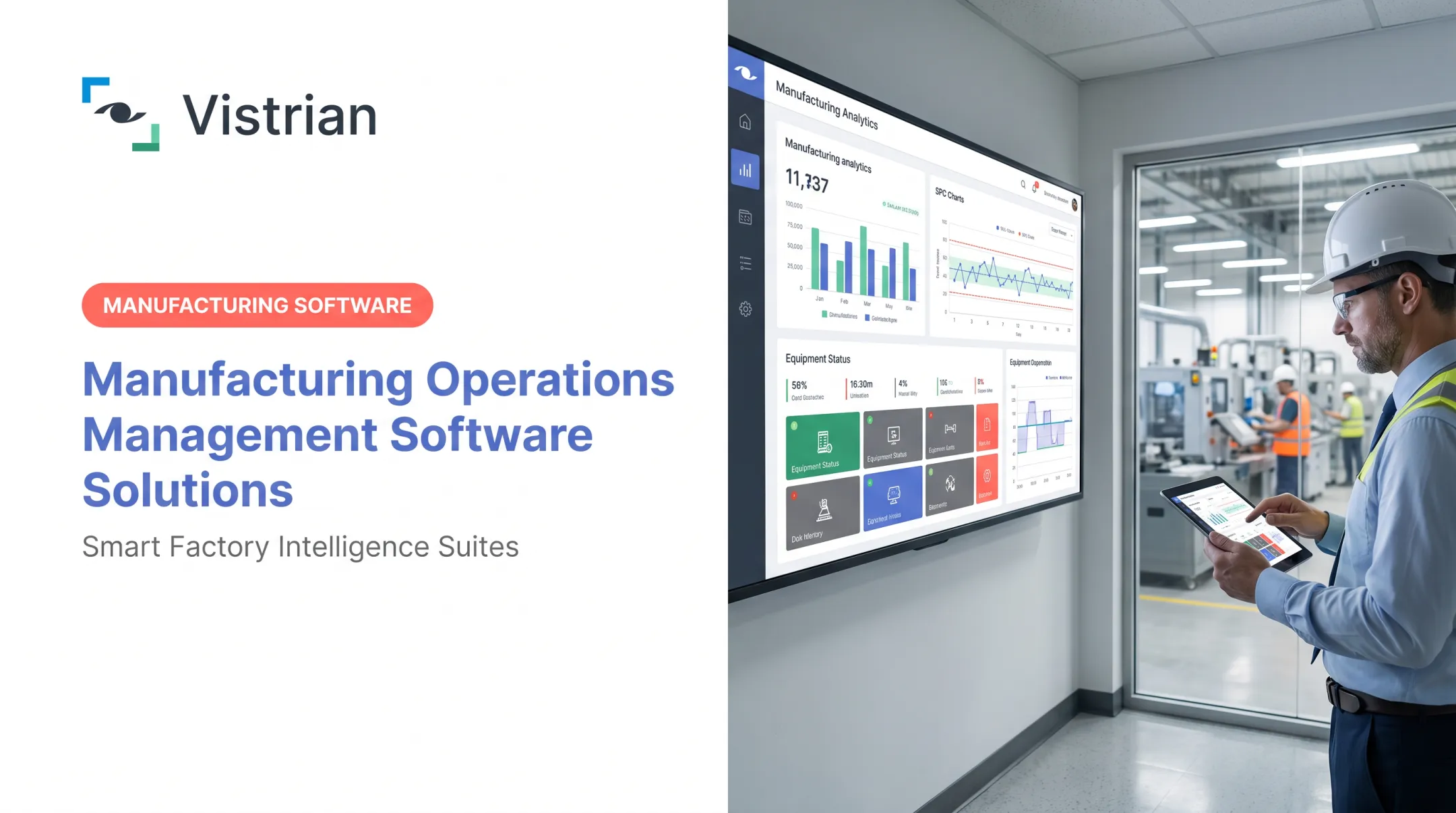
Modern platforms increasingly blur these lines. Vistrian's Manufacturing Suite, for example, combines equipment integration, data acquisition, IIoT, e-recording, historian, analytics, SPC, dashboards, reporting, and alerts under one modular, software-only architecture. It can deploy at the machine, line, plant, or enterprise level depending on what a customer needs at a given stage.
Integrations can also connect a detected production event directly to a maintenance work order or a quality record, rather than leaving those systems to reconcile manually later.
A quick modularity checklist:
- Which modules are available now versus on a roadmap?
- Are APIs open enough for future integrations?
- Can you export your own data without vendor lock-in?
- How much configuration effort does rollout require?
- What implementation support comes with licensing?
- Can the same architecture standardize across multiple plants?

What's Driving These Manufacturing Data Collection Software Trends
Several forces are pushing these trends forward at once — and they move at different speeds.
- Technology maturity varies widely. IIoT sensors, edge computing, and cloud platforms are mature and widely deployed. Machine learning for anomaly detection is close behind. Computer vision, digital twins, and natural-language interfaces are earlier stage. McKinsey's COO survey found only 2% of manufacturing leaders say AI is fully embedded across operations; most remain in exploration or targeted pilots.
- Customer expectations are tightening. Shorter lead times, traceability demands, and consistent quality all raise the bar for timely production data. Customers want proof of delivery reliability, not promises.
- Labor constraints are real and measurable. The Manufacturing Institute's 2025 workforce report found that 3.8 million manufacturing positions could open by 2033, with roughly 1.9 million potentially going unfilled. Fewer available hands make automated visibility more valuable, not less.
- Regulatory pressure is sector-specific, not universal. EPA's Greenhouse Gas Reporting Program covers roughly 8,000 large emission sources. FDA's Part 11 and food-traceability rules apply to covered electronic records and specific food categories. Neither is a blanket mandate, but manufacturers in scope need software that produces clean, retrievable records.
- Competitive dynamics push standardization. Multi-site manufacturers want the same KPI definitions everywhere. Inconsistent definitions make continuous improvement nearly impossible to compare across plants.
How These Trends Are Impacting the Manufacturing Industry
Operational Impact
Shared, near-real-time data changes daily routines. Shift meetings stop being a recap of what happened yesterday and start being a working session on what's happening right now. Downtime response gets faster because operators and maintenance see the same alert at the same time. Standardized data definitions also make plant-to-plant and shift-to-shift comparisons valid for the first time in some organizations. That requires upfront work, though: someone has to agree on what counts as "downtime" versus "changeover" before the numbers mean anything across sites.
Business Impact
Reliable production data feeds directly into capacity planning, delivery commitments, and cost-per-unit analysis. Multi-plant leadership teams get comparable performance reviews instead of five different spreadsheets with five different assumptions. The flip side is real risk from disconnected systems:
- Duplicated records across departments
- Inconsistent KPI definitions between plants
- Analytics that can't be reconciled with ERP or financial reporting
Workforce Impact
Data collection changes how operators, maintenance staff, and engineers work day to day, and the framing matters. The goal should be better decisions and faster process improvement, not surveillance of individual performance. Bring operators, maintenance, IT, OT, and quality into the rollout early. Clear explanations of how their input will be used often decide whether adoption sticks or stalls.
Future Signals for Manufacturing Data Collection Software in the Manufacturing Industry
Future Signals for Manufacturing Data Collection Software
The next one to three years will likely focus less on collecting more signals and more on making existing data actionable, interoperable, and secure.
Early indicators worth watching:
- Wider edge-to-cloud architecture adoption
- Unified data models replacing siloed point solutions
- API-based integrations becoming a baseline expectation
- Formal data-governance programs built in from the start
Technologies at different maturity stages:
- Established: predictive maintenance, anomaly detection, OEE analytics
- Emerging/pilot: AI-assisted root-cause analysis, computer vision, digital twins, natural-language query interfaces
Deloitte found that while 87% of manufacturers had started a generative AI pilot, only 10% had implemented use cases across broader networks. That gap shows these capabilities are still early-stage for most plants.
The same maturity gap shows up in closed-loop workflows. A true closed loop automatically turns a detected loss into an alert, investigation, corrective action, and verified follow-up—still more aspiration than standard practice for most manufacturers.
Modular, cloud-enabled platforms, including Vistrian's Manufacturing Suite, support that staged path from basic monitoring to analytics and enterprise reporting. How fast a plant moves still depends on its own integration and governance readiness.
Conclusion
Manufacturing data collection software is becoming the operational backbone for real-time visibility, performance management, and the AI capabilities still coming online. Novelty isn't the priority. Trustworthy data, legacy compatibility, cybersecurity, and genuine operator buy-in are.
A practical starting point:
- Pick one priority outcome
- Pilot it on a representative bottleneck
- Validate the data with the frontline team actually using it
- Measure what changed
- Scale the architecture once the business case holds up
That's a slower path than buying everything at once, and a far more reliable one.
Frequently Asked Questions
What is the best production software for manufacturing?
There isn't a single universal answer. It depends on your equipment mix, data sources, integration needs, scale, security requirements, and budget. Match options to your use case instead of chasing a generic "best" list.
What are the five types of software used in manufacturing?
Common categories include ERP, MES, manufacturing data collection (MDC/PDC), CMMS/EAM, and quality or analytics software. Many modern platforms now combine several of these functions into one modular system.
What data does manufacturing data collection software capture?
Typical data includes machine states, cycle times, part counts, downtime, scrap, quality checks, process parameters, energy use, and operator-entered context. Exact scope depends on your integrations and configuration.
Can manufacturing data collection software connect to legacy machines?
Yes, many platforms support legacy equipment through controllers, standard protocols, gateways, machine logs, databases, or retrofit sensors. Always verify compatibility and installation requirements before purchasing.
What is the difference between manufacturing data collection software and an MES?
Data collection software focuses on capturing and contextualizing operational information from the shop floor. An MES typically adds broader execution, scheduling, traceability, and workflow-control functions on top of that data.
What features should manufacturers look for in data collection software in 2026?
Prioritize automated and manual capture, edge and cloud processing, legacy connectivity, OEE and root-cause analytics, strong integrations, clear data ownership, and scalable role-based access.