
This shift, however, brings questions and concerns. How do you connect legacy equipment? What's the real return on investment (ROI)? How do you avoid the risk of investing in new technology without a clear operational goal? This article will provide a clear roadmap, defining smart manufacturing, explaining how the Internet of Things (IoT) powers it, and outlining practical use cases to guide your adoption strategy.
Key Takeaways
- Smart manufacturing uses connected equipment, real-time data, and analytics to improve production performance.
- The Industrial Internet of Things (IIoT) is the application of connected sensors and systems in industrial environments, focusing on operational reliability and safety.
- The best starting point is a focused business problem—like unplanned downtime or quality issues—not a technology wish list.
- You can modernize existing machinery with gateways and retrofit sensors instead of replacing every asset.
- Success is measured with concrete operational KPIs like OEE, uptime, throughput, yield, and cycle time.
What Is Smart Manufacturing?
Smart manufacturing is an integrated approach that uses connected machines, industrial data, analytics, and automation to monitor and improve manufacturing processes in real time. The result is a factory that can adapt, self-diagnose, and support faster decisions.
Automation alone runs pre-programmed actions. Smart manufacturing goes further: it uses a constant flow of data and feedback to optimize those actions as conditions change. According to the National Institute of Standards and Technology (NIST), a key goal is creating systems that can respond in real time to changing conditions and even learn from experience.
These terms often get used interchangeably—here’s how they differ:
- IoT (Internet of Things): The broad network of any connected physical device—from smart watches to thermostats—that collects and exchanges data.
- IIoT (Industrial Internet of Things): The specific application of IoT in industrial settings. This involves connecting sensors, machines, and operational systems in environments where reliability and safety are critical.
- Smart Factory: The physical production environment created by implementing these connected technologies.
- Industry 4.0: The wider industrial transformation that encompasses smart manufacturing, cyber-physical systems, cloud computing, AI, and robotics.
You don’t need a brand-new factory to put these ideas to work. Smart manufacturing can start small—connecting one production line or a group of critical assets to solve a specific problem—then expand as results prove out.
How IoT and IIoT Power Smart Manufacturing
The IIoT is the nervous system of a smart factory, enabling a seamless flow from data to action. This workflow typically follows a clear path:
- Sensors and machine controllers capture operational data—temperature, vibration, pressure, and cycle times.
- That data moves from the factory floor to edge or cloud systems for processing.
- Analytics software flags patterns, anomalies, or conditions that need attention.
- Dashboards and alerts notify the right teams about what is happening.
- Operators, maintenance technicians, or automated systems take corrective action.

This connectivity creates value across the entire organization. Operations teams see production bottlenecks in real time. Maintenance can move from reactive repairs to condition-based work. On the quality side, defects become traceable to their root cause.
Bridging the Gap with Legacy Equipment
A common hurdle is the "connectivity gap" between modern software and older machinery. Many plants operate with a mix of equipment, some with advanced controllers and others with no digital interface at all. Fortunately, you don't need to replace these valuable assets.
Older equipment can be integrated into a connected architecture using:
- Gateways and machine interfaces to translate proprietary protocols.
- Retrofit IIoT sensors to capture data like vibration, temperature, or power usage.
- Connections to existing data logs and databases that already store valuable information.
A software-led approach is key to unifying these disparate sources. For example, Vistrian’s FactoryLOOK connects directly with machine controllers, logs, databases, and IIoT devices. It consolidates that data into one platform—dashboards, analytics, and alerts—so plants get near-real-time visibility without a full hardware overhaul.
Technologies That Enable Smart Manufacturing
Smart manufacturing depends on an integrated stack of capabilities working together, not on any single piece of technology.
Core Technology Stack
- IIoT Sensors and Gateways: These are the data collectors. They capture information from machines, including older assets that lack native digital connectivity.
- Edge and Cloud Computing: Edge computing handles time-sensitive data near the equipment for immediate alerts. Cloud platforms centralize storage, analytics, and multi-site access.
- AI and Predictive Analytics: Machine learning algorithms analyze data to identify anomalies, forecast equipment failures, and recognize quality patterns, helping teams act proactively.
- Manufacturing Software Platforms: MES, CMMS, and reporting systems turn raw data into actionable workflows. Platforms like the Vistrian Manufacturing Suite combine data acquisition, dashboards, analytics, and work-order generation.
Advanced Capabilities
- Digital Twins: A virtual model of a physical asset or process, kept in sync with live data. Teams use it to simulate changes, optimize performance, and test scenarios without disrupting the factory floor.
- Robotics and Automation: Robots execute physical tasks, but it's the connected data and feedback loops that make the overall system "smart" and responsive.
A Note on Cybersecurity
Connecting your operational technology (OT) to a network introduces new security considerations. According to a 2023 NIST guide on OT security, it is critical to treat the plant floor differently than a standard IT environment. Key practices include:
- Network Segmentation: Isolate OT networks from corporate IT networks.
- Strict Access Control: Implement role-based access and require strong authentication for any remote commands.
- Data Encryption: Encrypt sensitive data both in transit and at rest.
- Secure Change Management: Test all patches and software changes in a non-production environment before deploying them on live systems.
Smart Manufacturing Use Cases and Business Benefits
Smart manufacturing delivers value through concrete operational gains—less downtime, faster decisions, tighter quality control, and better use of existing capacity.
Predictive and Condition-Based Maintenance
Instead of running maintenance on a fixed schedule, teams use real-time equipment data to predict failures before they happen. Monitoring vibration, temperature, and error patterns lets them investigate and fix issues early. Moving from reactive to predictive maintenance cuts unplanned downtime. A McKinsey report found that one factory increased its Overall Equipment Effectiveness (OEE) by 11% by using analytics to solve machine alarm issues.
Real-Time Production Monitoring
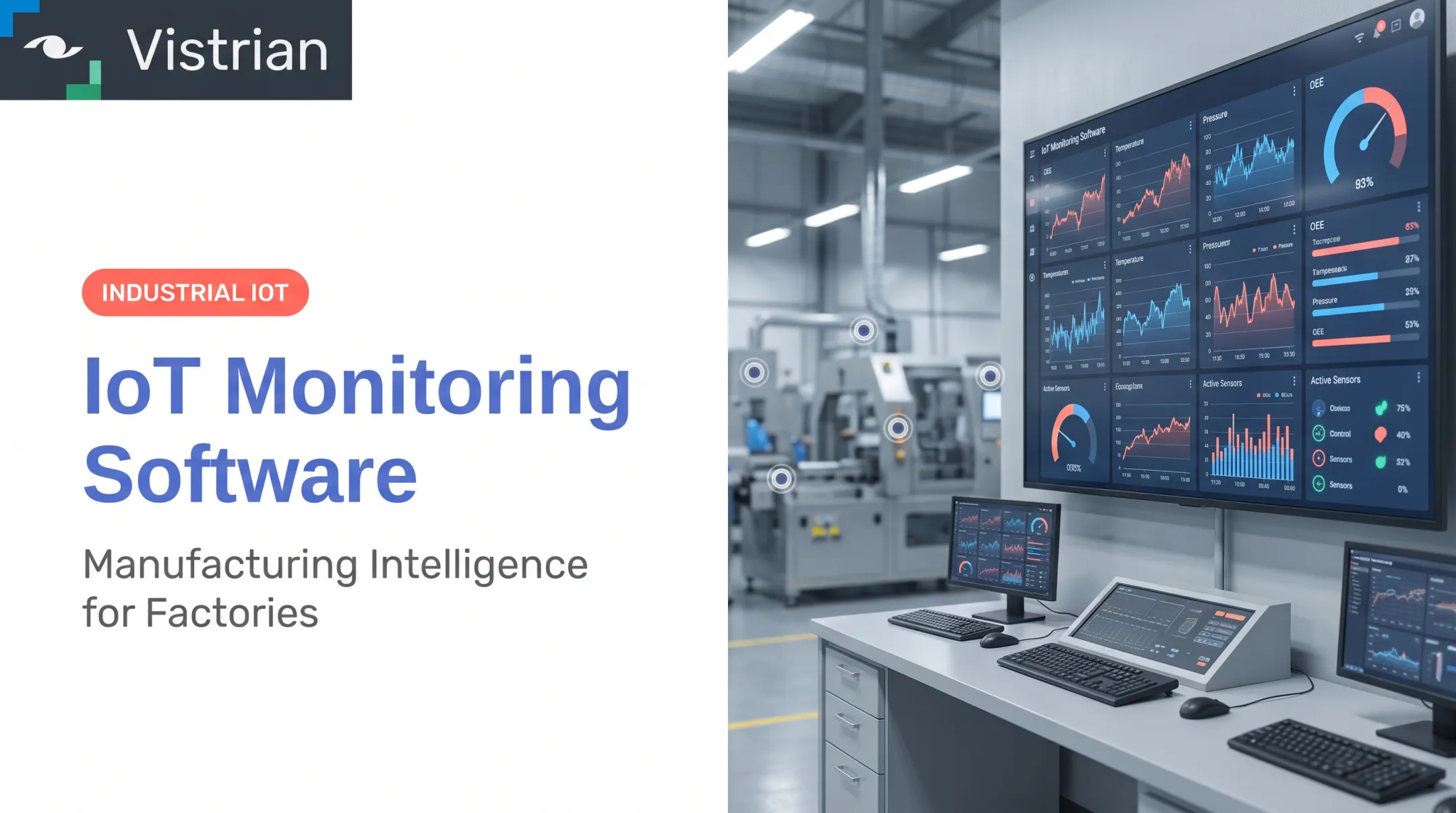
Live dashboards showing machine status, downtime reasons, throughput, and OEE replace delayed manual reports. This allows supervisors to identify bottlenecks as they form and make faster operational decisions. At one major North American cocoa processor, a Vistrian FactoryLOOK implementation provided this real-time visibility, helping them spot a bottleneck and avoid over $1 million in unnecessary capital spending.
Quality Assurance and Root-Cause Analysis
By connecting process conditions, equipment events, and inspection results, you can quickly trace the source of defects. When a quality issue arises, engineers can correlate it with specific machine parameters, material batches, or operator actions to support immediate corrective action and prevent recurrence.
Process Optimization and Resource Efficiency
Smart manufacturing exposes hidden losses and inefficiencies. Analyzing energy consumption, material usage, and asset utilization surfaces opportunities to:
- Cut scrap and rework
- Lower energy and consumables costs
- Optimize labor allocation
- Defer capital spend by extracting more from existing capacity
Multi-Plant and Enterprise Visibility
For companies with multiple facilities, standardizing data collection and reporting gives leadership a single source of truth. Teams can compare site performance, prioritize improvement work, and track enterprise-wide trends with consistent KPIs instead of plant-by-plant spreadsheets.
How to Implement a Smart Manufacturing Strategy
A successful implementation starts with a business problem, not a technology purchase. Follow these steps to build a practical and scalable strategy.
- Start with a Business Case and Baseline: Identify a specific, measurable problem. Is it unplanned downtime on a critical line? Low OEE? High scrap rates? Document the current process and establish a baseline KPI before you even think about technology.
- Audit Your Assets and Data Readiness: Inventory your machines, controllers, sensors, and existing software systems (MES, ERP, etc.). Determine which assets are already digitally accessible and which will require retrofitting. Identify where data is inconsistent or siloed.
- Choose a Contained Pilot Project: Begin with one production line or a small group of assets. Define success clearly, such as reducing unplanned downtime on Line 3 by 20% in three months. This validates the approach and builds momentum.
- Design the Architecture and Governance: Decide what data needs to be processed at the edge versus in the cloud. Define data ownership, access permissions, and cybersecurity controls. A clear governance plan prevents data chaos as you scale.
- Involve the People Who Use the Information: Involve operators, maintenance technicians, and engineers in dashboard and workflow design. Train them so they see how the new tools help them do their jobs better.
- Scale After Validating the Pilot: Once the pilot delivers measurable ROI, template the approach for broader rollout. Vistrian’s modular, cloud-enabled software supports scaling from plant-level visibility with FactoryLOOK to multi-plant monitoring with the full Manufacturing Suite. Clients often report payback periods of less than a year.

Challenges, KPIs, and How to Measure Success
The path to smart manufacturing has common hurdles, but they can be overcome with proper planning. A 2025 Deloitte survey highlighted challenges like skills gaps in key roles and significant concerns around operational and cybersecurity risks. Other common barriers include:
- Incompatible legacy equipment
- Unreliable networks
- Dashboards that produce data but don't drive action
Measurement is how you navigate these challenges and prove progress.
Key Performance Indicators (KPIs) to Track
Select a small set of KPIs that align directly with your initial business case. Don't track everything; track what matters.
- Overall Equipment Effectiveness (OEE): The gold standard—Availability × Performance × Quality
- Availability: Uptime, downtime duration, Mean Time Between Failures (MTBF)
- Performance: Throughput, yield, cycle time
- Quality: First Pass Yield (FPY), scrap rate, rework rate
- Maintenance: Mean Time To Repair (MTTR), maintenance schedule compliance
How to Evaluate Results
To prove ROI, establish a clear baseline before the project begins. Measure your chosen KPIs over a defined period and compare results to that baseline, accounting for variables like product mix or operating conditions.
Document both direct cost savings and operational improvements. That evidence builds the business case for future investment.
Frequently Asked Questions
Is Industry 4.0 the same as smart manufacturing?
No. Industry 4.0 is the broader fourth industrial revolution. Smart manufacturing is a core component of Industry 4.0, representing the practical application of its connected, data-driven technologies within a factory.
What is IoT in the manufacturing industry?
In manufacturing, IoT (specifically IIoT) refers to the network of connected sensors, machines, and systems used to collect and exchange operational data. This data provides real-time insights into production, quality, and maintenance.
What is the meaning of smart manufacturing?
Smart manufacturing is the use of connected technology, real-time data, and analytics to improve production processes. The goal is to make factories more adaptive, efficient, and capable of supporting faster, data-backed decisions.
What is an example of smart manufacturing?
Predictive maintenance is a common example. Sensors detect abnormal vibration and alert the maintenance team, who fix the issue during planned downtime before it causes a costly production stoppage.
How do manufacturers start implementing smart manufacturing?
Start small with a focused business problem, like reducing downtime on one critical machine. Audit your assets, run a limited pilot project with a clear success metric, and involve your team in the process.
Can smart manufacturing work with legacy equipment?
Yes. Many older assets can be connected using gateways, standard protocols, and retrofit IIoT sensors. A software-first approach, like Vistrian's platform, is designed to integrate data from both modern and legacy equipment without requiring immediate replacement.