
Introduction
Ask a plant manager how a specific machine performed last shift, and you'll often get three different answers: one from the whiteboard, one from the operator's memory, and one from a spreadsheet nobody updated since Tuesday.
This isn't a rare problem. A 2024 Manufacturing Leadership Council report found that 70% of manufacturers still collect production data manually, even as data volumes keep climbing. Machine status, downtime reasons, and maintenance records end up scattered across disconnected systems, controllers, and paper logs.
Machinery monitoring systems fix this by turning raw equipment signals into real-time visibility, alerts, and performance metrics. This guide covers what these systems are, how they work, what to track, and how to choose and implement one without wasting budget on features you don't need.
Key Takeaways
- 70% of manufacturers still rely on manual data collection, creating blind spots in machine status and downtime tracking
- Sensors, connections, analytics, and alerts turn equipment signals into decisions you can act on
- Track availability, performance, quality, and equipment condition together for full operational visibility
- Connect legacy machines through controllers, standard protocols, or retrofit IIoT sensors—no equipment replacement
- Pilot first to validate data accuracy and alert usefulness before plant- or enterprise-wide scale-up
What Are Machinery and Machine Monitoring Systems?
A machinery monitoring system combines sensors, machine connections, data-collection software, analytics, dashboards, and alerts to track equipment condition and production performance. Instead of walking the floor to check machine status, supervisors see it live on a screen.
The term gets used loosely, though. Several related categories often get lumped together:
- Production monitoring — tracks output, cycle time, downtime, utilization, and OEE
- Condition monitoring — watches signals like vibration, temperature, pressure, or current for equipment health
- Maintenance/CMMS software — manages work orders, preventive schedules, spare parts, and technician activity
- Asset or telematics monitoring — adds location, fuel, engine hours, and mobile-equipment data
Why the Distinction Matters
A modern manufacturing platform may combine all four capabilities. But buyers who skip identifying their specific problem first often end up comparing products on features that don't matter for their use case.
If your issue is unexplained downtime on a bottleneck machine, you need production monitoring with reliable downtime classification, not a full CMMS rollout.
Who typically uses these systems:
- Plant managers tracking daily performance against targets
- Production supervisors responding to live floor conditions
- Maintenance leaders scheduling and prioritizing work
- Quality teams investigating process variation
- Multi-plant executives comparing site performance
The common need across these roles is live visibility without replacing equipment that already works. Vistrian's FactoryLOOK, part of its Manufacturing Suite, connects machines, metrology tools, and IIoT devices to feed near-real-time data into dashboards and analytics. Manufacturers gain that visibility without ripping out working equipment.
How Do Machine Monitoring Systems Work?
Data has to travel a specific path before it becomes useful. Understanding that path helps you evaluate whether a system will actually work with your equipment.
From Machine to Dashboard
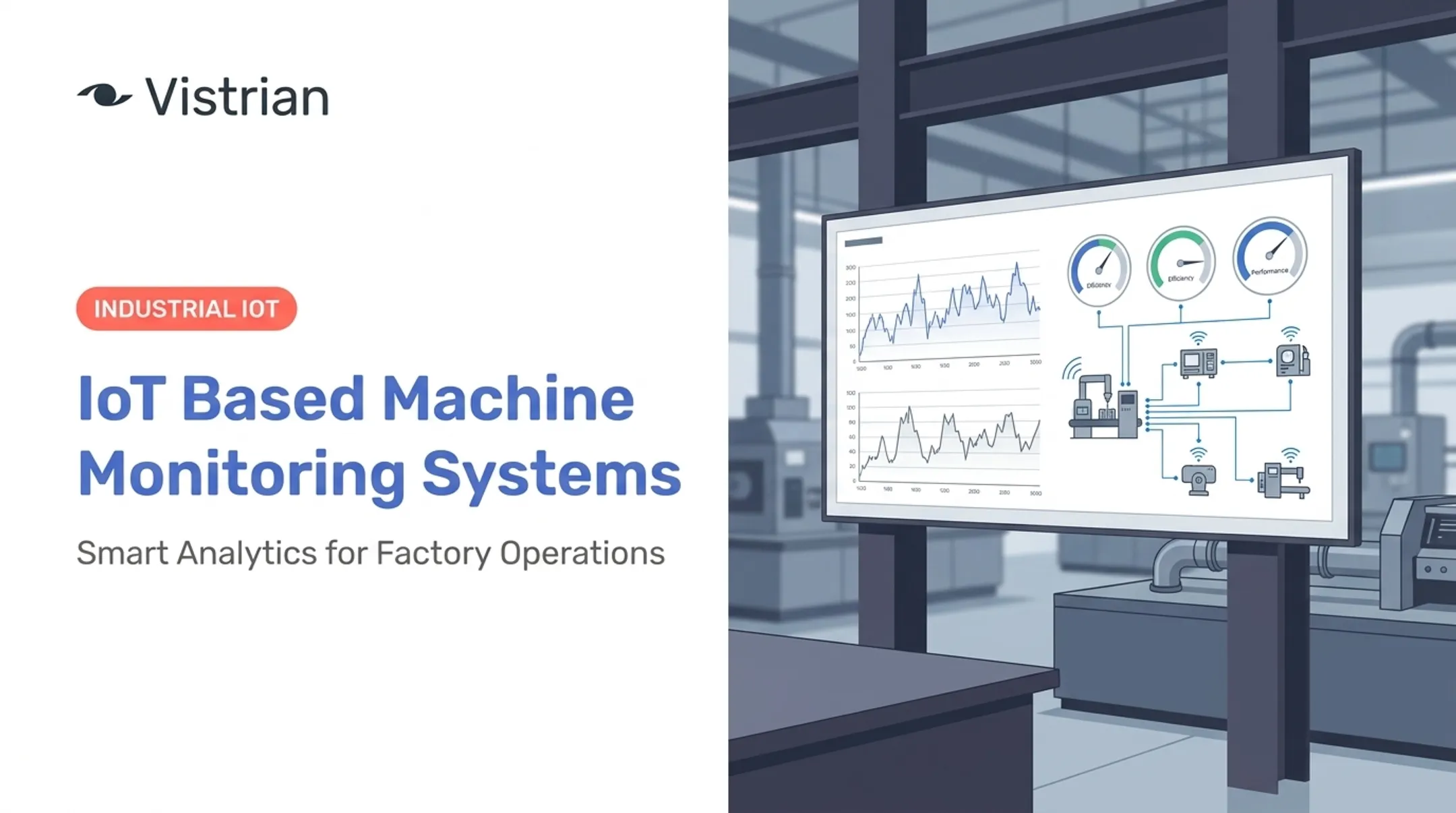
- Capture data from PLCs, CNC controllers, SCADA systems, machine logs, databases, industrial protocols, and retrofit IIoT sensors
- Normalize and time-stamp the information so teams can compare events across machines, shifts, and facilities
- Store data in a historian, cloud platform, or repository for trend analysis and auditability
- Present role-specific views for operators, supervisors, maintenance staff, and executives

FactoryLOOK follows this same structure. It connects to PLCs or PC-based controllers using standard industrial protocols, and when direct integration isn't possible, it pulls data from logs or databases instead. That flexibility matters most for facilities running a mix of decade-old and brand-new equipment.
Defining Machine States Consistently
Systems classify machines as running, idle, blocked, starved, or under planned or unplanned downtime. These states sound obvious until you try to configure them.
A machine "starved" of upstream material looks identical to a stopped machine on a status board unless the system distinguishes the two. State definitions must be configured consistently, or downtime reports become unreliable across shifts and lines.
Turning Visibility Into Action
Monitoring only creates value when it triggers a response. Vistrian's Manufacturing Suite sends alerts through a mobile app and email when sensors detect equipment deviations, routing the notification to whoever can act on it.
Analytics helps teams explain why an event happened:
- Compare actual output, cycle time, and downtime against targets
- Group downtime by reason, machine, product, or shift
- Correlate trends to support root-cause analysis, not one-off alerts
Benefits and Use Cases of Machinery Monitoring
The financial case for monitoring rests on a simple fact: downtime is expensive, and much of it is preventable once you know where it's coming from.
A 2025 Fluke survey of manufacturers found that 55% experienced unplanned downtime in the prior year, with capital impact reaching up to $207 million weekly across the industry. Even as industry-wide exposure rather than a single-plant loss, the figure shows how quickly unplanned stops add up.
Downtime Reduction in Practice
Effective monitoring reduces downtime through a repeatable sequence:
- Capture the exact time and duration of every stop
- Classify downtime reasons consistently across shifts
- Route alerts to the person who can act immediately
- Use historical trends to stop repeat failures before they return
Maintenance: Three Different Strategies
Not all maintenance approaches work the same way, and mixing them up leads to wasted spend:
| Approach | Trigger | Best For |
|---|---|---|
| Preventive | Fixed schedule or usage threshold | Predictable wear patterns |
| Condition-based | Measured equipment signal | Assets with reliable sensor data |
| Predictive | Historical + current data patterns | High-value, failure-prone equipment |
Monitoring improves the decisions behind each approach. It doesn't replace inspection, engineering judgment, or safe work procedures.
Real Plant Outcomes
Those clearer maintenance and downtime signals only matter if they change spend and yield decisions on the floor.
- Food & beverage: FactoryLOOK visibility into refiner utilization showed the bottleneck was plumbing to downstream tanks, not equipment wear—helping the plant avoid more than $1 million in unnecessary refiner capex.
- Disk media: Trend charts linked specific equipment alarm events to yield losses, giving quality a concrete investigation path instead of guesswork.
What Should a Machine Monitoring System Track?
More sensors don't automatically mean better decisions. The right starting point is a focused set of metrics tied to a specific business outcome.
Four Metric Categories
Most programs get the most value from four metric groups:
Availability
- Uptime and downtime duration
- Planned vs. unplanned stoppages
- Mean time between failures
Performance
- Output and throughput
- Cycle time and speed loss
- Schedule attainment
Quality
- Good units vs. rejects
- Rework and scrap rates
- First-pass yield
Condition and Resource Health
- Temperature, vibration, pressure, current
- Energy consumption
- Alarms and fault codes
The OEE Trap
OEE combines availability, performance, and quality into a single score. It's useful, but only when the underlying data is trustworthy. Inaccurate downtime reasons, inconsistent shift definitions, or incomplete quality records make OEE misleading rather than helpful.
There's also no universal target. OEE.com notes that 85% is often cited as world-class for discrete manufacturing, while many companies actually run closer to 60%. Set your own baseline first, then track improvement against it instead of chasing a generic benchmark.
Vistrian Analytics customizes throughput, utilization, and cycle-time metrics to the granularity a team actually needs, instead of dumping every available signal into one dashboard.
Different Dashboards for Different Roles
The same underlying data should surface differently by role:
- Operators get a live status view: current state, cycle count, immediate alerts
- Maintenance teams work from an equipment-health queue: flagged assets, pending work orders, condition trends
- Executives review multi-plant performance reports: OEE comparisons, cost impact, capacity utilization
How to Choose the Best Machinery Monitoring Software
Start with a needs assessment before you look at a single product demo. Map out your machines, current data sources, target users, number of facilities, and the specific business outcome you need the system to support.
Integration and Equipment Compatibility
This is where most evaluations succeed or fail. Ask vendors directly:
- Do they support your existing PLCs, CNCs, and controllers?
- How do they handle mixed-vendor fleets and intermittent connectivity?
- Can legacy machines connect without replacing functioning equipment?
FactoryLOOK, for instance, connects through standard industrial protocols first, then falls back to logs or databases when direct controller access isn't available. That fallback matters for older equipment that was never built to be "smart."
Capabilities Worth Comparing
- Real-time dashboards and historical trends
- Configurable KPIs, OEE, and downtime classification
- Root-cause analysis tools
- Alerting, reporting, and audit trails
- Integration with existing maintenance or enterprise systems
Usability, Scale, and Cost
Review role-based dashboards, mobile access, and whether operators can adjust views without calling IT every time. Then check the architecture:
- Does it support one line, one plant, or multi-plant deployment?
- Is it cloud, on-premises, or hybrid, and who owns the data?
- What are the security controls and user permission structures?
Those architecture choices feed directly into total cost of ownership. Build a comparison that covers:
- Licensing
- Sensors or gateways
- Implementation and training
- Ongoing administration
Vistrian's Manufacturing Suite bundles FactoryLOOK, Dashboards, and Analytics as a software-only, modular platform. Clients have reported average payback periods under one year.
Whatever you choose, run a pilot first. Validate connection reliability, data accuracy against your own records, and how quickly a dashboard turns into an actual improvement action.
How to Implement a Machine Monitoring System
Skip the temptation to monitor everything at once. Start with one clearly defined use case, such as cutting unplanned downtime on your worst bottleneck machine or improving OEE on a single line.
Build an Equipment Readiness Inventory
Before connecting anything, document:
- Machine models and controller types
- Available signals and sensor gaps
- Network access at each machine
- Downtime codes and quality-record formats
- Who owns each piece of equipment operationally
Run a Controlled Pilot
- Connect a representative mix of modern and legacy equipment, not just your newest machines
- Validate data accuracy against what operators and maintenance teams already record manually
- Configure a small number of actionable dashboards and alert thresholds
- Gather feedback from operators, supervisors, maintenance staff, and IT

Vistrian's own rollout with a North American cocoa processor and chocolate manufacturer followed this same pattern. A focused pilot proved data accuracy across a limited set of production tools before any wider commitment.
That evidence let leadership project over 20% OEE improvement and more than $1 million in avoided capital expenditure, which justified expanding FactoryLOOK across the rest of the plant.
Establish Governance Before Scaling
Define metric definitions, downtime-reason coding, user permissions, and escalation ownership up front. Skipping this step is how two plants end up reporting "downtime" differently and nobody can compare results.
Scale in stages, using pilot lessons to guide the next rollout. Document measurable outcomes at each stage rather than assuming success will repeat automatically.
Conclusion
A machinery monitoring system earns its budget when it connects reliable machine data to a specific operational decision, not when it simply produces more dashboards nobody checks.
When comparing options, prioritize:
- Equipment compatibility
- Metrics tied to business outcomes
- Actionable alerts
- Scalability and usability
- Total cost of ownership, including costs vendors rarely surface up front
If you're evaluating how real-time visibility could work across your machines, lines, or plants, Vistrian's FactoryLOOK, Manufacturing Suite, and Vistrian Analytics offer a modular starting point built around legacy-equipment connectivity and measurable operational outcomes.
Frequently Asked Questions
What is the best machinery monitoring software?
The best option depends on your machine compatibility, required metrics, and deployment model, not on a generic ranking. Compare systems through a use-case-led pilot before committing to a full rollout.
What are equipment monitoring systems?
Equipment monitoring systems combine sensors, machine connections, software, dashboards, analytics, and alerts to track performance, condition, utilization, and maintenance needs. They turn raw machine signals into decisions operators and managers can act on.
What are some examples of monitoring systems?
Common categories include production monitoring (tracking OEE and downtime), condition monitoring (vibration and temperature sensors), predictive maintenance platforms, CMMS software for work orders, and asset/telematics tracking for mobile equipment location.
Which metrics should a machine monitoring system track?
Focus on availability (uptime, downtime), performance (cycle time, throughput), quality (yield, scrap), and condition signals (temperature, vibration, alarms). The right mix depends entirely on your specific business use case.
Can machine monitoring systems connect to legacy equipment?
Yes. Many systems use controllers, standard protocols, logs, databases, or retrofit IIoT sensors to pull data from older machines without replacing functioning equipment. Always verify compatibility with your specific machines through a pilot before committing.