
Introduction
Most facility teams still juggle spreadsheets, paper checklists, and a maintenance approach that kicks in only after something breaks. That reactive cycle is expensive, and it's becoming harder to justify.
A 2024 ASHB survey of building operators and managers found that 90% of respondents already reported smart capabilities in their buildings — connected sensors, automated controls, or centralized monitoring replacing manual walk-throughs.
This article explains what smart facility management means, how the technology works, and which solution categories deliver the most value. It also shows how US organizations can evaluate implementation without overspending on features they don't need.
Along the way, we cover legacy-system integration, measurable KPIs, cybersecurity, and why phased rollouts beat all-at-once deployments.
Key Takeaways
- Smart facility management links assets, systems, and people so teams act before problems escalate.
- Core coverage spans predictive maintenance, work orders, environmental monitoring, occupancy, and portfolio reporting.
- Success depends on interoperability, clean data, cybersecurity, and staff adoption, not just new software.
- Evaluate platforms on how well they turn raw data into prioritized, actionable workflows.
What Is Smart Facility Management and How Does It Work?
Smart facility management uses connected devices, software, analytics, and automated workflows to improve how buildings and equipment are operated, maintained, and monitored. It's the difference between walking the floor with a clipboard and having a dashboard tell you which asset needs attention before it fails.
Traditional facility management relies on scheduled inspections and reactive repairs. Smart FM supplements — or replaces — that with continuous monitoring, condition-based decisions, and automated alerts routed to the right person.
How Data Moves Through a Smart FM System
The workflow follows four stages:
- Data generation — Sensors, meters, controllers, equipment logs, and service requests produce raw operational data.
- Connectivity and integration — Gateways and standard protocols transmit that data across systems, including older equipment that wasn't built to be "smart."
- Analysis — Analytics engines flag trends, abnormal readings, and performance gaps.
- Action — Dashboards, alerts, and automated work orders turn those insights into tasks for technicians, vendors, and managers.
You don't need to rip out every legacy asset to get here. Digital retrofits, IoT gateways, and phased integrations can modernize older facilities without a full system replacement. Vistrian's approach reflects this directly: its modular design integrates legacy systems with modern digital infrastructure rather than demanding a complete technology overhaul.
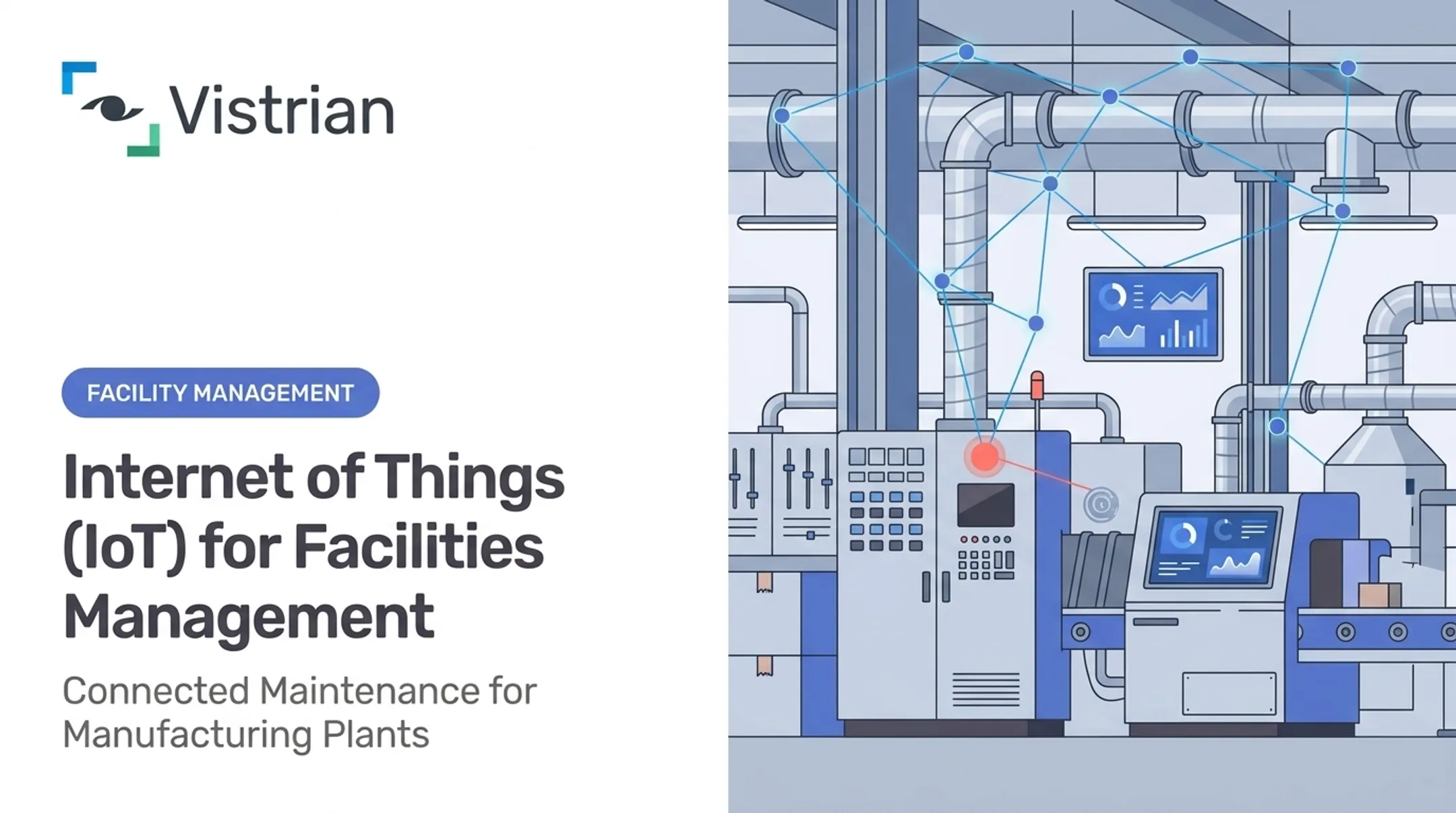
The technology stack includes IoT sensors, building or facility management systems, CMMS or CAFM software, cloud platforms, analytics engines, and mobile access for field technicians. For example, Vistrian FactoryLOOK connects to machine controllers, historical logs, and IIoT devices to collect near-real-time equipment data, while Vistrian IoT adds sensors to machines that lack digital interfaces.
Smart Facility Management Solutions and Practical Use Cases
Group solutions by the operational problem each one solves, not by the technology label on the box.
Predictive and Condition-Based Maintenance
Predictive maintenance uses equipment condition data, historical records, and anomaly detection to catch risks before failure. This differs from calendar-based preventive maintenance (fixed schedules regardless of actual condition) and reactive maintenance (run it until it breaks).
The DOE Federal Energy Management Program's O&M Best Practices Guide estimates:
- Preventive maintenance saves 12%–18% versus purely reactive approaches
- Predictive maintenance saves an additional 8%–12% versus preventive-only strategies
The same guide notes that facilities relying heavily on reactive maintenance (over 55% of activity, in the referenced benchmark) leave significant savings on the table.
A typical alert-to-resolution flow looks like this:
- Sensor data crosses a threshold and an alert fires
- A work order is created and assigned to a technician
- Spare parts are checked against inventory
- The job is completed and logged
- Results feed back into performance history

VistrianMMS pairs with FactoryLOOK and Vistrian Analytics to support this condition-based workflow, using AI-powered prioritization to route work orders by urgency.
Asset, Work-Order, and Service-Request Management
A CMMS, CAFM, or FMS platform replaces paper forms, email chains, and scattered spreadsheets with one shared operational record. That typically covers:
- Digital asset registers and complete asset histories
- Preventive-maintenance scheduling and inspections
- Work orders, spare parts tracking, and vendor coordination
- Mobile updates from the field
VistrianMMS applies this model as a CMMS: it schedules preventive maintenance, manages work orders, and keeps spare-parts data in one live system so planned, open, and overdue tasks stay visible.
Environmental, Energy, and Indoor-Condition Monitoring
Sensors tracking temperature, humidity, air quality, lighting, water, and energy consumption feed real-time trends that support occupant comfort and sustainability reporting.
Energy is often the biggest lever here. JLL research notes that electricity alone can account for up to one-quarter of a building's operating costs, which makes even modest efficiency gains meaningful at scale. FactoryLOOK integrates equipment- and process-level energy data with production metrics, which can reveal when equipment idles wastefully or runs out of sync with peak-demand periods.
Occupancy, Space, and Asset-Utilization Insights
Occupancy and utilization data can inform space planning, cleaning schedules, room management, and even capital decisions about which facilities need investment.
Collecting data on people's locations or behavior patterns also creates governance obligations. NIST recommends limiting personal data collection, restricting access, and auditing who can see what. Apply that standard before you deploy occupancy sensors, not after.
Portfolio-Wide Visibility and Decision Support
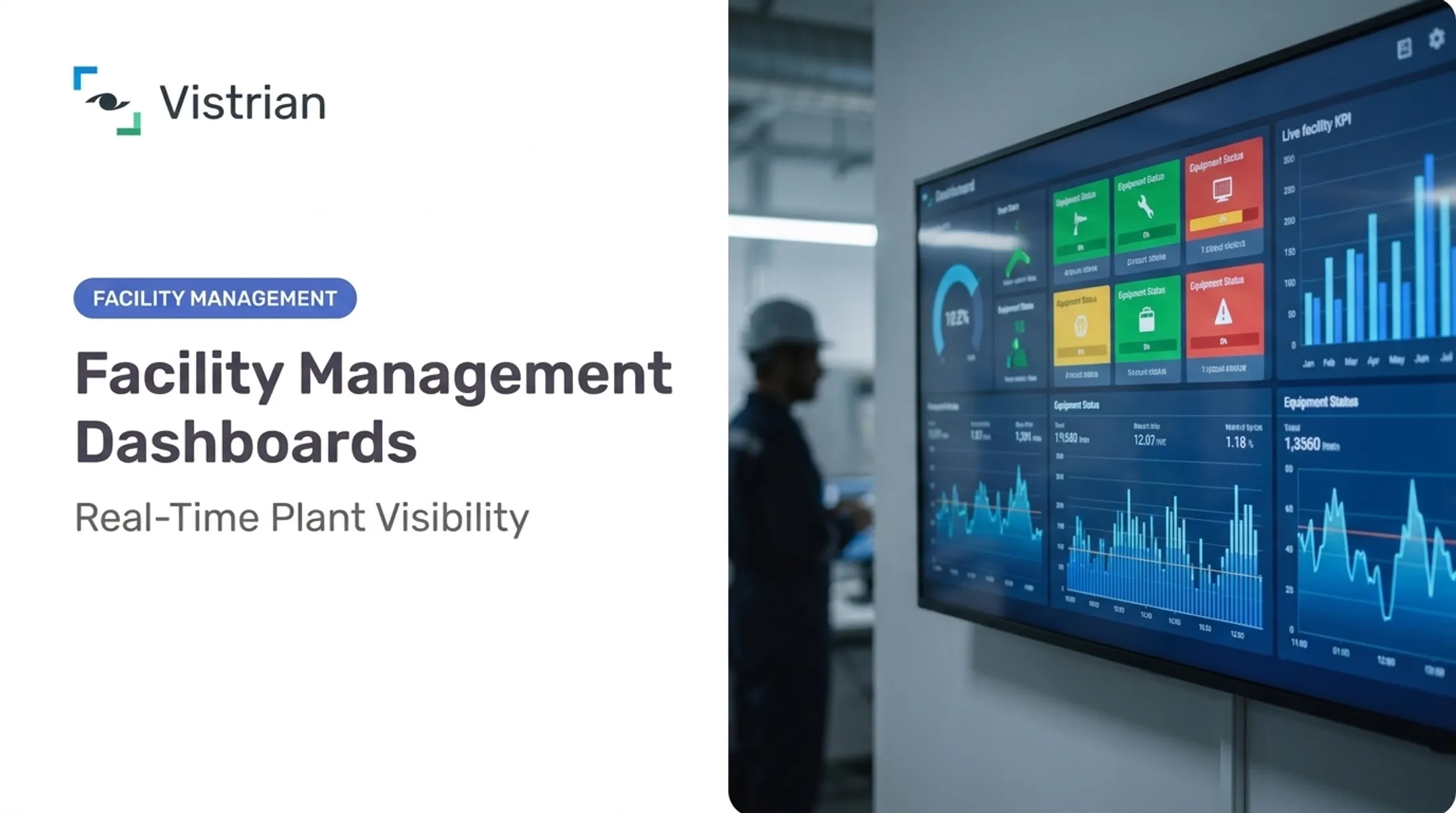
Dashboards, benchmarking, and role-based alerts let leaders compare performance across sites and spot recurring loss drivers. Vistrian's modular, cloud-enabled platform supports this kind of centralized monitoring so multi-site leaders can compare facilities, prioritize interventions, and act on shared operational data.
Benefits of Smart Facility Management
Connected monitoring and digital workflows change how facility teams operate, but the benefits are conditional, not automatic.
Maintenance and asset outcomes:
- Reduced avoidable downtime through earlier detection of equipment issues
- Better maintenance prioritization instead of guesswork
- Extended asset life through less wear and fewer emergency repairs
JLL reports that smart-building upgrades can cut maintenance costs by up to 20%, partly because equipment experiences less strain from being run to failure. In one JLL-documented case, Workspace Group reduced electricity use by 31% within five months of implementing smart building measures, saving roughly 63,000 kWh per month.

Operational visibility and decision quality:
Consistent data across sites helps facility leaders move past anecdotal site reports:
- Identify bottlenecks across buildings and campuses
- Compare performance between locations on the same metrics
- Confirm whether service levels are actually being met
Occupant and stakeholder outcomes:
- Faster resolution of service requests
- Safer working conditions through earlier hazard detection
- More consistent experiences across multiple locations
Sustainability and resilience:
- Lower energy waste through continuous monitoring and corrective action
- Stronger compliance documentation from auditable usage and maintenance records
- Faster recovery readiness when unplanned disruptions hit critical systems
The practical limit is simple: benefits depend on data quality, integration depth, workflow design, and user adoption. A platform full of sensors won't save money if technicians ignore the alerts or the data feeding it is inconsistent.
How to Implement and Choose a Smart Facility Management Solution
Start With a Current-State Assessment
Document your facilities, critical assets, existing systems, and recurring failures before evaluating any platform. Pick one or two high-value use cases (preventive maintenance or multi-site reporting, for instance) rather than attempting a full transformation on day one.
Define Measurable Outcomes
Select KPIs that matter to your operation: asset uptime, planned-versus-reactive maintenance ratio, mean time to repair, work-order completion rate, and cost per asset. Establish a baseline before rollout so you can actually measure change.
A useful reference point: Parrish Medical Center's facilities team, a 210-bed hospital, implemented a CMMS with clear compliance and overtime targets. Overtime dropped from 4.2% to 2% of productive hours, and the facility achieved 100% compliance with life-safety inspections over two consecutive years, a direct result of tracking the right metrics from the start.
Evaluate Integration and Interoperability
Confirm the platform supports your existing BMS, ERP, access-control, and metering systems. Ask vendors directly:
- How do you handle legacy machines without digital interfaces?
- What happens with duplicate records or inconsistent naming?
- Can we add facilities without creating new data silos?
Vistrian Management Suite, for context, integrates equipment regardless of manufacturer or vintage and supports both cloud-based and on-premises deployment.
Assess Platform Capabilities and Usability
Look for configurable workflows, role-based permissions, and audit trails. Prioritize actionable alerts over dashboards that dump data without telling you what to do next. A system that generates 200 alerts a day with no clear next step creates noise, not clarity.
Plan Security, Governance, and Change Management
Evaluate authentication, encryption, backup protocols, and vendor access before signing anything. Assign clear ownership for data quality and cybersecurity reviews.
Then train staff by role and pilot the system with a small group before wider rollout. Resistance to new CMMS software is common, and skipping training tends to make it worse.
Roll Out in Phases
- Pilot with a representative facility or asset group and document what works.
- Expand integrations and sites in stages, standardizing naming conventions as you go.
- Review KPI performance at each stage before scaling further.

VistrianFMS fits this pattern for facility teams managing service requests, assets, and scheduled upkeep across multiple locations. It is deployable in as little as three to four weeks, including configuration and onboarding. That said, validate integrations, security requirements, and implementation support against your specific environment before committing.
Conclusion
Smart facility management is an operating model built on connected information, proactive workflows, and steady improvement over time—not a pile of sensors or a feature list.
The practical path looks like this:
- Assess your current processes
- Pick one high-value use case
- Set clear KPIs
- Verify interoperability and security
- Pilot with real users
- Scale based on what the data shows, not vendor promises
If your team still tracks maintenance on spreadsheets or finds equipment failures after the fact, evaluate a connected platform such as Vistrian’s facility and maintenance suites. Start with one use case and measure visibility gains across assets, work orders, and multi-site operations.
Frequently Asked Questions
What is smart facility management and how does it work?
Smart facility management uses connected devices, software, and analytics to monitor facilities in real time. Data from sensors and systems feeds analytics tools that trigger alerts and work orders for facility teams to act on.
What is CAFM and how does it differ from CMMS?
CAFM covers broader facility activities like space, property, and workplace management. CMMS focuses specifically on maintenance, assets, and work orders — though many platforms overlap both functions.
What are the main benefits of smart facility management?
Teams typically gain better visibility, more proactive maintenance, lower emergency-repair costs, and an improved occupant experience. Results depend on how well the system is implemented and used.
What technologies are used in smart facility management?
IoT sensors, BMS/BAS integrations, CMMS or CAFM software, cloud platforms, analytics engines, mobile tools, and security controls all typically form part of the stack.
What are the main challenges of implementing smart facility management?
Legacy-system integration, data quality, cybersecurity, upfront cost, and staff adoption are the most common hurdles. Clear KPIs from the start help teams stay focused on what actually matters.
How should an organization choose a smart facility management solution?
Evaluate use-case fit, integration capability, security, usability, and reporting depth. Run a pilot before a full rollout so your decision rests on real evidence, not vendor claims.