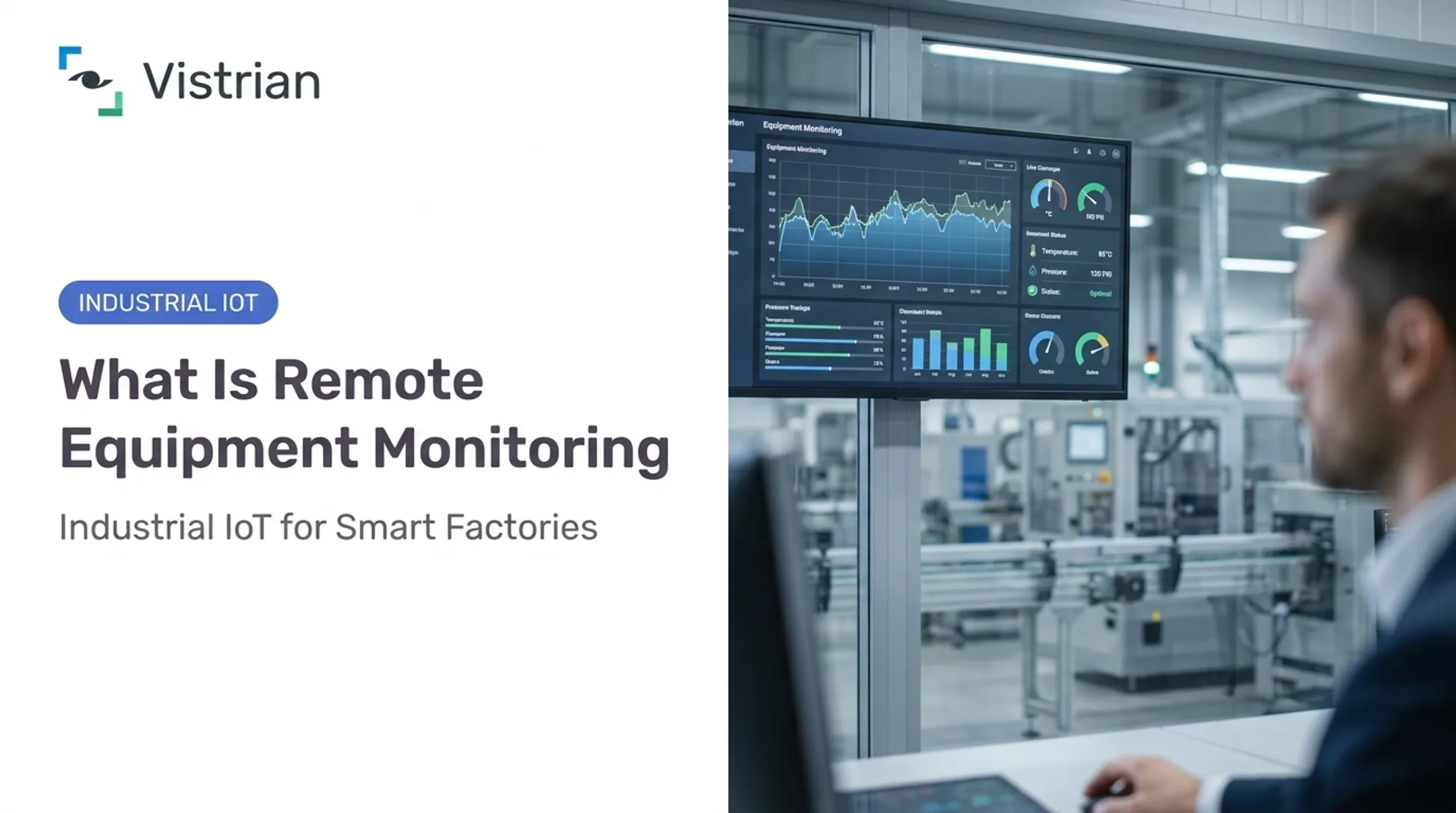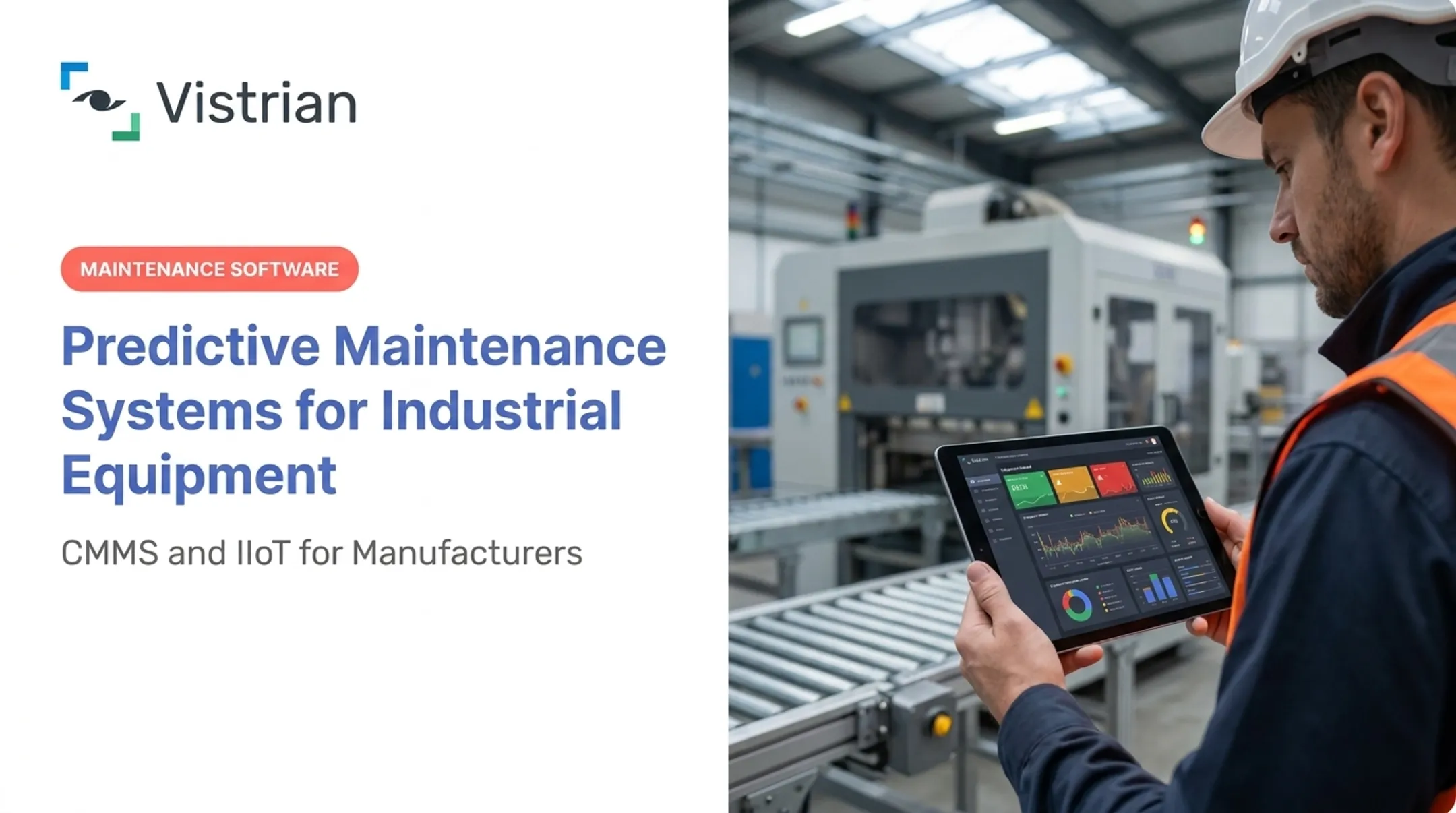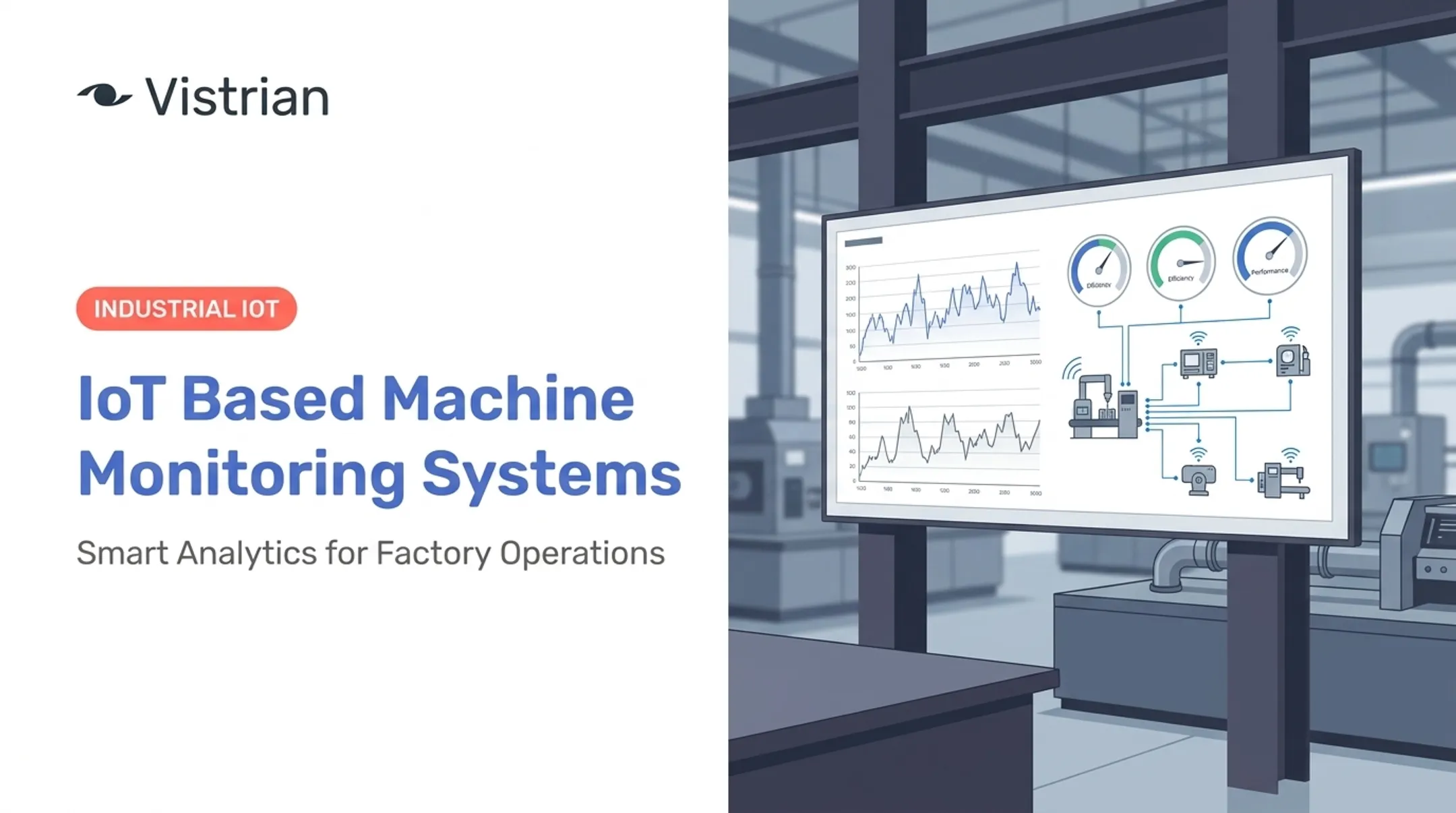

Remote condition monitoring systems flip that timeline. They collect equipment-health data from a distance, send it for analysis, and alert your team when readings drift into abnormal territory. According to a 2025 Fluke survey of over 600 US manufacturing decision-makers, unplanned downtime now costs some plants up to $207 million per week in capital impact.
This guide covers how these systems work, the core techniques and pillars behind them, manufacturing benefits, practical use cases, and a realistic implementation path, whether your plant runs brand-new IIoT sensors or controllers older than some of your employees.
Key Takeaways
- Remote condition monitoring closes the loop from machine data through analytics, dashboards, and maintenance action.
- Data only matters when it converts into prioritized action, not just more dashboards to ignore.
- Pilot critical assets first; scale plant-wide only after data quality and alert rules prove out.
- Monitoring enables predictive maintenance but isn't the same thing—prediction needs history and validated failure patterns.
What Is Remote Condition Monitoring and How Does It Work?
Remote condition monitoring tracks measurable indicators of asset health, such as vibration or temperature, without anyone standing next to the machine. That's different from basic equipment status monitoring, which typically just tells you whether a machine is running or stopped. Condition monitoring tells you how well it's running.
RCM vs. PM, PdM, and CBM
These terms get used interchangeably, but they're not the same:
- Preventive maintenance (PM): Fixed-interval work performed regardless of actual condition, per SMRP's Best Practices guidance.
- Predictive maintenance (PdM): Uses technology to catch operating discrepancies before they're detectable by human senses.
- Condition-based maintenance (CBM): Assessing real-time condition and triggering corrective work only when a reading demands it.
- Remote condition monitoring: The delivery mechanism, remotely acquiring and transmitting that condition data so PdM and CBM decisions can happen off-site.
The Monitoring Workflow
- Select the asset and build a baseline — establish what "normal" looks like before you can flag "abnormal."
- Sense and transmit data — via IIoT sensors, PLCs, machine logs, or historians.
- Analyze against thresholds — the system compares live readings to baseline and trend patterns.
- Alert the right person — notifications route to whoever owns that asset or work queue.
- Prioritize and act — an inspection or work order gets created and resolved.
- Verify the fix — confirm the reading returned to normal after the repair.

What Gets Tracked
Systems typically pull in signals such as:
- Vibration, temperature, pressure, and speed
- Current, energy use, and cycle time
- Machine state, process values, and alarms
- Production output
Vistrian FactoryLOOK, for example, connects to PLCs, sensors, legacy controllers, and IIoT devices to pull this data from equipment already on your floor—no full retrofit required.
That data only helps if it stays complete and actionable. Connectivity isn't always constant, so edge buffering matters: it preserves readings locally and syncs them once communication returns, rather than silently dropping evidence of a developing fault.
Poorly configured thresholds create alert fatigue fast. If everything triggers a notification, nothing gets prioritized.
Condition Monitoring Techniques and Five Core Pillars
No single sensor tells the whole story. Combining techniques is often necessary when one signal alone can't confirm a failure mode.
Five Core Techniques
- Vibration analysis: detects imbalance, misalignment, looseness, and bearing wear. ISO 13373-2 links vibration diagnostics to accelerated wear, flow problems, and lubrication issues.
- Thermal monitoring / infrared thermography: flags overheating, abnormal friction, and electrical resistance before they become visible faults.
- Oil and lubricant analysis: tracks contamination, viscosity shifts, and wear particles in gearboxes, hydraulics, and other lubricated components.
- Acoustic/ultrasonic monitoring: catches leaks, friction, and electrical discharge through sound signatures that other measurements miss.
- Electrical and process monitoring: watches current, voltage, power, pressure, flow, speed, and cycle time for signs of degrading performance.
The Five Practical Pillars
Behind any working system, five pieces have to function together:
- Sensing: chosen based on failure modes, asset criticality, and what data the machine already produces.
- Connectivity: moves data securely through gateways, wired networks, or cellular links.
- Data management: normalizes timestamps, units, and asset names so comparisons hold up over time.
- Analytics and visualization: builds baselines, spots trends, and surfaces prioritized alerts.
- Action and feedback: ties alerts to work orders, root-cause analysis, and confirmation the fix worked.

Continuous, Periodic, or Event-Triggered?
| Approach | Coverage | Data Volume | Cost | Response Speed |
|---|---|---|---|---|
| Continuous monitoring | Highest | Highest | Highest | Fastest |
| Periodic route-based inspection | Moderate | Low | Lowest | Slowest |
| Event-triggered recording | Targeted | Moderate | Moderate | Fast for flagged events |
Most plants land somewhere in between: continuous monitoring on critical rotating equipment, periodic checks on lower-risk assets, and event triggers everywhere data volume needs to stay manageable.
Benefits for Manufacturing Operations
The financial case starts with what downtime actually costs. 2025 Fluke research found the average incident runs $400,000 per hour, with a single event reaching up to $13.8 million. Earlier visibility into abnormal readings gives maintenance teams a chance to schedule the fix instead of reacting to it.
Condition data feeds directly into the numbers plant leaders already track:
- Uptime and OEE — fewer surprise stoppages
- Throughput and yield — degraded equipment often produces more scrap before it fails outright
- Cycle time and utilization — drift in these often precedes a breakdown
- Bottleneck identification — recurring alerts point to the constraint
Those same dashboards support remote review. Specialists and multi-plant reliability engineers don't need to be on-site to check a trend line, which cuts travel time and lets one engineer support several facilities from a single view.
Financial value drivers worth tracking include:
- Avoided downtime and emergency labor premiums
- Reduced secondary damage from cascading failures
- Better spare-parts planning, less rush shipping
- Deferred capital expenditure on premature replacements
- Longer useful asset life
The gains aren't only financial. Earlier detection of overheating, pressure deviations, or unstable process conditions protects employees and products, not just equipment.
That said, don't expect automatic savings. Measure a baseline before deployment, then compare results after, the way Vistrian's cocoa-processing customer did before reporting over $1 million in avoided capital expenditure and a projected 20%+ OEE improvement.
Use Cases and What to Monitor
Manufacturing Applications
Rotating equipment, CNC machines, pumps, motors, compressors, and process lines are the usual starting points. Mixed-vendor production floors benefit most, since one platform can pull data from multiple equipment brands and ages.
Older Equipment Isn't a Dealbreaker
Plants with legacy or digitally isolated machines don't need to replace everything. Vistrian's Manufacturing Suite, for instance, supports controllers as old as 40 years, adding IIoT sensors only where direct data access isn't possible.
Multi-Plant Visibility
Operations leaders overseeing several sites can compare normalized KPIs, spot recurring loss drivers, and still see site-level exceptions without losing local context. That's how one disk-media manufacturer scaled from a five-tool pilot to 300+ tools across seven plants in four countries, with payback in under six months.

A Quick Healthcare Example
Remote monitoring of a ventilator or imaging system can track selected operating conditions and alert qualified personnel. Per the Hamilton-T1 operator's manual, it doesn't replace clinical oversight, required safety procedures, or manufacturer-scheduled servicing. Across industries, the same principle holds: monitoring supports human judgment rather than replacing it.
Beyond Manufacturing
Facilities, energy, transportation, and agriculture apply the same monitoring principles. Sensors, regulations, and response procedures simply vary by sector.
How to Prioritize Assets
Start with assets where monitoring will change outcomes fastest:
- Criticality and failure history
- Safety and production impact
- Early failure detectability
- Data availability
- Feasibility of corrective action
How to Implement a Remote Condition Monitoring System
Build the Business Case First
Identify the operational problem, target assets, failure modes, and current maintenance process. Define what decision the monitoring system needs to improve, not just what data it will collect.
Pick a Focused Pilot
Choose equipment with a known failure risk, available data, and a realistic response process already in place. Instrumenting everything at once usually stalls the project.
Map the Technical Environment
Document legacy controllers, PLCs, historians, network boundaries, and integration points with CMMS, EAM, MES, or ERP systems before buying anything.
Set Governance Rules Early
- Standard asset naming and units
- Sampling rates and data retention
- Access permissions and escalation paths
- Threshold ownership and alarm priority
- A process for retiring alerts that don't earn their keep
Design Cybersecurity In
Segmented networks, least-privilege access, encrypted transmission where supported, and a plan for what happens during connectivity loss all need to be designed in, not added later.
Close the Loop on Every Alert
Define who validates an alert, who creates the work order, and how the outcome gets recorded. VistrianMMS, for example, routes alerts into work orders complete with owners, due dates, and parts lists, so the alert doesn't just sit in an inbox.
Train by Role
Maintenance, reliability, operations, IT, and management all need different training. Adoption depends on trusted data and clear workflows, not just a clean interface.
Review the Pilot
SMRP's published benchmarks give a useful reference point: 95% PM compliance, planned work at 90%, and reactive work below 10% represent strong industry performance. Compare your pilot's alert-to-work-order completion, data completeness, and OEE movement against your own baseline before scaling up.
When you are ready to expand beyond the pilot, Vistrian's modular Manufacturing Suite and Vistrian Analytics support the same chain at scale—equipment integration, IIoT connectivity, dashboards, and root-cause visibility across one plant or many.
Frequently Asked Questions
What does remote condition monitoring do?
Remote condition monitoring collects and analyzes equipment-health data from afar, flags abnormal trends or threshold breaches, and alerts personnel so they can investigate before a failure turns into downtime.
What are five examples of condition monitoring techniques?
Vibration analysis (mechanical wear), thermal monitoring (overheating), oil analysis (contamination and wear particles), acoustic/ultrasonic monitoring (leaks and friction), and electrical/process monitoring (current, pressure, and flow changes).
What are the five pillars of condition monitoring?
Sensing, connectivity, data management, analytics and visualization, and action or maintenance feedback. Each pillar has to function for the system to deliver useful outcomes, not just data.
What is an example of remote condition monitoring in healthcare?
Remote monitoring of equipment like a ventilator or imaging system, tracking selected operating conditions and alerting qualified staff. It supports clinical oversight; it doesn't replace required supervision, safety controls, or manufacturer servicing.
How is remote condition monitoring different from on-site-only checks?
Remote systems stream sensor and machine data off the plant floor for continuous review, so teams can spot issues without standing at the asset. On-site-only checks rely on scheduled walk-arounds and miss problems that develop between inspections.