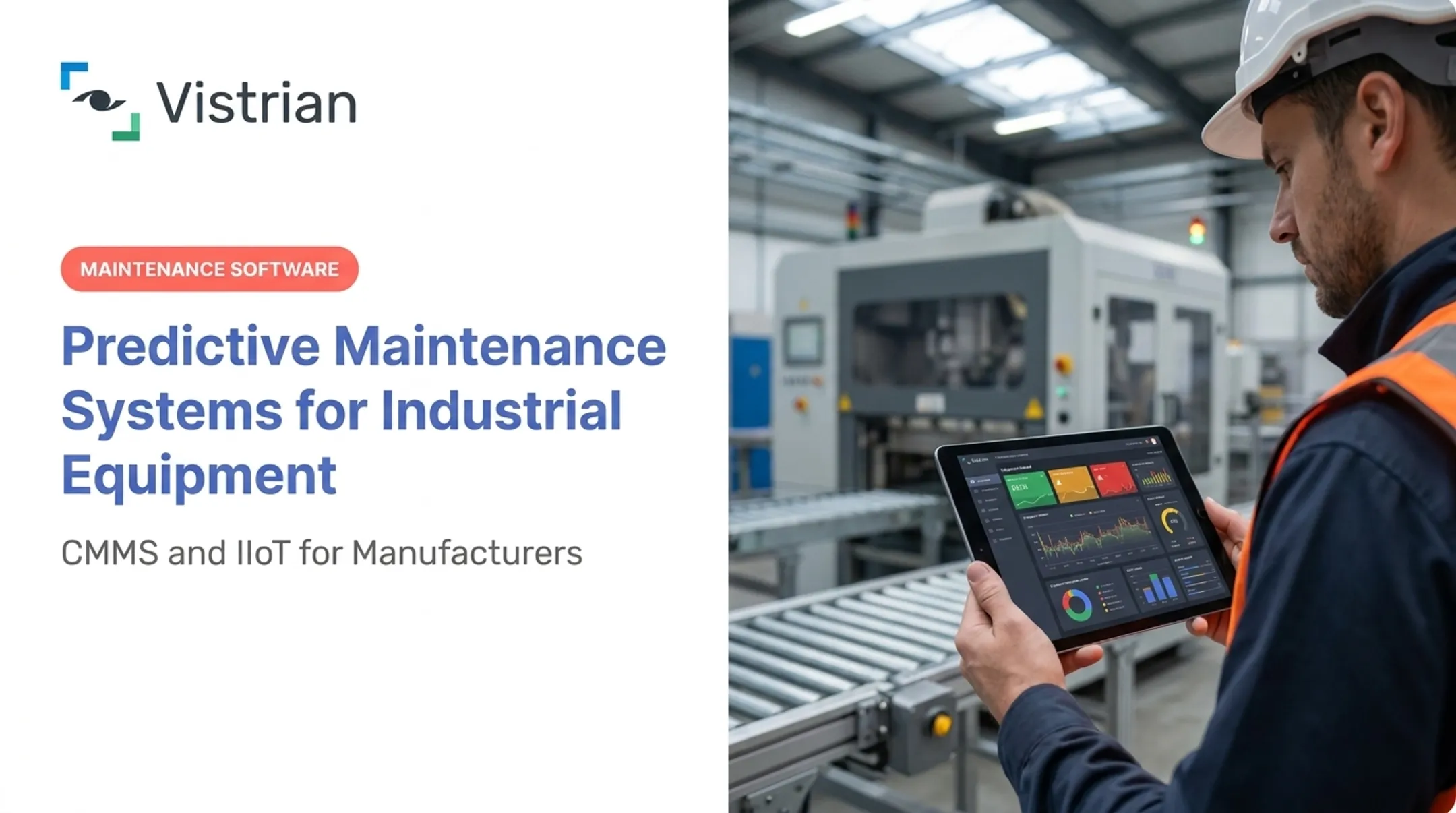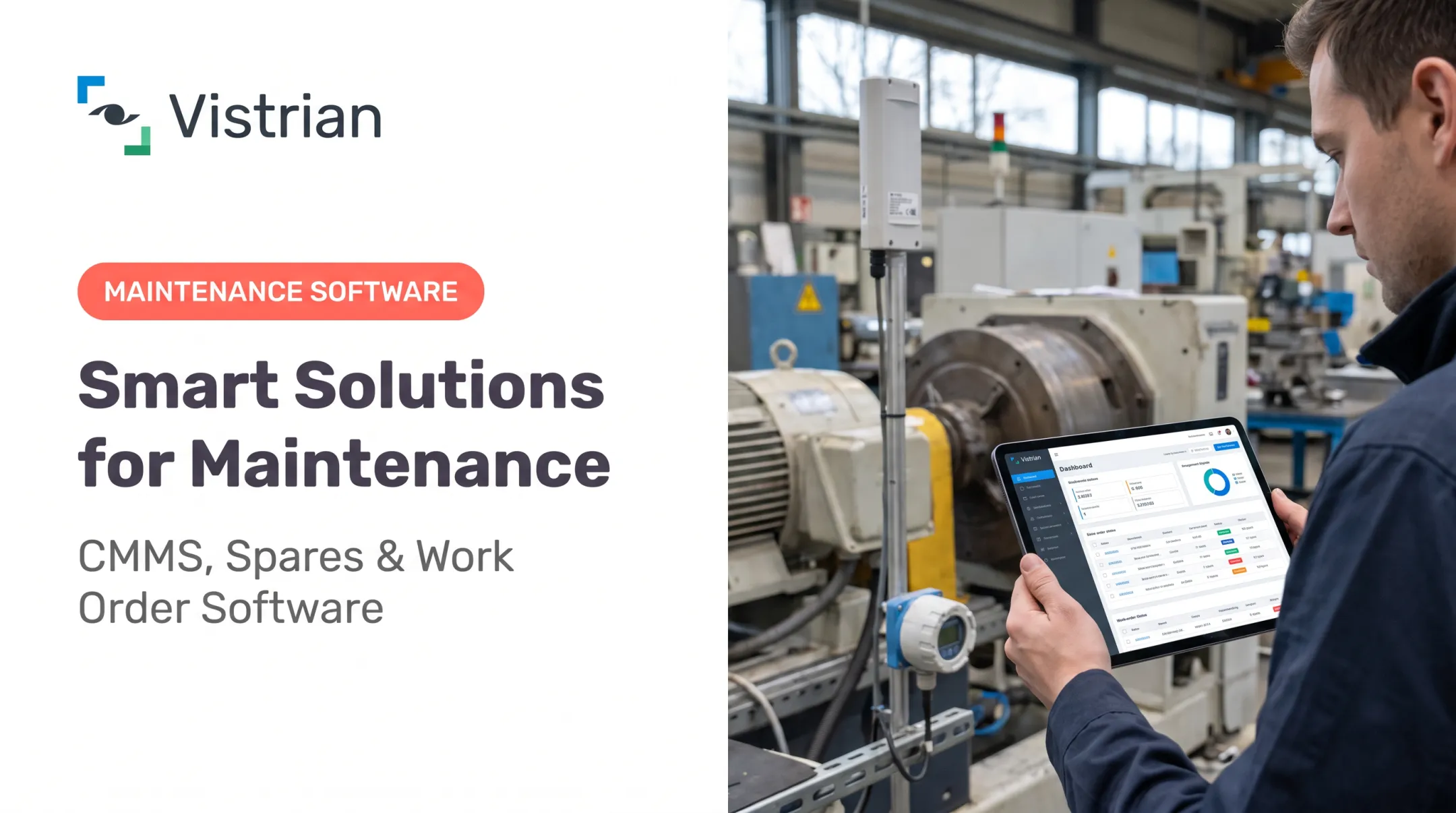

Predictive intelligent maintenance changes that equation. It combines connected equipment, IIoT sensors, real-time data, analytics, and maintenance workflows to catch developing problems before functional failure occurs. This guide walks through the technology stack, how the system actually works, where manufacturers deploy it, what results to expect, and how to implement a program without overbuilding it on day one.
Key Takeaways
- Predictive maintenance links physical equipment, sensors, industrial networks, analytics, and maintenance execution into one closed loop.
- Sensor data only pays off when it becomes reliable alerts, diagnoses, and completed work orders.
- Start with critical assets, validate data quality and team adoption, then expand.
- Legacy machines can join the program through controllers, protocols, logs, databases, or retrofit IIoT sensors.
What Is Industry 4.0 Predictive Intelligent Maintenance?
Industry 4.0 is the factory-floor layer that connects machines, data, and people in real time. It brings together cyber-physical systems, IIoT, automation, cloud or edge computing, AI, and plant-wide data exchange so condition signals reach the teams who act on them.
Predictive maintenance (PdM) sits inside that framework as a condition-based strategy. It uses current and historical equipment data to detect anomalies, estimate developing failure risk, and schedule intervention before a breakdown happens. The National Institute of Standards and Technology defines it plainly: PdM is initiated from predictions of failure based on observed temperature, noise, and vibration data.
Four Maintenance Strategies, One Key Difference
- Reactive maintenance — fix it after it breaks
- Preventive maintenance — service on a fixed schedule, whether needed or not
- Condition-based maintenance — act when observed asset health crosses a threshold
- Predictive maintenance — use analytics to anticipate degradation before it's visible
Predictive maintenance becomes "intelligent" when Industry 4.0 data stops sitting in dashboards and starts driving action. Sensor count alone doesn't get you there. The difference is the workflow around the data:
- Automated collection from machines and IIoT sensors
- Contextual analysis and anomaly detection
- Prioritization by asset criticality
- Root-cause insight that feeds straight into maintenance execution
Platforms such as VistrianMMS follow that path: FactoryLOOK and sensor feeds surface AI-assisted alerts, then those alerts become digital work orders before a small issue turns into a costly repair.
Intelligent maintenance doesn't replace your technicians. It gives them earlier, more consistent evidence for deciding what to inspect, repair, replace, or keep watching.
The U.S. Department of Energy's foundational operations guide estimated that a solid predictive maintenance program saves 8% to 12% compared with preventive maintenance alone. That 2010 figure is a useful floor, not a universal modern benchmark.
Newer case evidence often shows larger gains. Results still depend on asset criticality, data quality, and how fully teams adopt the workflow.
How Industry 4.0 Predictive Maintenance Equipment Works
Think of it as an end-to-end path: physical asset → data → analysis → maintenance action. Each layer has a specific job.
Equipment and Data Collection
Sensors capture condition indicators specific to the failure modes that matter for that asset:
- Vibration (bearing wear, misalignment)
- Temperature and thermal (electrical faults, friction)
- Pressure, flow, and acoustic signals
- Current, voltage, and speed
- Lubrication and process-condition data
There's no universal sensor set. The right variables depend entirely on the asset and how it tends to fail. For older or unconnected equipment, retrofit IIoT sensors extend monitoring without requiring a full controller upgrade. Vistrian's IIoT layer, for instance, adds sensors to machines that lack digital interfaces and syncs that data directly into FactoryLOOK.

Connectivity and Integration
Data has to travel reliably from the machine to wherever it gets analyzed. That means PLCs, machine controllers, gateways, industrial networks, and standard protocols working together, often across mixed-vendor and legacy environments.
This is where a lot of predictive maintenance projects stall, because plants underestimate how fragmented their existing controllers and logs really are. FactoryLOOK is built to integrate with PLCs, sensors, and legacy systems, including controllers as old as 40 years.
Storage, Analytics, and Decision Support
Raw sensor readings mean nothing without context. A vibration reading needs an asset ID, a timestamp, an operating state, and units — otherwise it's just noise. Historian systems store this data over time so patterns become visible.
On the analytics side, approaches typically include:
- Threshold and rule-based monitoring
- Statistical analysis
- Machine learning models
The right method depends on data availability, how predictable the failure mode is, and whether the team can validate what the model produces. FactoryLOOK's rules engine identifies anomalies and performance issues as they occur and pushes real-time notifications when a threshold is crossed.
Here's a practical example: a pump starts showing an abnormal vibration signature. The system flags it, a technician verifies the reading, a targeted work order gets created, parts get reserved, and the repair happens during a planned maintenance window instead of an emergency shutdown. That's the entire value chain in one sequence.
Vistrian's Manufacturing Suite illustrates this modular approach well. It connects controllers, logs, databases, and IIoT devices while combining data acquisition, historian capabilities, analytics, dashboards, and alerts in one platform.
What Intelligent Maintenance Equipment Can Do for Manufacturers
Connecting predictive maintenance equipment to production systems pays off in several concrete ways.
Manufacturers typically see gains in four areas:
- Less unplanned downtime — early anomaly detection lets teams intervene in a planned window instead of an emergency one
- Fewer wasted resources — condition-based decisions cut unnecessary inspections, premature part swaps, emergency labor, and expedited shipping
- Better quality and throughput — catching drift in motors, pumps, or conveyors protects cycle time, yield, and OEE, not just uptime
- Safer routines — continuous or remote monitoring means fewer trips into hazardous or hard-to-reach areas just to read a gauge
A 2021 manufacturing study associated heavier use of predictive and preventive maintenance with 52.7% less unplanned downtime and 78.5% fewer defects among the firms studied.
That figure blends both strategies rather than isolating predictive maintenance alone, but it matches what plants report after deployment.
On the resource side, Vistrian's Maintenance Suite (CMMS, work orders, and spares) has reported:
- 20.1% reduction in equipment downtime
- 28.3% increase in maintenance productivity
- 19.4% reduction in material costs
- 17.8% reduction in MRO inventory

One real example: a North American cocoa processor and ingredient chocolate manufacturer implemented FactoryLOOK for machine data and visibility. The plant reported over $1 million in avoided capital expenditure and a projected OEE gain of more than 20%, largely by getting more useful life out of equipment it already owned.
Those results only hold up if you can measure them. Before a pilot, baseline:
- Unplanned downtime and OEE
- Mean time between failures (MTBF) and mean time to repair (MTTR)
- Maintenance cost and first-time fix rate
- Scrap rate
Without that snapshot, you cannot prove the program worked.
Applications and Use Cases for Industry 4.0 Predictive Maintenance
Predictive maintenance scales to fit the situation: a whole factory, a single line, or just a handful of critical assets, depending on risk and data readiness.
Common asset types include motors, pumps, compressors, fans, gearboxes, conveyors, CNC equipment, robotics, and electrical systems. Different industries adapt monitoring variables to their own equipment:
- Semiconductor and electronics fabs monitor tool performance, process conditions, and qualification status alongside maintenance data
- Food and chemical processors track process-condition sensors tied to consistency and compliance
- Discrete manufacturers focus on cycle-critical machines like CNC and assembly equipment
For multi-plant operations, centralized dashboards allow cross-site comparison, standardized asset definitions, and enterprise-level reporting. Vistrian's architecture supports this directly. Corporate teams get standardized KPIs while individual sites keep control over schedules, spares, and local reporting.
Six Application Areas of Industry 4.0
Predictive maintenance is one piece of a broader Industry 4.0 landscape. The six major application areas include:
- Smart manufacturing and IIoT connectivity: linking machines and sensors across the plant
- Predictive maintenance: detecting and forecasting equipment degradation
- Robotics and automation: executing production tasks with monitored actuators and drives
- Digital twins and simulation: modeling equipment and processes to test conditions virtually
- Connected supply chains: sharing production and equipment signals with planning systems
- Quality and process analytics: correlating condition data with defects, yield, and process parameters
How to Implement an Industry 4.0 Predictive Maintenance Program
Skipping straight to sensors is the most common mistake. Here's a more reliable sequence:
- Rank assets by risk. Score equipment on safety impact, production loss, quality risk, repair cost, and failure frequency. Include whether useful data already exists for that asset.
- Pick a focused pilot. Choose one measurable problem with a defined baseline, a named owner, and a realistic plan for validating alerts.
- Audit data and connectivity first. Identify existing controllers, PLCs, sensors, logs, historians, and CMMS records before buying anything new. Flag which machines need retrofit IIoT sensors.
- Define the architecture. Decide on edge versus cloud processing, cybersecurity controls, access permissions, and how alerts route into your maintenance-management software.
- Build the human workflow. Specify who reviews each alert, how severity gets assigned, when it triggers a work order, and how spare parts get reserved.
- Manage data quality and alert fatigue. Set rules for sensor calibration, missing data handling, false-positive review, and periodic threshold checks.
- Train the full team. Bring maintenance, reliability, production, IT, and management up to speed on both the technology and its limits.
- Measure against baseline before scaling. Confirm operational value and adoption before expanding to more assets.

Software choice should match that same staged model. Vistrian's Manufacturing Suite, Analytics, and Maintenance Suite modules combine equipment visibility, OEE and root-cause analytics, alerts, and work-order management so a pilot can prove value before it scales across the plant.
Frequently Asked Questions
What is Industry 4.0 in manufacturing?
Industry 4.0 is the connected, data-driven integration of IIoT, automation, analytics, AI, and cyber-physical systems across a factory. It allows equipment, people, and business systems to exchange data and act on it in near real time.
What are the 6 main applications of Industry 4.0 today?
The six major areas are smart manufacturing and IIoT, predictive maintenance, robotics and automation, digital twins, connected supply chains, and quality or process analytics. Together they turn equipment data into operational decisions.
What does Industry 4.0 and 5.0 mean?
Industry 4.0 focuses on connectivity, automation, and data-driven efficiency. Industry 5.0 builds on that foundation but shifts emphasis toward human-machine collaboration, resilience, and sustainability rather than efficiency alone.
How much does predictive maintenance reduce downtime?
Documented cases show about 20% to 50%+ less unplanned downtime. Results still depend on the asset, data quality, and how fully teams adopt the workflow.
What equipment needs predictive maintenance sensors first?
Start with assets that combine high failure impact and high repair cost: motors, pumps, compressors, and critical CNC or process equipment are the usual starting points.