
Why IoT Matters for Facilities Management
Most facilities teams don't find out a rooftop unit is failing until tenants start complaining about the heat. Or that a wing of the building is wasting electricity until the utility bill lands on someone's desk weeks later.
That's the nature of reactive facilities management: equipment failures, energy waste, safety risks, and space problems surface only after they've already caused disruption.
Internet of Things (IoT) for facilities management flips that model. Connected sensors on physical assets collect, transmit, and sometimes act on operational data in near real time, turning silent equipment signals into visible, actionable information.
The stakes are real. A 2017 Pacific Northwest National Laboratory study for the Department of Energy found that properly tuned commercial building controls could cut energy consumption by roughly 29%, equal to 4-5% of total US energy use.
This article covers IoT device types, practical applications, operational benefits, implementation steps, integration risks, and how to evaluate the software that ties it all together.
Key Takeaways
- IoT sensors catch equipment problems before they become failures, replacing guesswork with actual data
- Well-tuned building controls cut energy waste, according to DOE-backed research
- Legacy equipment doesn't need full replacement: retrofit sensors and gateways can connect it
- Connecting alerts to maintenance workflows delivers value sensors alone cannot
- Cybersecurity and alert design deserve as much planning as device selection
What IoT Means for Facilities Management: Types, Devices and Architecture
IoT, Smart Buildings, and FM Software Aren't the Same Thing
These terms get used interchangeably, but they describe different layers of the same system.
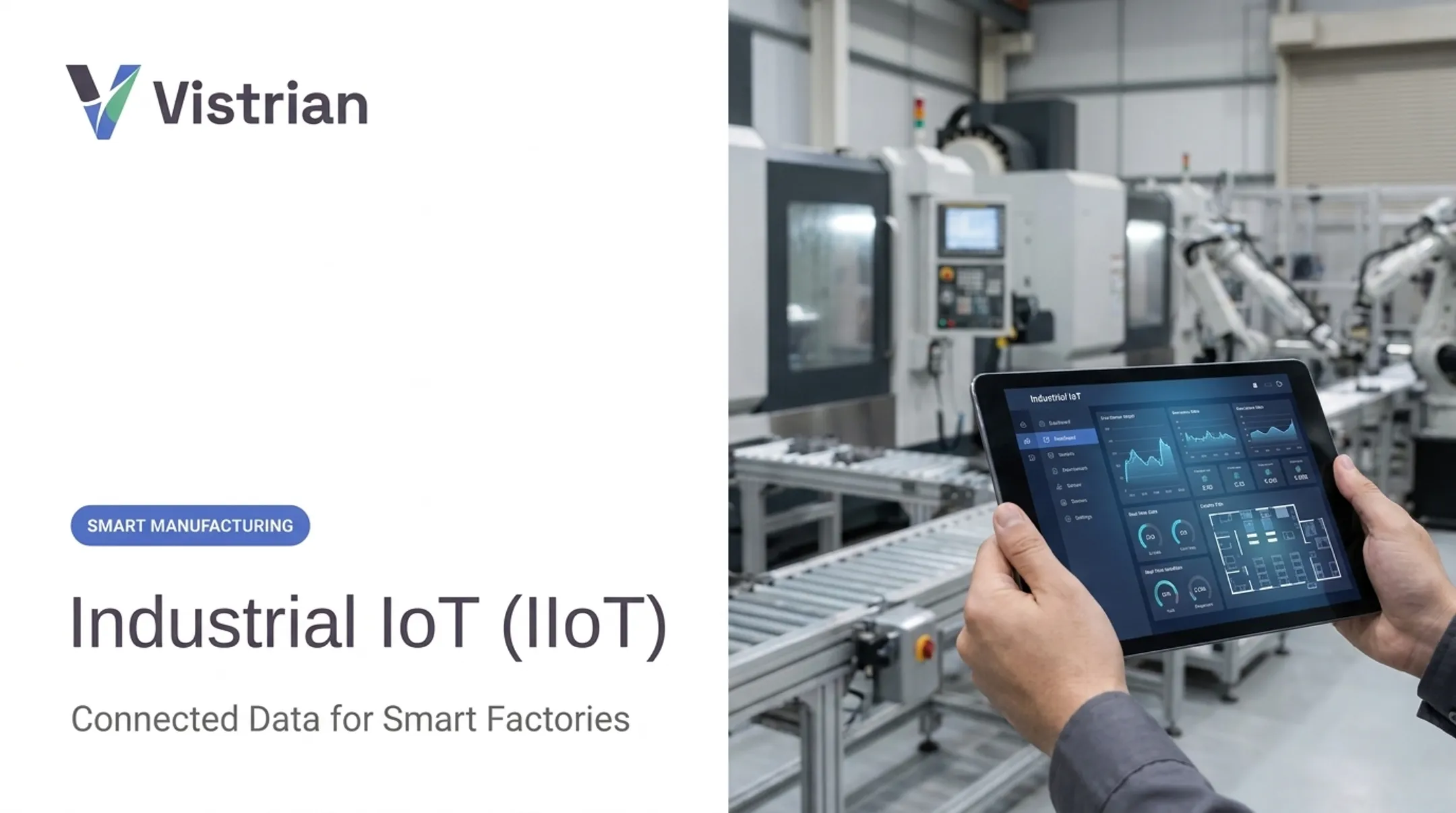
IoT for facilities management refers to the physical sensors and connected assets that collect data. Smart building technology is the interoperability layer that connects those systems to optimize performance. Industrial IoT (IIoT) is a related but separate category focused on manufacturing, energy, and industrial applications rather than buildings. Facilities management software is what turns raw sensor data into decisions: work orders, alerts, dashboards, and reports.
In other words: sensors generate data. Software makes it useful. Those data streams typically fall into four monitoring categories.
The Four Categories of IoT Monitoring
| Category | What It Tracks |
|---|---|
| Environmental & occupancy | Temperature, humidity, air quality, noise, room use, people flow |
| Asset & equipment | HVAC, pumps, elevators, lighting, machinery, utilities |
| Security & safety | Access control, smoke/fire, water leaks, intrusion, vibration, structural conditions |
| Energy & utility | Electricity, gas, water, demand, equipment-level consumption |
Common Devices and the Data Path
Typical devices include:
- Smart meters, thermostats, and connected lighting
- Occupancy, temperature, humidity, and air-quality sensors
- Vibration sensors and leak detectors
- RFID or Bluetooth tags
- Cameras, access-control readers, and network gateways
The general data path looks like this:
- Sensor or machine generates a signal
- Gateway or network transmits the data
- Cloud or on-premises platform receives and processes it
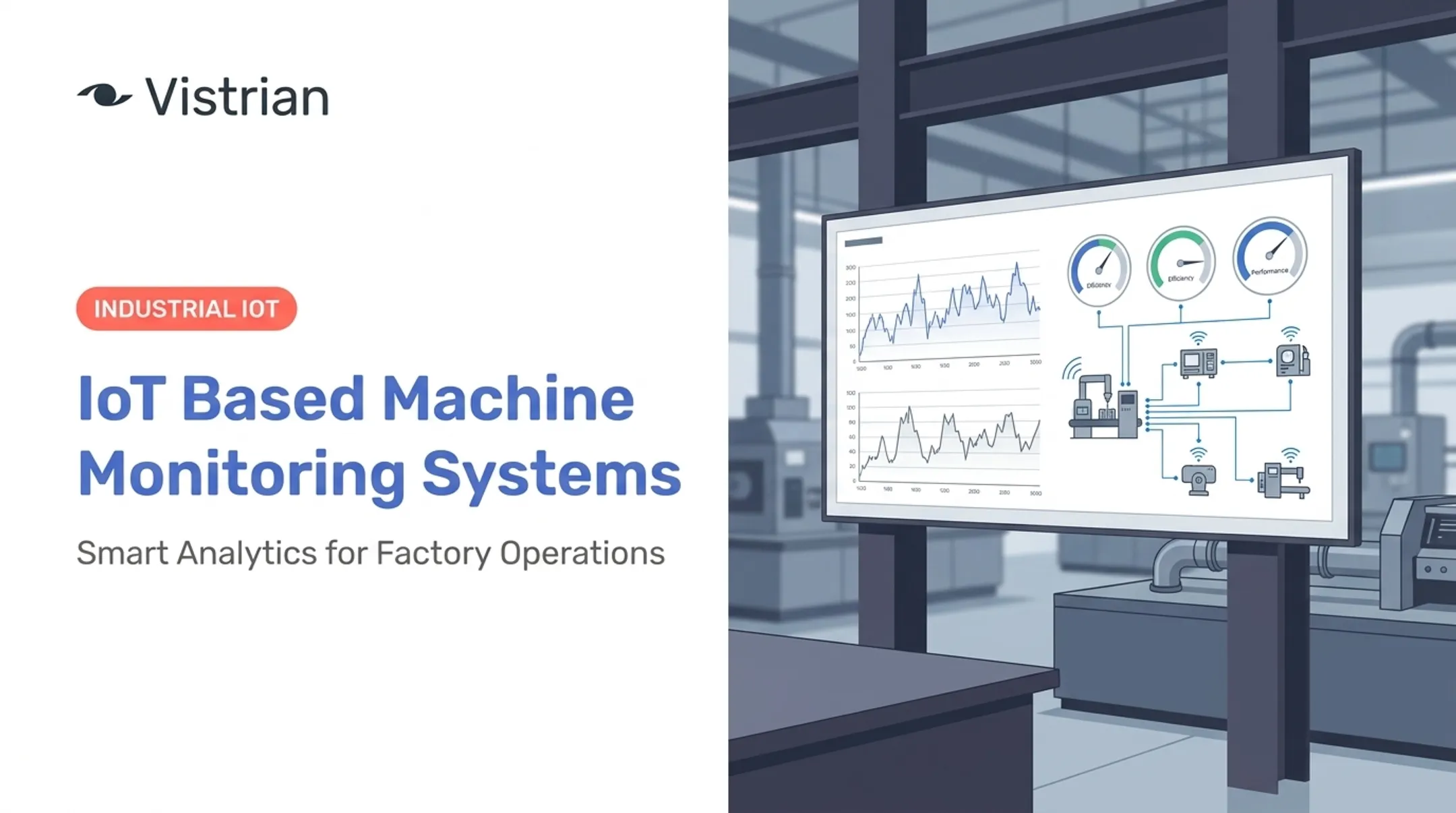
- Dashboard or analytics engine turns it into insight
- Alert or work order is created
- Technician responds
- Outcome is verified

Vistrian's real-time data-flow architecture follows this pattern closely. It captures, processes, and delivers equipment signals within minutes of an event, not hours later.
Edge processing, cloud platforms, APIs, and standard protocols like BACnet and MQTT support scaling beyond a single building. Before you commit, vendors should explain exactly how their architecture handles that scale.
Practical IoT Applications in Facilities Management
IoT earns its keep in facilities when sensor data drives a concrete action—maintenance, energy control, comfort, space planning, or fault response. These are the applications where that loop shows up most clearly.
Predictive and Condition-Based Maintenance
Equipment rarely fails without warning signs. Abnormal vibration, unusual runtime patterns, pressure drift, or temperature creep almost always appear before the breakdown, if something is watching for them.
- Vibration sensors flag bearing wear before it becomes a bearing failure
- Thermal imaging catches electrical issues that visual inspections miss
- Runtime and cycle data reveal degradation trends invisible to manual checks
VistrianMMS pulls sensor data from FactoryLOOK and Vistrian Analytics to support this kind of condition-based maintenance. It connects the anomaly to an inspection, a work order, the right spare parts, and a technician—automatically. In Vistrian's own deployments, company-reported maintenance suite data shows this workflow delivering a 20-50% reduction in unplanned downtime and longer equipment life.
Energy Management and Optimization
The same sensor layer that flags equipment health can cut waste on utilities. Connected meters, HVAC controls, occupancy sensors, and lighting systems give facilities teams the granular view utility bills never provide.
One documented case: Adobe's headquarters used timers, sensors, and VAV boxes to shut down conditioned airflow to unoccupied zones and reported a 65% reduction in energy use for those spaces. Aggressive, but it shows what happens when occupancy data drives HVAC instead of a fixed schedule.
Indoor Environmental Quality
Comfort problems follow the same pattern as equipment faults: drift first, complaints later. Sensors tracking CO2, temperature, humidity, and noise let teams set thresholds and act on trends before a stuffy room becomes a ticket. Environmental management moves from reactive to proactive—teams see the drift, not only the aftermath.
Asset Tracking and Space Utilization
Beyond room conditions, facilities teams need to know where assets and people actually are. RFID tags, Bluetooth beacons, and occupancy sensors provide that real-time view. Search time for mobile equipment drops, and planners get usage data—not guesses—for space and capital decisions.
Automated Fault Detection
Leaks, refrigeration failures, smoke conditions, and access anomalies all benefit from automated detection, but only when alerts are prioritized and routed correctly. A flood of low-priority notifications buries the one that matters.
FactoryLOOK's anomaly detection scans live signals and flags conditions before they escalate. VistrianMMS then applies prioritization logic so the right alert reaches the right person instead of everyone.

Operational Benefits of IoT for Facilities Teams
Continuous monitoring gives facilities managers something reactive processes never provide: a comparable view across buildings, campuses, or plants. Instead of guessing which site has recurring problems, the data shows it directly.
That visibility connects to several measurable outcomes:
- Lower unplanned downtime through earlier fault detection
- Faster response times when alerts route directly to the right technician
- Better maintenance compliance with automated scheduling and tracking
- Reduced energy consumption from data-driven HVAC and lighting adjustments
- Longer asset life through condition-based rather than calendar-based maintenance
- Improved space utilization based on actual occupancy data, not estimates
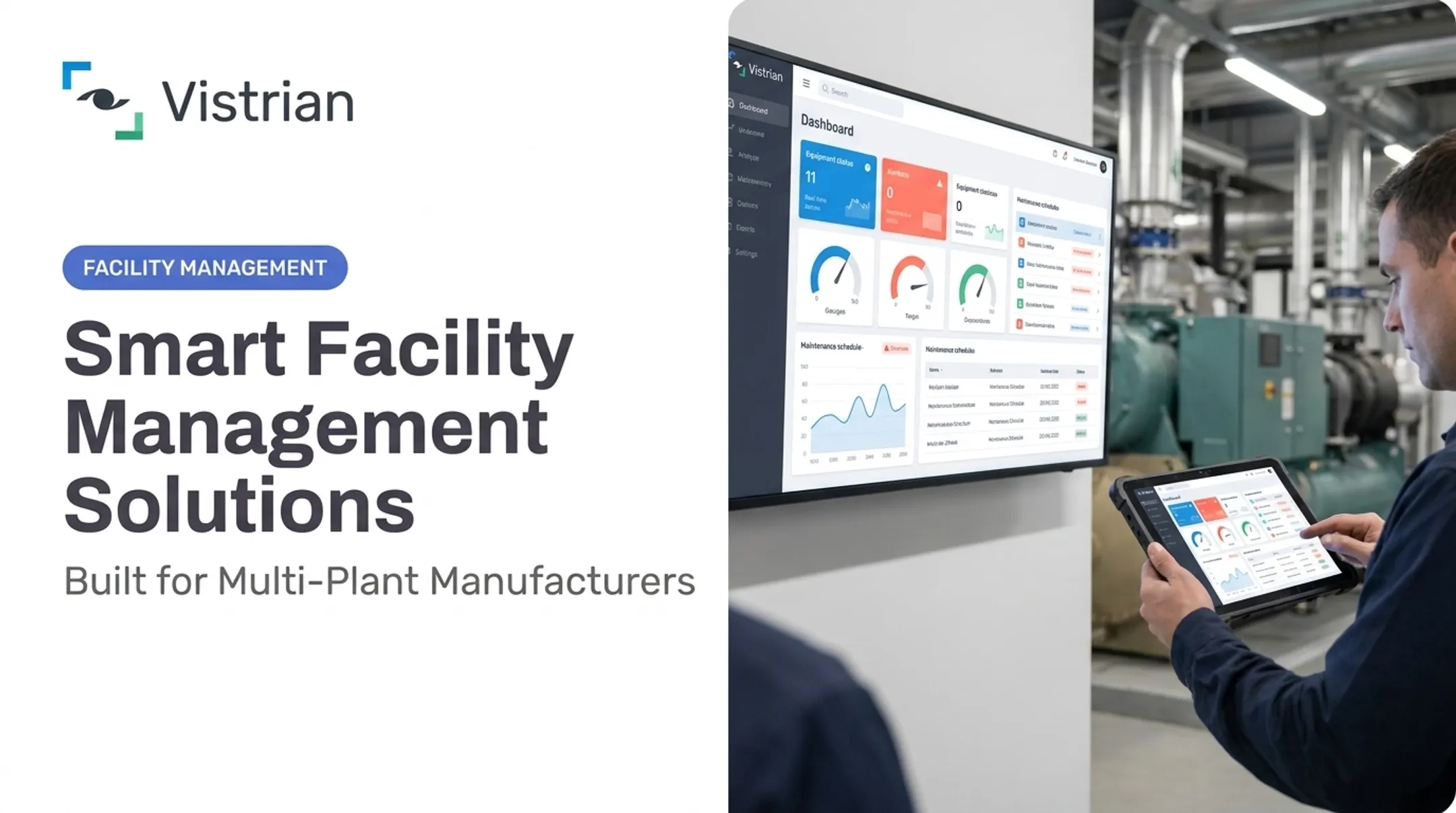
VistrianFMS ties these outcomes together by connecting real-time facility performance data to inefficiency detection and maintenance prediction across a single dashboard.
Those same energy and utility readings also support sustainability reporting when they are captured and labeled correctly.
Sustainability and ESG Reporting
IoT-collected energy and utility data can support ESG reporting, but only if it's clearly labeled. Reporting frameworks like GRI 302 require organizations to disclose whether energy figures come from direct measurement, estimation, or modeling.
Similarly, ENERGY STAR Portfolio Manager separates "estimated project savings" from actual measured consumption. Measured sensor data is more defensible in an audit than a utility-bill assumption, but it has to be tagged that way from the start.
How to Implement IoT in Facilities Management
1. Start with a specific problem and a baseline. Pick a high-impact asset or process (for example, chiller performance or a recurring HVAC failure) and document current performance before touching any technology. Define the outcome the deployment needs to improve.
2. Prioritize use cases. Score potential projects against factors such as:
- Criticality and failure consequences
- Data availability and expected value
- Deployment complexity and cybersecurity exposure
- How easily the solution scales to other sites
3. Audit before you buy. Document existing building-management systems, your CMMS or CAFM/IWMS tools, controllers, meters, networks, data owners, and gaps in asset records. You can't connect what you haven't mapped.
4. Choose interoperable technology. Define these upfront:
- Data model and connectivity requirements
- Retention policy, access controls, and alert thresholds
- APIs and workflow integrations
Ask vendors directly about device lifecycle, calibration, firmware updates, and ongoing support. Don't assume.
5. Consider where software fits. This is where a platform like VistrianFMS becomes relevant for facility and campus operations teams managing many assets across locations. It can cover:
- Work-order management and preventive-maintenance scheduling
- Calibration management and stakeholder dashboards
- Cloud or on-premises deployment with browser, mobile, and tablet access
It's one option among several, and the right fit depends on your existing systems and scale.
6. Pilot, then scale. Test one use case. Validate whether the data is accurate and the alerts are actually useful. Measure results against your baseline. Train staff, refine the process, and set governance rules before rolling out to additional sites.

Challenges and Safeguards When Adopting IoT
Legacy system integration is usually the first hurdle. Mixed-vendor equipment and aging controllers don't disappear just because you're adding sensors.
Gateways, APIs, standard protocols, and retrofit sensors reduce the pressure to replace everything at once. Vistrian's Manufacturing Suite, for example, supports legacy controllers as old as 40 years and deploys IoT devices to fill data gaps where direct access isn't available.
Cybersecurity deserves equal weight. NIST's guide to operational technology security notes that OT systems can remain in service for 20+ years, often outliving vendor patch support entirely. Compensating controls therefore become necessary rather than optional. Facilities teams should prioritize:
- Network segmentation between IT and OT devices
- Identity and access management with least-privilege defaults
- Encrypted communications and secure update processes
- An accurate, maintained device inventory
- Vendor risk reviews and a documented incident-response plan
Data quality and alert fatigue cause more failed IoT projects than bad hardware does. Without calibration, clear data definitions, and prioritized thresholds, teams either drown in false alerts or start ignoring them altogether.
Practical safeguards:
- Build escalation rules with clear ownership
- Keep a human in the review loop
- Train staff on what each alert means
- Ask regularly whether each alert led to a useful action
Building a More Proactive Facilities Operation
IoT sensors alone don't fix anything. Value shows up only when reliable data connects to clear decisions, maintenance workflows, and accountable teams working toward measurable goals. A building full of sensors feeding nobody's dashboard is just noise with a subscription fee.
The practical next step is narrower than most teams expect:
- Pick one high-value facilities problem
- Establish a clear performance baseline
- Assess integration and security requirements
- Evaluate platforms that connect existing systems to work-order workflows your teams will actually use
Start small, prove the loop from sensor data to completed work, then expand once the results are measurable.
Frequently Asked Questions
What is the best software for facilities management that supports IoT?
The best option depends on your asset types, facility scale, integration requirements, and security needs. Compare platforms through a defined pilot with clear use-case criteria rather than choosing based on feature lists alone.
What are the main types of IoT used in facilities management?
The main categories are environmental and occupancy monitoring, asset and equipment condition monitoring, energy and utility monitoring, and security or safety monitoring. Location and space-utilization tracking is a fifth, increasingly common category.
What are common IoT devices used in facilities management?
Common devices include environmental sensors (thermostats, occupancy and air-quality monitors), condition monitors (smart meters, vibration sensors, leak detectors), and access or tracking hardware (RFID or Bluetooth tags, connected lighting, access-control readers, and network gateways).
How does IoT improve facilities management?
Real-time data supports earlier maintenance response, energy optimization, faster fault detection, better asset visibility, and evidence-based space planning. It replaces complaint-driven decisions with data-driven ones.
What are the challenges of implementing IoT in facilities management?
The main challenges include integrating legacy systems, managing cybersecurity risk, maintaining data quality, avoiding alert fatigue, covering upfront costs, and getting staff to adopt new workflows.
How can a facilities team start an IoT project?
Start with a focused pilot tied to one documented operational problem. Set baseline metrics, define success criteria, review security requirements, assign clear ownership, and plan for scaling before you expand further.